1. The helmet is the only non-negotiable
Every bicycle helmet sold in the US must meet the federal safety standard at 16 CFR Part 1203, which sets requirements for impact attenuation, strap strength, peripheral vision and labeling. That means a $40 certified helmet and a $250 certified helmet have both passed the same mandatory test. Price buys ventilation, weight, fit adjustment and looks — not a higher grade of certification.
The one feature genuinely worth paying a little extra for is MIPS or an equivalent rotational-management layer. Most real crashes are oblique rather than straight-on, and a low-friction layer inside the shell is designed to let the helmet move slightly relative to your head to help redirect that rotational energy. It now appears on helmets that cost barely more than uncertified ones, which is why our top pick has it.
Fit is worth more than any feature.The helmet should sit level with about two fingers’ width above your eyebrows, the side straps should form a V just under your ears, and the chin strap should be snug enough that opening your mouth wide pulls the helmet down. A loose helmet is closer to no helmet than to a good one. Our helmet roundup covers fit and the picks at every price.
2. Padded shorts do more than any saddle
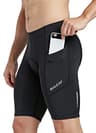
This is the purchase that surprises beginners. If rides are ending because you are uncomfortable, the instinct is to replace the saddle. Padded shorts are cheaper, faster and usually more effective — because the padding moves with you rather than staying with the bike, and because the seamless chamois removes the seam-against-skin problem that ordinary shorts create.
Two things people get wrong. Chamois shorts are worn without underwear— the pad is the layer, and adding another one puts seams back in exactly the place you were trying to protect. And shorts versus bibs is a real choice: waistband shorts are easier to get on and off and easier at a rest stop; bibs have straps over the shoulders instead of elastic at the waist, so they never roll down or dig in on a long ride. Start with shorts. Move to bibs if you find yourself riding for hours.
If you would rather not look like a cyclist, baggy shorts with a removable liner give you the same chamois under normal clothing. Our shorts and bibs roundup compares the options on the pad, which is the part that matters.
3. Gloves fix a problem you did not know you had
Numb or tingling hands after 30 minutes is one of the most common complaints from new riders, and it is almost always pressure on the ulnar nerve where your palm rests on the grip. Padded gloves spread that pressure. They also improve grip when your hands are sweaty and, in a fall, they are the thing between your palms and the road — hands are what people put down first.
Half-fingergloves are the default for anything above about 60 °F. Full-finger gloves matter below that, and by freezing they are the difference between a pleasant ride and a miserable one, because your hands sit still in the wind while the rest of you generates heat. Gel padding suits most riders; if you prefer feel over cushioning, thinner foam is fine. Our glove roundup covers both.
Dressing for the temperature
The rule that saves the most misery: dress for about 10 °F warmer than the thermometer says, because you generate a lot of heat once you are moving. If you are comfortable standing at the door, you are overdressed. The exception is e-biking with heavy throttle use — you generate far less heat when the motor is doing the work, so dress closer to what the temperature actually says.
- Above 70 °F— a technical or synthetic t-shirt and shorts. Cotton is the one fabric to avoid: it holds sweat, stops insulating when wet, and chills you on a descent.
- 55–70 °F— short sleeves with arm warmers or a light long-sleeve layer you can push up. This is the range where a packable layer earns its place.
- 40–55 °F— a long-sleeve base layer, a wind-resistant outer, full-finger gloves and something over your ears. The wind is the problem here, not the air temperature.
- Below 40 °F— layers, insulated gloves, warm socks and covered ears. Extremities are what suffer; your core is usually fine. Our winter riding guide covers the cold-weather specifics, including what happens to your battery.
Be visible, in daylight too
A meaningful share of bike-vehicle collisions happen in daylight, and dark clothing on a shaded road is genuinely hard to pick out. Bright colors are cheap insurance and cost you nothing to choose at purchase time. Reflective details matter separately — they only work when a headlight hits them, so they are a night feature, not a daytime one.
Neither replaces lights. At e-bike speeds a front light with a daytime flash mode does more for how early a driver notices you than any jersey color, and most value e-bikes ship without one — see our lights roundup and the what-to-buy-first order.
What you can skip (for now, or entirely)
- A jersey. A jersey is a t-shirt with three back pockets and a long zip, and those pockets are genuinely useful once you ride far enough to need to carry things. For your first month, a synthetic t-shirt does the job. When you do want one, our jersey picks cover the value end, and the apparel hub has every garment roundup in one place.
- Cycling shoes and clipless pedals.Genuinely useful for efficiency on a road bike, almost pointless on a throttle-assisted e-bike, and a learning curve involving at least one slow-motion fall. Skip until you know you want them — then see the shoe roundup, which includes commuter-friendly options you can walk in.
- Cycling-specific socks. The cheapest thing on this list and the last one that matters. Any non-cotton sock works. When you replace them, the sock roundup includes waterproof options for wet commutes, which are the one genuinely transformative version.
- Sunglasses.Worth having, and the reason is eye protection from grit and insects rather than sun — at 20 mph a bug in the eye is a real hazard. Any wraparound pair works; our picks if you want a cycling-specific one.
The whole thing, in one paragraph
Buy a certified helmet that fits, wear whatever synthetic clothing you already own, and ride. When your rides start ending early because of discomfort, buy padded shorts. When your hands go numb, buy gloves. Everything else in a bike shop is an optimization for a problem you have not encountered yet, and the best way to find out which ones you actually need is to ride the bike.