Volt & Velo

Best E-Bike Chargers (and How to Match One Safely)

A replacement or faster charger is a cheap fix — but the wrong voltage or connector is useless or dangerous. How to match one to your bike, and the value picks by system.

By Stephen V.Last updated How we pick

A spare or faster charger is one of the cheapest quality-of-life upgrades on an e-bike — keep one at work and you halve your charging downtime, or replace a lost original for a fraction of what a first-party unit costs. But chargers are the one accessory where “close enough” is genuinely dangerous: the wrong voltage or connector is at best useless and at worst a fire risk. So this page is a matching guide first, and a shortlist second.

Read this before you buy anything:your charger must match your battery’s system voltage exactly. A 48 volt pack fully charges to about 54.6 volts; a 36 volt pack charges to about 42 volts — and the two are notinterchangeable. You must also match the connector (a 3-prong XLR is the most common on value bikes, but not universal). Check your bike’s manual or the label on the battery before ordering. When in doubt, buy the charger your bike’s maker sells.

How this is funded:we earn a commission if you buy through our links, at no extra cost to you. It never changes which product we recommend, and we’ll tell you plainly when to skip one. Full disclosure.

Quick picks

Ranked on published specs, price and buyer fit. Select a row to jump to the full write-up. We have not ridden every one of these — here is exactly what we do instead.

#ProductBest forPrice
1
YZPOWER 54.6V 4A XLR Charger (48V packs)

YZPOWER 54.6V 4A XLR Charger (48V packs)

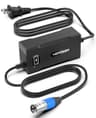
A common, well-reviewed replacement for 48 V systems: it outputs 54.6 V at 4 A (a 48 V pack fully charges to ~54.6 V) through a 3-pin XLR plug, the connector most value e-bikes use. The rule that matters more than brand: confirm your pack is 48 V and uses an XLR port before you order. The listing makes no UL claim.

Best 48V spare
$37.58 · View on Amazon

$42.0011% off

Price as of July 23, 2026. #ad How we’re funded

2
Generic 54.6V 4A XLR Charger with Display

Generic 54.6V 4A XLR Charger with Display

The value fast-charger for 48 V bikes: 54.6 V at 4 A through an XLR plug, with an LED screen that shows real-time voltage so you can watch the charge finish. Unbranded and no UL claim, so treat it accordingly — but for a 48 V/XLR bike where you want a quicker top-up, it's the budget pick.

Best fast 48V charge
$29.99 · View on Amazon

Price as of July 23, 2026. #ad How we’re funded

3

LotFancy 42V UL-Listed Charger (36V packs)

Not every value e-bike is 48 V — several here (the Retrospecs, the Jasion, the isinwheel) run 36 V systems, which charge to 42 V and are NOT compatible with a 48 V charger. This is a genuinely UL-listed 42 V unit for 36 V packs. If your bike is 36 V, this is the class of charger you need; confirm the connector against your port.

Best for 36V bikes

The picks in full

#1Best 48V spare

YZPOWER 54.6V 4A XLR Charger (48V packs)

A common, well-reviewed replacement for 48 V systems: it outputs 54.6 V at 4 A (a 48 V pack fully charges to ~54.6 V) through a 3-pin XLR plug, the connector most value e-bikes use. The rule that matters more than brand: confirm your pack is 48 V and uses an XLR port before you order. The listing makes no UL claim.

What you get

  • 54.6 V / 4 A output charges a 48 V (13S) pack faster than a 2 A unit
  • 3-pin XLR is the most common value-e-bike charge connector
  • A spare at work halves your charging downtime

Trade-offs

  • You MUST confirm your pack is 48 V and uses an XLR port — chargers are not universal
  • No UL listing stated; treat any third-party charger with care and never charge unattended
Key spec54.6V output, 4A, 3-pin XLR connector; charges 48V (13S) lithium packs
Best forA spare or replacement 48 V XLR charger

Specs read from the manufacturer or retailer listing, on July 22, 2026. “Not published” means the maker does not state that figure.

#2Best fast 48V charge

Generic 54.6V 4A XLR Charger with Display

The value fast-charger for 48 V bikes: 54.6 V at 4 A through an XLR plug, with an LED screen that shows real-time voltage so you can watch the charge finish. Unbranded and no UL claim, so treat it accordingly — but for a 48 V/XLR bike where you want a quicker top-up, it's the budget pick.

What you get

  • 4 A charges a 48 V pack faster than a stock 2 A unit
  • LED display shows live charging voltage
  • Standard XLR connector for common value e-bikes

Trade-offs

  • Unbranded with no UL claim — never charge unattended
  • Confirm your pack is 48 V/13S and uses XLR first
Key spec54.6V output, 4A, 3-pin XLR; LED voltage display; for 13S 48V packs
Best forA budget fast charge with a voltage readout

Specs read from the manufacturer or retailer listing, on July 22, 2026. “Not published” means the maker does not state that figure.

#3Best for 36V bikes

LotFancy 42V UL-Listed Charger (36V packs)

Not every value e-bike is 48 V — several here (the Retrospecs, the Jasion, the isinwheel) run 36 V systems, which charge to 42 V and are NOT compatible with a 48 V charger. This is a genuinely UL-listed 42 V unit for 36 V packs. If your bike is 36 V, this is the class of charger you need; confirm the connector against your port.

What you get

  • Genuinely UL-listed — a real safety signal, uncommon on cheap chargers
  • Correct 42 V output for 36 V lithium packs
  • Widely stocked and inexpensive

Trade-offs

  • 1 A output charges slowly
  • 42 V is for 36 V packs ONLY — never use it on a 48 V bike
Key spec42V 1A output, mini 3-prong connector; UL Listed; for 36V lithium packs
Best for36 V value e-bikes that charge to 42 V

Specs read from the manufacturer or retailer listing, on July 22, 2026. “Not published” means the maker does not state that figure.

The three things that must match

1. Voltage.Match your battery’s system voltage (36 V or 48 V). The charger’s output will be higher than the nominal figure — ~42 V for a 36 V pack, ~54.6 V for a 48 V pack — and that is correct. 2. Connector. Match the plug shape; XLR is common but bikes also use DC barrel and proprietary connectors. 3. Amperage.A higher amperage (say 4 A vs 2 A) charges faster; it is generally safe as long as the voltage and connector are right, but a faster charge run constantly can shorten battery life a little.

Why a safety listing is worth it

The CPSC’s micromobility program exists because cheap, uncertified chargers and packs cause fires. A UL-listed charger is a real signal that the unit has been tested. Where a listing does not state a certification, we say so — and regardless of the charger, never charge a battery unattended or overnight, and stop using anything that runs hot or smells odd.

Frequently asked questions

Can I use any charger on my e-bike?

No. The charger must match your battery's system voltage (36V or 48V) and connector exactly. A 48V charger on a 36V pack (or vice versa) can damage the battery or cause a fire. Check your manual or the battery label, and when unsure, buy the charger your bike's maker sells.

How do I know if my e-bike is 36V or 48V?

It's usually printed on the battery itself and in the manual. As a cross-check, the original charger's output voltage tells you: ~42V output means a 36V system; ~54.6V output means a 48V system.

Will a higher-amp charger charge my e-bike faster?

Yes — a 4A charger fills a pack faster than a 2A one, as long as the voltage and connector match. It's generally safe, but charging fast all the time can slightly shorten battery life, so it's best for when you're in a hurry rather than every day.

Is it safe to leave an e-bike charging overnight?

The CPSC advises against charging lithium batteries unattended, and overnight charging is the classic unattended scenario. Charge while you're awake and around, use a certified charger, and unplug once the battery is full.

Sources

Keep reading