Charge times for the packs we actually list
Every figure here is our arithmetic from the published pack capacity, with the 15% allowance applied and the constant-voltage tail included. No maker’s charge claim has been copied.
| Pack | On a typical supplied charger | On a 4 A charger |
|---|
| 281 Wh (36 V 7.8 Ah) - isinwheel U3 | About 9 h on the 36 V 1 A charger (36 W) | About 3 h on a 36 V 3 A charger |
| 360 Wh (36 V 10 Ah) - Jasion EB5, Retrospec Chatham | About 6 h on a 36 V 2 A charger (72 W) | About 4 h on a 36 V 3 A charger |
| 499 Wh - GoTrax Ranger | About 6 h on a 48 V 2 A charger (96 W) | About 3 h on a 48 V 4 A charger |
| 672 Wh - GoTrax F3 | About 8 h on a 48 V 2 A charger (96 W) | About 4 h on a 48 V 4 A charger |
| 1,040 Wh (52 V 20 Ah) - SASIKEIBIKE folder | About 12 h on a 52 V 2 A charger (104 W) | About 6 h on a 52 V 4 A charger |
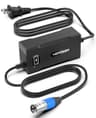
One thing the table makes obvious: a bigger battery is a longer charge on the same charger, and most big-battery value bikes ship with the same small charger as the small-battery ones. The 1,040 Wh folder in our registry is the clearest case — a 6–8 hour charge is listed as one of its drawbacks, and that is the honest price of the biggest pack on the site. If you ride that bike to empty daily, a 4 amp charger is the single most useful $40 you can spend on it.
You almost never charge from empty
Full-charge time is the number everybody asks for and the wrong one to plan around. What matters is the top-up, and that is set by your ride, not your pack.
Use the site’s planning figure of about 20 watt-hours per mile. A ten-mile round-trip commute spends roughly 200 Wh, which on a 2 amp 48 V charger is a bit over two hours; on a 4 amp charger it is about an hour. A five-mile school run is half an hour. The only riders who regularly see a full cycle are people doing 25 miles a day on a 360 Wh bike — and they should be reading how to increase e-bike range instead, because the answer there is a second battery, not a faster charger.
When a faster charger is the wrong purchase
Fast charging is not free, and on a value e-bike it is often a bad trade.
- The pack’s BMS sets the ceiling, not the charger.The battery management system limits charge current. Plugging a 6 amp charger into a pack whose BMS accepts 2 does not halve your charge time; at best nothing happens, at worst you have stressed a cheap BMS.
- Heat is what ages a lithium pack. Higher current means a warmer battery, and sustained heat is the main thing that shortens calendar life. Our battery lifespan guide covers what actually determines how many years you get.
- Overnight slow charging solves the same problem for free.If the bike sits for eight hours anyway, a 2 amp charger is already fast enough — with the important caveat below about where it sits while it does it.
Buy a faster charger when you genuinely need two cycles in a day: delivery riding, a long commute with a lunchtime top-up, or a big pack you flatten regularly. Our charger picks are the ones that match the connectors value bikes actually use.
Charge safely, because this is the one risk that matters
The CPSC’s micromobility guidance is short and worth following exactly.
- Use the charger that came with the pack, or an exact voltage-and-connector match. A 54.6 V charger on a 36 V pack is a fire, not a fast charge — and the connectors are not reliably different, which is why battery and charger compatibility deserves its own page.
- Charge where you can see it and where it does not block your exit. Not in a hallway, not against the only door, not under a bed.
- Unplug when it is done. Most chargers stop on their own; leaving a pack on the charger for days is still the habit most likely to leave it sitting at 100% in a warm room, which is the worst state for it.
- Stop using a pack that is swollen, hot, smoking or damaged. Do not charge it to see if it recovers.
- Charge indoors at room temperature. Charging a pack below freezing is genuinely damaging; bring it inside for an hour first. Our winter storage guide covers the cold months in full.
Should you charge to 100%?
For daily use, charging to around 80–90% and topping up often is gentler on the pack than running it flat and filling it to the brim. Charge to 100% before a long ride, because that is what the capacity is for — and store the bike at roughly half charge if it is going to sit for a month or more. None of this is fussing: these are the two habits that make the difference between a pack that is still useful in year five and one that is not.
What charging costs is a separate and cheerful question: a 672 Wh pack is about 0.77 kWh at the wall, which at average US residential electricity prices is pennies. We show the full sum, including cost per mile against a car, in our charging-cost guide.