The battery: indoors, cool, and about half full
Three decisions, in order of how much they matter.
Where.Off the bike and indoors. A lithium pack in an unheated garage spends the winter cycling between sub-freezing nights and warmer afternoons, and cold is the condition that most reduces usable capacity. “Indoors” does not mean in a cupboard against the furnace, either — heat ages a pack faster than anything else. A cool, dry, room-temperature spot, on a hard surface, away from anything flammable and not in the path you would use to get out of a bedroom. That last point is the CPSC’s, and it is about the fire case rather than the capacity case.
At what charge.Roughly half. Lithium-ion ages fastest held at a very high state of charge, and a pack left genuinely empty can self-discharge below the point where the battery management system will allow a charge at all, which is the failure that ends packs. Half is the compromise every maker’s storage advice circles around, and it is what we recommend across this site.
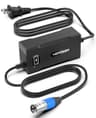
Not on the charger. Do not leave a pack plugged in for four months on the theory that it will stay topped up. Whatever the charger does at the end of a cycle, an unattended charger connected to an uncertified pack for months is the single worst version of this. Charge it to about half, unplug it, and walk away.
Prepare the bike before it sits, not after
Get the salt off.If the bike has been ridden on salted roads, it needs a rinse before storage, because salt left on a drivetrain for four months is corrosion with time on its hands. Hose on low pressure only — never a pressure washer, which drives water straight past hub-motor and bottom-bracket seals. Dry it, then lube the chain so the metal is not bare while it sits.
Inflate the tires. A tire at pressure holds the rim off the ground and the sidewall in shape. A tire left flat for a season takes a set, and a heavy e-bike resting on a flat tire for months can damage both the casing and the rim. Inflate to the normal range on the sidewall and check it again at each monthly visit, because tires lose pressure steadily, faster in the cold. Our tire pressure guide covers what that range means on a fat tire.
Get the weight off the tires if you can.A wall rack or a stand that lifts one or both wheels removes the question entirely. On a 60 to 75 lb bike, make sure whatever you hang it from publishes a limit that clears your bike’s weight — most bike hooks are rated for something half as heavy. Our storage rack roundup compares the published limits, which is the whole decision.
Relax the drivetrain and cover the contacts.Shift to the smallest cog before you park it so the derailleur spring is not held under tension all winter, and put the battery cover or blanking plate back over the frame contacts so nothing corrodes or shorts across them. If your bike has turn signals or an integrated light that runs off a small internal cell, read the manual — a few of them drain slowly even switched off.
Indoors, garage, or outside under a cover
Indoors is best, for the obvious reason and a less obvious one: a bike stored in your living space is a bike nobody is going to steal over the winter, and an unattended bike in a yard for four months is a much easier target than the same bike locked outside a shop for an hour. Our apartment living guide covers no-drill options and the lease question.
An unheated garage or shed is acceptable for the bike — it is a bicycle with a motor in it, and cold does it no harm — but take the battery inside. That split is the single most important sentence in this guide. The other garage consideration is damp: a bike in a shed that condenses moisture every time the temperature swings will develop surface rust on the chain and the hardware, so a cover or a dehumidifier earns its keep.
Outside under a cover is the last resort, and if that is your situation, buy the cover with a lock hole so the bike stays locked while it stays covered, and accept the honest trade-off: a cover advertises that there is something worth covering underneath. Pair it with a proper lock from our lock roundup and read our stolen e-bike guide for the five minutes of preparation (serial photographed, bike registered) that matters if the worst happens.
The fifteen-minute monthly check
Set a calendar reminder for every four to six weeks. The visit is short.
Check the pack’s state of charge and bring it back to about half if it has drifted low — this is the one task that genuinely matters, and a charger with a voltage display makes it a glance rather than a guess. Top the tires back up. Spin both wheels and listen for anything dragging. Look for corrosion on the chain and re-lube if it looks dry. And if the bike is outside, check the cover has not torn at a seam and filled with water, which is the usual failure in sustained wind.
What you are not doing: cycling the pack fully, running the motor on a stand for “exercise,” or leaving it on charge between visits. None of those help.
Waking it up in spring
Charge the pack fully the night before the first ride, not months in advance. Then do a proper pre-ride check, because a bike that has sat for four months is closer to a newly-assembled bike than to one you rode last week: tire pressure, brake lever feel and pad clearance, and a re-torque of the stem, handlebar, seatpost and both wheel fixings. Our maintenance checklist and assembly guide cover the torque values and the order to work in.
Expect the first ride to show slightly less range than you remember, and do not panic about it: a cold spring morning accounts for some of it, and a pack that has aged four months accounts for a little more. If the drop is dramatic — half the range, or a display that reads full and then collapses under load — that is a pack problem rather than a storage one, and our battery lifespan guide covers how to tell and what a replacement involves.
What not to do
Do not leave the pack on the bike in a freezing garage. Do not store it fully charged, or fully flat, or on the charger. Do not charge a pack that is still cold from the garage — let it come up to room temperature first. Do not pressure-wash the bike before storing it. Do not store it wet. And do not hang a 70 lb e-bike from a hook rated for a road bike, which is the mistake that ends with a bike on the floor and a hole in the drywall.
One last thought: if the reason the bike is going away is weather rather than preference, it may not need to. Fenders, lights and a five-minute rinse routine keep a value e-bike in use through most American winters. Our winter gear page covers what that takes, and our winter riding guide covers the riding itself. Four months of riding beats four months of careful storage.