Cycles and calendar: the two clocks running at once
Lithium-ion packs age two ways, simultaneously, and confusing them is why people get very different answers to this question.
Cycle agingis wear from charging and discharging. A cycle is a full charge’s worth of energy, however you accumulate it — two half-discharges make one cycle. Manufacturers usually quote a cycle count at which a pack retains a stated share of its original capacity. That number is a lab figure under controlled conditions; real use is harder on a pack than a laboratory is.
Calendar aging happens regardless of use. A pack sitting on a shelf loses capacity slowly, and it loses it faster when stored hot or stored full. A three-year-old battery that has barely been ridden is not a new battery, which is worth knowing when buying a used e-bike.
For most commuters the practical answer is that the pack degrades gradually rather than failing suddenly: range shortens year by year until one winter it no longer covers your ride. That is the normal end of life, and it is why the replacement question is a when rather than an if.
What makes a pack age faster
- Heat. The biggest factor and the easiest to control. A battery stored in a hot car, a sun-baked shed or against a garage wall in summer ages faster than one kept at room temperature.
- Sitting at 100% charge. Cells held full are under more stress than cells at a middle state of charge. Charging to full the night before a long ride is fine; leaving the pack on the charger for two weeks is not.
- Deep discharges. Running to zero repeatedly is harder on a pack than topping up from a third.
- Charging cold. Charging a pack below freezing can cause permanent damage. Bring it indoors and let it reach room temperature first.
- Vibration and impact. Cheap packs mounted rigidly on a bike with no suspension take a beating. This is a real factor on fat-tire value bikes ridden on bad pavement.
Our battery care guide turns those into habits that take no extra time. The summary version: store it around half charge, keep it indoors and at room temperature, and do not leave it charging unattended.
Signs your pack is going
Range that keeps shrinkingis the honest signal, and it needs to be measured against comparable conditions — a cold, wet winter reduces range on a healthy pack too, so compare like with like across seasons.
A voltage display that sags under load and recovers when you stop is a sign of rising internal resistance, which is what an aging pack does. Cutting out on hills at a state of charge that used to be fine is the same phenomenon with a bigger load.
Any physical change— swelling, a cracked case, heat while idle, or a smell — is different in kind. Stop using and stop charging that pack immediately, keep it away from anything flammable, and dispose of it through a proper battery recycling route rather than household waste. Lithium fires are the reason certification matters, and they are not a risk to manage casually.
Replacing the pack
Three things have to match: voltage(a 48 V bike takes a 48 V pack, full stop), the connector and controller compatibility, and the physical mount— the frame rail, the lock and the key. A pack that is electrically right and physically wrong is still no use.
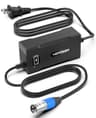
Buy certified. Look for packs and bikes certified to UL 2271 or UL 2849, which is the standard the CPSC points consumers toward for e-bike battery safety. Our battery roundup covers what to match and what to insist on, and the charger guide covers the other half: never charge a pack with a charger that was not designed for it, and replace a damaged charger rather than improvising.
Retiring a pack safely
A battery that has reached the end of its useful life is not household waste, and it is not something to put in a curbside recycling bin. Lithium cells that are crushed in a collection truck are a documented cause of fires in waste facilities, which is why dedicated battery recycling exists and why retailers and municipal programs accept them.
The practical steps: stop charging it, tape over the terminals so nothing can short across them, store it somewhere cool and away from anything flammable until you can hand it over, and take it to a battery recycling point rather than a general one. If the pack is damaged, swollen or has been immersed, say so when you drop it off — handling differs, and it matters.
One thing not to do: keep a failing pack “as a spare.” A battery that has been retired for a reason is not a backup, and a garage shelf is exactly the wrong place for it.
The check to do before you buy the bike
This is the practical takeaway. Before buying any value e-bike, search for a replacement battery for that exact model and confirm one exists at a price you would be willing to pay in a few years.
Bikes using a common format — the downtube “Hailong” style pack, for instance — have a genuine aftermarket. Bikes with a proprietary integrated pack and no spares listing are a bet on the manufacturer still being around and still supporting the model. On a bike that costs under $1,000, that single check is worth more than most of the spec sheet, and it is exactly the kind of question our brand guide asks of each maker.