The rule that governs everything: the battery is the bike
On a value e-bike, the battery is the single largest slice of what you are paying for. It is also the only major component that wears out on a schedule you cannot inspect. A frame either is or is not cracked. Brake pads either have material left or they do not. A battery looks identical at 100% health and at 60%, and the display on a budget bike will happily show four bars in both cases.
Capacity fades with charge cycles and with calendar age, and the fade is gradual rather than a failure — which is exactly what makes it easy to sell to someone who does not know to ask. Our e-bike battery lifespan guide covers how that decline actually works and what shortens it. For buying purposes the practical consequence is simpler: treat every used e-bike as though the battery has meaningful wear until the seller gives you a reason to think otherwise, and price it accordingly.
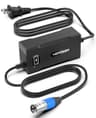
The second consequence is that you must know, before you commit, whether a replacement pack for that specific bike can still be bought at all. A battery that is no longer manufactured turns a repairable bike into a disposable one. Our replacement battery roundup covers the mainstream formats; the pack listed above is one of them, and its live price is the number to hold in your head while you negotiate. It is an anchor for the arithmetic, not a part to order — packs are matched to a specific voltage, mount and connector, and buying one blind is a mistake we warn against everywhere on this site.
The free check to run before you travel
Do this from your sofa, before you spend an evening driving to look at something. Ask the seller for the frame serial number, which on almost every bike is stamped underneath the bottom bracket — the shell the pedal cranks pass through. Then search it against a stolen-bike registry.
Bike Index is a 501(c)(3) nonprofit that runs a free, publicly searchable serial-number database. It is not a small project: as of September 2026 its own front page reported over 1.8 million bikes registered, more than 180,000 of them logged as stolen, and over 18,000 recovered. Searching a serial takes seconds and costs nothing, and a seller who will not give you the serial has told you everything you need to know without you leaving the house.
This check is worth more on an e-bike than on a bicycle, simply because the values involved make e-bikes a more attractive thing to steal. It also protects you from a consequence people underestimate: buying stolen property does not make it yours, and a recovered bike goes back to its registered owner, not to the person who paid a stranger for it.
The inspection, in the order that saves you time
Work from the expensive and unfixable toward the cheap and replaceable. Most bad bikes fail in the first two steps, and there is no point examining brake pads on a bike you are not going to buy.
1. The battery and its paperwork
Ask how old the bike is, how often it was charged, and whether it was stored somewhere that freezes or bakes. Look at the pack itself for cracks, dents, corrosion on the contacts, or any swelling or distortion of the case. Check that the key turns and that the pack seats and locks positively rather than wobbling in its cradle. Ask whether the original charger is included — a missing charger is common on secondhand sales and is a real cost, as the replacement listed above shows.
Ask directly whether the bike and the battery carry a safety certification, and look for the marking. The CPSC has been explicit about buying e-bikes and packs certified to the relevant UL standards, and this matters more on the used market than the new one, because you are also inheriting whatever charging habits and aftermarket parts the previous owner used. Any sign that the pack has been opened, repaired, rewired or replaced with something non-original ends the conversation. Refurbished packs of unknown provenance are the single worst thing you can buy in this category.
2. The motor, wiring and display
Look at the motor housing for dents and corrosion, and at every cable run for fraying, kinks, tape repairs or connectors that have been forced. Power the bike up and confirm the display lights, reports a battery level, and responds to the assist buttons. Spin the rear wheel by hand and listen: a hub motor should sound smooth, not gritty or notchy.
Ask what happens in the rain, and whether it has been ridden through winter salt. Our rain guide explains what water does and does not do to a budget e-bike, and the honest summary is that occasional wet riding is fine but a bike stored outside uncovered for two winters will show it in the connectors first.
3. The bicycle half
Only now look at the parts any bike shop can price. Check the rims and spokes, spin both wheels for wobble, squeeze the brakes and look at pad thickness, check the chain and sprockets for wear, and look over the frame — especially around the welds at the head tube and the dropouts — for cracks or a repaint hiding a repair. E-bikes are heavy and fast, which loads wheels, tires and brakes harder than a bicycle of the same price. Our weight guide explains why that matters more than most buyers expect.
4. The legal question nobody asks
Confirm what class the bike is, and whether it has been modified. A derestricted bike, or one that was never class-compliant to begin with, can be barred from bike paths and in some places is not legally a bicycle at all. Our class and law guide sets out the three-class system. On the used market this is a live risk, because derestricting is a popular modification and the seller has no obligation to mention it.
The test ride that actually tells you something
A slow lap of the parking lot tells you nothing about a battery. A weak pack behaves perfectly at rest and at low current, and only reveals itself when the motor asks for real power — which is the entire point of the test.
Ride it properly. Get it up to speed on the throttle if it has one, and take it up the steepest hill within reach at full assist. Watch the battery indicator while you do. What you are looking for is a reading that falls steeply under load and then jumps back up when you stop, which is a sign the pack cannot hold voltage under current. A gradual, steady decline is normal; a large swing that recovers at rest is not. Budget displays are imprecise, so treat this as a strong signal rather than a measurement.
Ask to start the ride with the pack as close to full as the seller can manage, and be suspicious of a bike presented at half charge with an explanation. The range you get on a test ride is not a number you can extrapolate from, but a pack that drops two bars in a mile has told you something conclusive. Our range guide covers why the manufacturer figure was never achievable anyway.
The arithmetic: what a used e-bike has to beat
This is where most used e-bike decisions are actually made, and it is why the new bike listed above is on this page. The value bracket this site covers has an unusual property: new, warrantied, certified e-bikes start low enough that a used bike has to be genuinely cheap, not merely cheaper, to make sense.
Run the sum honestly. Take the asking price, then add what you will realistically spend to put the bike right: a replacement pack if the battery is suspect, a charger if it is missing, new brake pads and a chain if they are worn, and a shop service if you are not doing the work yourself. Compare that total against the current price of a new bike at the bottom of the market, which comes with a full-health battery, a warranty and no unknown history.
Do that arithmetic and a large share of used listings stop being attractive immediately. A used bike at half the price of a new one, needing a battery, is more expensive than the new one. This is the same conclusion our budget e-bike guide reaches from the other direction, and it is the reason we are more cautious about the used market than most sites: the floor on new prices is low enough to make used a narrower win than it is for cars, or even for regular bicycles.
Where used clearly does win is higher up. A two-year-old bike from a brand that sold at two or three times the budget bracket, with a healthy pack and a documented history, can put you on far better components than anything new at the same money. That is a real opportunity and worth pursuing. It is just not the same transaction as buying someone’s four-year-old no-name bike for $300.
Red flags that should end the conversation
Any one of these is enough to walk away, and none of them is worth a discount.
- A swollen, cracked or repaired battery pack. This is a safety issue, not a bargaining position.
- No serial number, or a refusal to provide it. There is no innocent version of this.
- No charger and no idea which one it takes. Chargers are voltage and connector specific, and a seller who cannot say which one the bike needs probably cannot say much else reliably.
- A seller who will not allow a real test ride. On an e-bike this is close to disqualifying, because the loaded ride is the only battery check available to you.
- Frame cracks, or a repaint around the welds. An aluminum frame that has been cracked is finished.
- A bike that has been derestricted. You inherit the legal position and the wear on brakes and tires that were never specified for the speed.
Where used e-bikes come from, and which sources are safer
A private sale from the original owner, with the receipt, the original charger and a straight answer about age and storage, is the best version of this transaction. You get the full history and the lowest price, and you carry all of the risk.
A bike shop selling a traded-in or refurbished e-bike costs more and gives you two things worth paying for: someone has already inspected it, and there is an identifiable business to return to. For a first e-bike, that is often worth the premium over a marketplace listing.
Certified-refurbished programs run by the original brand sit in between, and the thing to establish is exactly what was replaced and what warranty comes with it — particularly whether the battery is new or merely tested. Our where to buy guide covers the new-bike channels alongside these, and our brand guide is the place to check whether the brand on a used bike still exists and still sells parts, which is the question that decides whether it is repairable in three years.
When used is right, and when it is not
Buy used when you can inspect the bike in person, the seller is the original owner and can prove it, the battery is young or has documented health, a replacement pack is still available for the model, and the total cost after repairs is clearly below a new bike of similar capability. Buying a better bike secondhand than you could afford new is a genuinely good strategy at the mid and upper end.
Buy new when the used candidates are all at the bottom of the market, when the seller cannot answer basic questions about the battery, when you would be buying remotely without a test ride, or when the price gap is small. A new budget e-bike gives you a full-health pack, a warranty, a certified charger and a known starting point — and at the prices in our value e-bike roundup and the under-$1,000 bracket, that combination is hard for a used listing to beat.
Whichever way you go, budget for the things a bike does not come with. A lock appropriate to an e-bike, lights, and a basic tool kit for keeping bolts tight are not optional on a machine this heavy and this worth stealing, and they are the same purchases either way.