Value E-Bikes
The best e-bikes for the money — value-first picks under $1,500, compared on published specs and real running cost, not marketing.
An e-bike is the rare purchase where spending three times as much does not get you three times the bike. Above roughly $1,500 you are mostly paying for brand, a torque sensor and a nicer app — not more range or a motor that will get you to work any faster. Below it, a handful of budget brands now build genuinely usable bikes: a 500–750 watt hub motor, a 400–700 watt-hour battery, hydraulic or decent mechanical brakes, and a throttle for the mornings you would rather not pedal. That is the whole premise of this section — the best value e-bikes, judged on what they actually deliver for the money.
The honest complication is where these bikes are sold. The value brands people love most — Lectric, Ride1Up, Aventon, Rad Power — sell direct from their own sites, not on Amazon. We cover them where they are the right answer, but the models you can actually buy through the links here are the Amazon-carried budget brands: GoTrax, Heybike, Retrospec, Jasion, Vivi, Hiboy, isinwheel and a few others. When a bike sells direct instead, we say so and point you to check its price at the source rather than pretending it is something it is not.
How to read a value e-bike spec sheet
Four numbers do most of the work. Battery watt-hours (volts multiplied by amp-hours) is the honest measure of range — a 360 Wh pack is a short-hop bike, a 700 Wh pack is a real commuter, regardless of the “up to 60 miles” on the box. Rated motor watts tells you how it climbs; 350 W is fine on the flat, 500–750 W handles hills. Class decides where it is legal — a 20 mph Class 2 bike is allowed almost everywhere a bike is, while a 28 mph Class 3 is barred from some paths. And weight is the spec nobody reads until they have to carry the thing up a step: most of these bikes are 50–75 lb, and that number matters more than any other if you live up a flight of stairs.
The single figure the budget brands are least honest about is range, so we do not repeat it uncritically. Instead we tell you the battery size and let you judge, and on our charging-cost guide we show the arithmetic that turns watt-hours into cents per charge and cents per mile — the number that actually decides whether an e-bike is cheaper than driving.
Where to start
If you just want the short answer, start with the best value e-bikes — the overall picks, ranked. Shopping to a number? We have dedicated roundups for under $1,000 and the genuinely tricky under $500. Buying for a particular rider or job, we break it down by commuting, seniors, women and beginners. And once you have a bike, the money you spend next — a real lock, proper lights — matters more than most people think; that lives in Upgrades & Accessories.
Shopping by shape, or by bike
Two categories cut across the price and rider roundups because they change what the bike can do rather than who it suits. Folding e-bikes solve a storage problem — and we are blunt about the fact that folding changes a bike’s shape, not its weight. Fat-tire e-bikes buy you comfort on broken pavement, gravel and light snow, at a real cost in weight and range.
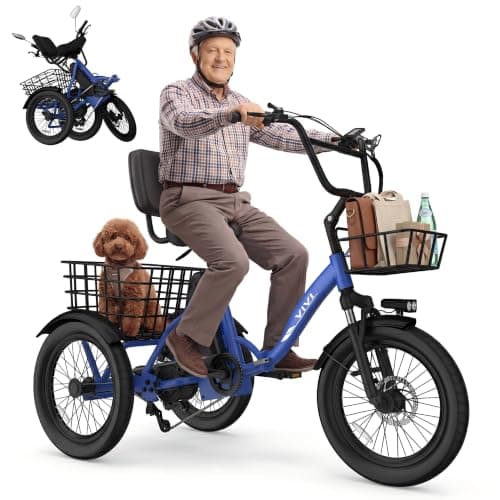
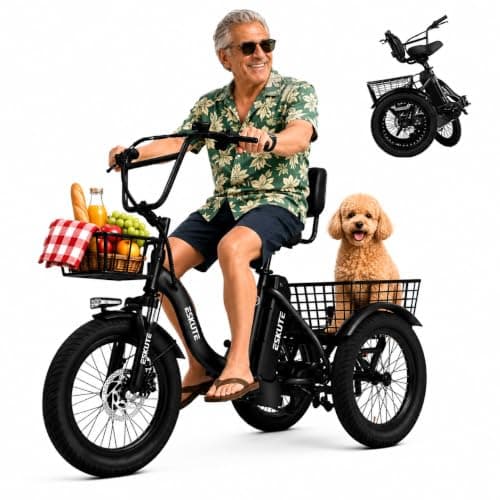
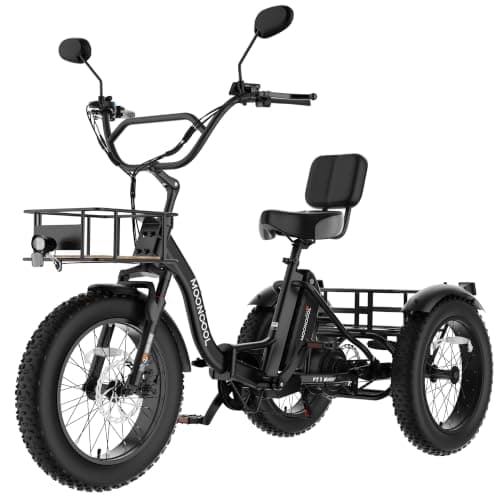
A third shape changes it more than either of those. Electric trikes for adults swap the whole premise: you can stop without putting a foot down and carry a week of shopping in a welded basket, and in exchange you get a 30-inch-wide vehicle that weighs 93 to 110 lb. That page ranks on the four specs no Amazon listing shows — stand-over height, published load, whether there is a real rear differential, and whether there is a parking brake. The cheapest of those four now has its own write-up: our Eskute T300 reviewcovers the one trike on the list that its maker says fits a rider as short as 4′9″, and the certification question — a TUV-certified battery rather than a UL 2849 listing for the complete bike — that kept it out of first place. The two trikes ranked above it now have reviews too: the Vivi FatGo1, our top pick at around $700, where Vivi’s own spec sheet contradicts itself three times, and the Mooncool FT1, the only trike in the bracket publishing a rated motor figure and a torque number rather than a peak watts claim.
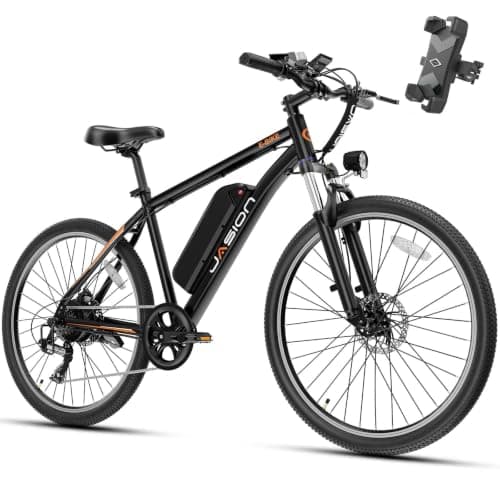
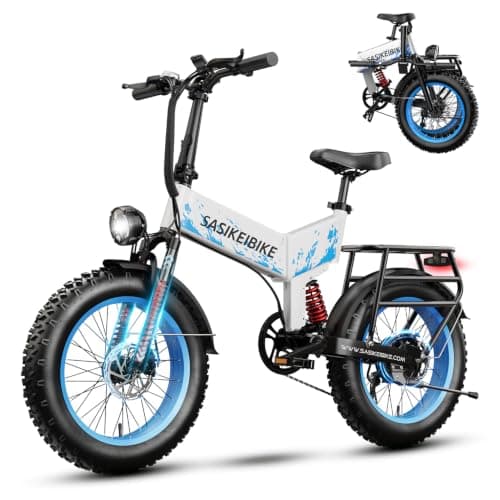
And every bike we recommend has its own write-up. If a roundup names a top pick you like the look of, the review is where the specs, the trade-offs and the “who should skip this” live — the GoTrax Ranger, Jasion Roamer, Vivi C26, Retrospec Beaumont Rev and SASIKEIBIKE 20″ folder are the ones most people land on, with the GoTrax F3, Retrospec Chatham Rev, Heybike Ranger S and isinwheel U3 covering the rest of the field. One review stays up for a bike nobody sells any more: the Sohamo S3 step-thruwas discontinued in August 2026, and the page keeps our original read on its 960 Wh low-step format alongside what to buy instead, because people still search the model name and deserve a straight answer rather than a dead link.
Shopping by what the bike has to do
Three roundups filter on capability rather than price or rider. Long-range e-bikes ranks the biggest batteries in the bracket on watt-hours rather than the mileage claim on the box. E-bikes for hills covers the bikes that hold a gradient, and why a 750 W motor is not automatically the better climber. And e-bikes for adults is the fit page — standover, reach, wheel size and payload, which are the things you cannot check when you buy online.
Shopping by who is riding, and by brand
Four newer pages answer the questions that arrive as a person rather than a spec. E-bikes for college students ranks on the things a campus bike faces — stairs, theft and charging in a dorm — and e-bikes for teens is the 16-and-up version, limited to legal 20 mph bikes with the state age and helmet rules spelled out. E-bikes for delivery work ranks on watt-hours, load rating and class legality, because a shift is the hardest job a value bike does. And Heybike vs Jasion vs GoTrax puts the three Amazon-carried brands head to head on what each one publishes and what it leaves blank, and Retrospec Chatham vs Beaumont settles the one comparison Retrospec buyers actually make — same platform, same price, and published rider-height ranges that barely overlap.
Buying one as a gift, or waiting for November?
Two seasonal questions come up constantly in the last quarter of the year. If you are buying for an e-bike owner rather than for yourself, gifts for e-bike owners covers what an e-bike actually needs — and the two things you must never buy blind, because a battery or charger is matched to one specific bike. And if you are weighing up whether to buy the bike now or hold out, our Black Friday and Cyber Monday page explains why complete bikes and accessories discount on almost opposite patterns, without inventing a single number about this year’s deals.
Two more ways to choose a bike
Added this month, both for buyers whose question is not “which is best” but “which is right for what I am doing.” E-bikes for hunting ranks on the three specs that decide a bike out of cell range — watt-hours you cannot recharge in the field, a published load limit that has to carry you and what you bring back, and tire width for soft ground — and covers the federal rule that decides where an e-bike may be ridden on public land. And e-bikes for exercise and weight loss inverts the usual spec sheet: if the point is to get fitter, the sensor type, the gearing and the weight matter far more than the motor, and the lightest bike we list is also the cheapest.
Added this month: two jobs, and one head-to-head
Three pages for buyers whose question is a situation rather than a price. E-bikes for camping and RV travel ranks on the number almost nobody checks — the published weight, against the roughly 50 lb-per-bike limit printed on most RV racks — and the useful finding is that five of the bikes we list publish no weight at all, which rules them out of rack duty whatever else they do well. E-bikes for trails and rail trails puts the e-bike class first instead of tire width, because on a managed trail the class is what the sign names and five bikes here publish none. And Eskute T300 vs T300 Pro settles the comparison trike buyers actually make: same name, 624 Wh against 998.4, 93 lb against 110.2, and a three-and-a-half-inch difference in minimum seat height that decides it for shorter riders.
Everything in E-Bikes
Best Value E-Bikes
The e-bikes that give you the most bike for the money under $1,500 — where to spend and where to save.
Best E-Bikes Under $1,000
The sub-$1,000 e-bikes worth buying, and the honest trade-offs you make at that price.
Our top pick
SASIKEIBIKE 20" Folding Fat-Tire (52 V 20 Ah)
Best E-Bikes Under $500
Truly-cheap e-bikes are rare and compromised — here's the least-bad, and why stretching a little pays off.
Best E-Bikes Under $2,000
One bracket above our ceiling — what the extra money buys, and why most of what Amazon sells above $1,300 is not a legal e-bike.
Our top pick
SASIKEIBIKE 20" Folding Fat-Tire (52 V 20 Ah)
Best E-Bikes on Amazon
The e-bikes actually worth buying on Amazon — the budget brands that deliver and the ones to skip.
Our top pick
Aipas A2 Folding Fat-Tire
$688.99 · View on AmazonPrice as of October 22, 2026. #ad How we’re funded
Best Commuter E-Bikes
Value e-bikes built for the daily ride — range, lights, racks and comfort that survive a real commute.
Our top pick
Jasion Roamer (Step-Over)
$719.00 · View on AmazonPrice as of October 22, 2026. #ad How we’re funded
Best E-Bikes for Seniors
Low-step, stable, easy-throttle e-bikes that are genuinely comfortable to mount, ride and stop.
Our top pick
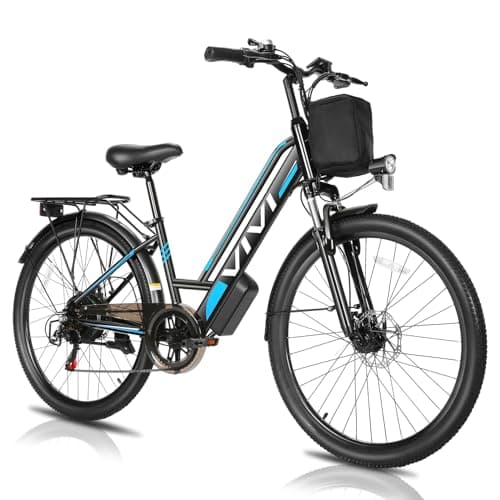
Vivi C26 Cruiser (Step-Through)
Best E-Bikes for Women
Step-through frames and comfort-first geometry that fit a wider range of riders, on a value budget.
Best E-Bikes for Beginners
Simple, forgiving first e-bikes — easy assist, upright riding and nothing you have to fettle out of the box.
Best Folding E-Bikes
Fold-and-carry e-bikes for small apartments, car trunks and transit — and the honest weight you still have to lift.
Our top pick
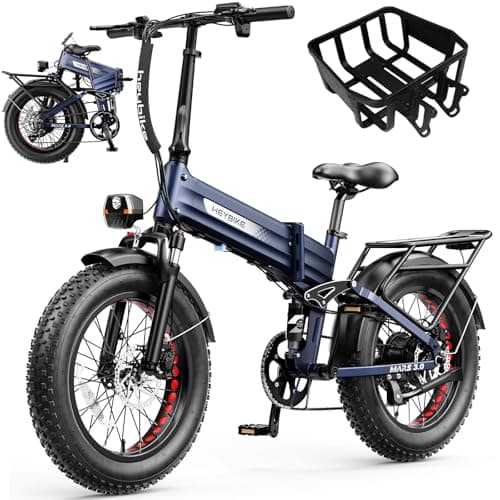
Heybike Mars 3.0
$1,199.00 · View on AmazonPrice as of October 22, 2026. #ad How we’re funded
Best Fat-Tire E-Bikes
Four-inch tires soak up bad pavement, gravel and snow without a suspension budget. The value fat-tire picks, and what they cost you.
Best Long-Range E-Bikes
The value e-bikes with the biggest batteries, ranked on watt-hours rather than the mileage claim on the box.
Our top pick
SASIKEIBIKE 20" Folding Fat-Tire (52 V 20 Ah)
Best E-Bikes for Hills
Which budget e-bikes actually climb — rated watts, torque and sensor type, and the gradient where each one gives up.
Our top pick
Heybike Mars 3.0
$1,199.00 · View on AmazonPrice as of October 22, 2026. #ad How we’re funded
Best E-Bikes for Adults
Full-size e-bikes that actually fit a grown adult — standover, reach and payload, then the picks that suit each body.
Best E-Bikes for Heavy Riders
Payload capacity is the spec the budget bracket words differently on every listing — the bikes that publish a real number, and what each one counts.
Our top pick
Heybike Mars 3.0
$1,199.00 · View on AmazonPrice as of October 22, 2026. #ad How we’re funded
Best E-Bikes for College Students
A campus e-bike gets stolen, carried up stairs and charged in a dorm. The value bikes that survive that, ranked on weight, certification and price.
Best E-Bikes for Delivery
A shift is hours of stop-start riding with a bag on the back. The value picks ranked on watt-hours, load rating, charging time and class legality.
Our top pick
SASIKEIBIKE 20" Folding Fat-Tire (52 V 20 Ah)
Best E-Bikes for Teens
Legal 20 mph Class 1/2 bikes a teenager can lift and lock, what the state age and helmet rules say, and why the bikes marketed at teens often are not e-bikes.
Heybike vs Jasion vs GoTrax
The three Amazon-carried value brands head to head: six bikes compared on what each brand publishes, what it withholds, and which bike wins at each budget.
Our top pick
Jasion Roamer (Step-Over)
$719.00 · View on AmazonPrice as of October 22, 2026. #ad How we’re funded
Retrospec Chatham vs Beaumont
Same 350 W / 360 Wh platform, same price. The published rider-height ranges barely overlap, and that — plus tires and what is in the box — decides it.
Best Electric Trikes for Adults
A third wheel changes which specs matter. The value e-trikes ranked on stand-over height, published load, the rear differential and the parking brake.
Best E-Bikes for Hunting
Watt-hours you cannot recharge in the field, a published load limit that has to carry you and the meat, and the land-access rule that decides whether you can ride it at all.
Our top pick
SASIKEIBIKE 20" Folding Fat-Tire (52 V 20 Ah)
Best E-Bikes for Exercise and Weight Loss
If the point is to get fitter, the sensor type and the gearing matter more than the motor. The value bikes that make you pedal, ranked on torque sensing, gears and weight.
Heybike Mars 3.0 Review
Torque sensor, full suspension and both UL listings on a 20x4 folder — and the four specs Heybike will not publish.
The bike
Heybike Mars 3.0
$1,199.00 · View on AmazonPrice as of October 22, 2026. #ad How we’re funded
Heybike Mars 2.0 Review
Discontinued as of September 2026. Our original read on the 750 W, 600 Wh folding fat-tire bike — and what replaced it.
Discontinued
Heybike Mars 2.0
No longer sold — review kept for reference
Jasion EB5 Review
One of the lightest, cheapest ways into a real e-bike — where it makes sense and where its modest power shows.
Aipas A2 Review
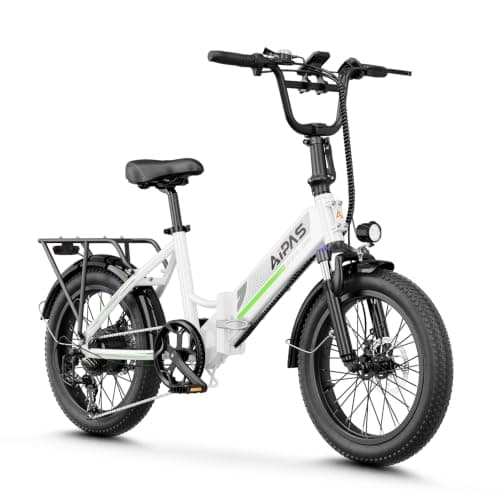
A switchable-class folding fat-tire bike — what the Class 1/2/3 toggle really buys you, and the trade-offs.
The bike
Aipas A2 Folding Fat-Tire
$688.99 · View on AmazonPrice as of October 22, 2026. #ad How we’re funded
GoTrax Ranger Review
The default first fat-tire e-bike under $1,000 — 500 W, 499 Wh and a throttle, at the cost of ~70 lb and basic brakes.
GoTrax F3 Review
A torque-sensored 28 mph commuter with a 672 Wh battery — the value bike that rides like a much pricier one.
Hiboy P7 Review
Discontinued as of August 2026. Our original read on the 720 Wh, 9-speed commuter — and what to buy instead.
Discontinued
Hiboy P7
No longer sold — review kept for reference
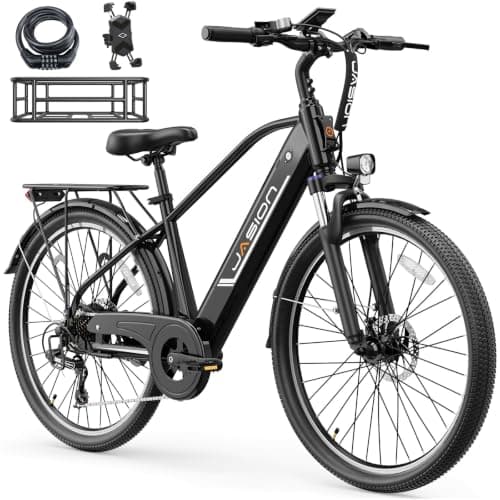
Jasion Roamer Review
A UL 2849 commuter with turn signals and a brake light for well under $1,000 — and the 528 Wh pack that sets the honest range.
The bike
Jasion Roamer (Step-Over)
$719.00 · View on AmazonPrice as of October 22, 2026. #ad How we’re funded
Vivi C26 Cruiser Review
A low-step, throttle-first cruiser built for comfort over range — why the small 374 Wh battery is the whole conversation.
The bike
Vivi C26 Cruiser (Step-Through)
Retrospec Beaumont Rev Review
A UL-certified step-through city bike at ~57 lb — the easiest bike here to get on and off, with modest power to match.
Retrospec Chatham Rev Review
The value cruiser that carries both UL 2849 and UL 2271 certification — what that actually buys you at this price.
Heybike Ranger S Review
The bigger, longer-range Heybike folder — a 692 Wh UL-certified pack and suspension, for about 3 lb less than the Mars.
Sohamo S3 Step-Thru Review
Discontinued as of August 2026. Our original read on the 960 Wh low-step folder — and what to buy instead.
Discontinued
Sohamo S3 Step-Thru
No longer sold — review kept for reference
SASIKEIBIKE 20″ Folding Fat-Tire Review
1,040 Wh in a folding 20x4 frame for about $700 — the most watt-hours per dollar we list, and what it costs you.
The bike
SASIKEIBIKE 20" Folding Fat-Tire (52 V 20 Ah)
isinwheel U3 Review
A 16-inch folder for last-mile trips and small apartments — genuinely portable, with a 281 Wh battery that sets the limits.
Eskute T300 Electric Trike Review
The cheapest trike we list, and the one with the narrowest safety paperwork - a TUV-certified battery and no UL 2849 listing for the complete bike.
Mooncool FT1 Electric Trike Review
The only trike we list that publishes a RATED motor figure rather than a peak one - 500 W and 45 Nm - and the only one that contradicts its own range claim.
The bike
Mooncool FT1
Vivi FatGo1 Electric Trike Review
Our top trike pick at around $700, with UL 2849 and UL 2271 listings - and a spec sheet that disagrees with itself in three places.
Best E-Bikes for Camping and RV Travel
Ranked on the number almost nobody checks - the published weight, against the per-bike limit printed on your RV or hitch rack.
Best E-Bikes for Trail Riding and Rail Trails
On a trail the deciding spec is the one most budget makers leave blank: the e-bike class. Ranked on published class first, then tires, then range.
Eskute T300 vs T300 Pro
Same name, two very different trikes: 624 Wh against 998.4 Wh, 93 lb against 110.2, and a three-and-a-half-inch difference in minimum seat height.