What each item is actually solving
Fenders: measure the tire first
A fender has to clear the tire by enough that grit and slush cannot wedge between them, which means fender width is set by tire width and there is no universal set. The two fitments that cover nearly every bike on this site: a 700c / 26–27.5-inch road or hybrid tire, and a 20/24/26 x 4-inch fat tire. A fender sized for the first will not go near the second.
Coverage length is the other variable, and it is what separates a fender that keeps your back dry from one that keeps your bike clean. Short clip-on fenders stop the rooster tail. Full-length fenders with proper stays also stop the spray that goes forward off the front wheel onto your feet and your bottom bracket, and they are the reason a winter commuter’s chain lasts a season instead of a month. If you intend to keep the bike for years, the full-length option in our fender roundup is the buy-once answer; if you are getting through this winter, the clip-ons are genuinely fine.
Fit note for e-bikes specifically: a rear hub motor means cables and a wide hub where a fender stay wants to mount, and most value e-bikes already have a rack or rack bosses competing for the same bolts. Check clearance at the chainstay bridge and the disc caliper before you commit, and use a thread-locker on budget mounting hardware, which rattles loose over winter potholes.
Lights: the winter problem is being seen, not seeing
On an unlit path you need a beam. On a winter commute through traffic at 5pm, nearly all of the value is in other people seeing you early enough to change what they are doing. That calls for a bright front light run in flashing mode during daylight and steady after dark, a rear light that is genuinely visible from a shallow angle, and the discipline to charge both on a schedule rather than when they die.
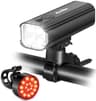
The Ascher set is here because it is a complete front-and-rear pair with a 1000-lumen headlight and a 6000 mAh battery at a price where there is no excuse not to have lights. Beam quality and mount durability trail the premium brands — our lights roundupcovers the Cygolite and NiteRider options if you ride unlit roads regularly. One e-bike-specific point: you are travelling at 20 mph, which closes distance much faster than a casual cyclist does, so a light that is adequate on a 12 mph bicycle is marginal on this one.
Reflective material is the cheap multiplier. It does nothing on its own and a great deal when a car’s low beams hit it, which is exactly the situation that matters on a dark wet road. A vest over your jacket is the version that survives contact with reality, because it works no matter what you are wearing underneath. Our reflective gear page has the rest, and NHTSA’s bicycle safety guidance is the underlying source for riding visibly in low light.
The glove gap, and what to look for
We are not going to pick a winter glove we have not researched, so here is the specification instead. On an e-bike you need three things that a general-purpose winter glove often lacks: enough dexterity to work a thumb throttle and a brake lever without taking the glove off; a windproof outer, because 20 mph of apparent wind is what makes e-bike riding colder than walking at the same temperature; and a long cuff that goes under or over the jacket sleeve so there is no gap at the wrist.
The e-bike detail people miss: throttle and brake operation is a fingertip job, and a thick ski glove makes it clumsy in exactly the conditions where braking matters most. Lobster-style or three-finger gloves are the usual compromise, and heated grips are the alternative if your bike has a 12 V accessory output. Our glove roundupcovers what we do have — gel-padded half-finger gloves for three-season riding — and says so plainly at the top.
Cold takes range before it takes comfort
Lithium cells deliver less usable capacity cold, which is why a bike that does 35 miles in September does noticeably less in January on the same route. The planning figure this site uses is about 20 Wh per mile for a heavy bike ridden with plenty of throttle; in winter, plan higher and charge more often rather than discovering the difference on the way home.
Three habits matter more than any purchase. Store the pack indoors and fit it to the bike when you leave, rather than leaving it on a bike in an unheated garage overnight. Let a cold pack come up to room temperature before charging it. And follow the CPSC’s charging guidance in general — charge on a hard surface, not unattended, not in the path you would use to leave a bedroom. Our battery care guide and winter riding guide are the longer versions, and if the bike is going away until spring instead, our winter storage guide covers that properly.
Salt is the thing that actually kills the bike
Cold is an inconvenience. Road salt is corrosion, and it attacks exactly the parts a value e-bike has fewest spares for: the chain, the cassette, the derailleur pivots, the brake hardware, the battery contacts and any exposed connector. A bike ridden through a salted winter and never rinsed is a bike with a seized drivetrain by March.
The routine is five minutes. Rinse with a hose on low pressure — never a pressure washer, which drives water straight past hub-motor and bottom-bracket seals — wipe the rims and the frame, dry the chain and re-lube it, and keep water away from the battery contacts and the controller. If the bike lives outdoors, the cover is doing a double job here: it keeps rain and salt spray off between rides, and its lock hole means the bike stays locked while it stays covered. The honest trade-off is that a cover advertises that something worth covering is underneath, which is why our lock picks matter more than the cover does.
What we would buy first
In order, for a value e-bike that has to keep working through winter: fenders sized to your tire, then the light set, then the reflective vest, then the cover if the bike is outside. That is a small total spend and it addresses three of the four problems directly.
Two things we would not buy, for the record. Studded winter tires are excellent and almost nobody in the value bracket needs them — they are for genuine ice, and if your winters are wet rather than frozen, the money belongs in fenders and lights. And we would not buy a cheap handlebar muff or bar mitt without checking it clears your display and your thumb throttle, because a lot of them do not.