Volt & Velo

Are E-Bike Batteries Interchangeable?

Mostly, no - and matching the voltage is not enough. Four things have to agree before a pack fits another bike: nominal voltage, the physical mount, the connector and its polarity, and the BMS discharge rating against your controller. Here is how to check all four before you spend $230.

By Stephen V.Last updated How we pick

The honest answer is no, not generally — and the specific answer is “only if four things match.” There is no industry standard for e-bike batteries the way there is for AA cells. A pack has to agree with your bike on nominal voltage, on the physical mount, on the connector and its polarity, and on the discharge current its management system will supply. Get voltage right and mount wrong and you have bought an expensive brick; get polarity wrong and you can take the controller with it.

The good news is that one widely-copied format — the Hailong-style down-tube pack — is common enough across value brands and conversion kits that a replacement is often genuinely available. That is why both 48 V packs we recommend are Hailong-pattern, and why a conversion kit is the easiest case of all: you are choosing the controller and the pack together, so you get to make them agree.

The four checks, in the order to do them

Run these before you put anything in a basket. Each one is a hard gate, not a preference — the table below the picks spells out exactly how each one fails.

1. Nominal voltage.This is printed on the pack and on the charger. A 36 V pack (10 cells in series) charges to 42 V; a 48 V pack (13S) charges to 54.6 V; a 52 V pack (14S) charges to 58.8 V. The controller is built for one of those windows. Going up is an overvoltage event. Going down means the controller sees a “flat” battery and shuts off.

2. The mount. Measure the cradle, the bolt spacing and the available length inside the frame. Down-tube packs in particular come in a family of near-identical cases that are not actually identical, and a half-inch is the difference between fitted and returned.

3. The connector and its polarity. Check the discharge plug type and which pin is positive, with a multimeter if you have one. Two packs with the same XT60 plug can be wired opposite. Note that the charge port is usually a separate connector from the discharge plug, and both have to work out.

4. The BMS continuous discharge rating.The least-checked and most-complained-about spec. If your controller pulls 22 amps on a hill and the pack’s BMS is rated for 15 continuous, the BMS protects itself by cutting out. The bike is not broken; it is mismatched.

All three packs below publish enough to run these checks, which is the main reason they are the ones we list. This is our method.

How this is funded:we earn a commission if you buy through our links, at no extra cost to you. It never changes which product we recommend, and we’ll tell you plainly when to skip one. Full disclosure.

Quick picks

Ranked on published specs, price and buyer fit. Select a row to jump to the full write-up. We have not ridden every one of these — here is exactly what we do instead.

#ProductBest forPrice
1
Unit Pack Power 48V Hailong Battery

Unit Pack Power 48V Hailong Battery

One of the most common aftermarket 'Hailong'-style 48 V packs for extending or replacing range on a value e-bike. Batteries are the one upgrade where you should not cut corners: match the voltage and connector to your bike, confirm the BMS and cell type, and strongly prefer a pack with a recognized safety certification.

Best 48 V replacement or spare
$247.00 · View on Amazon

Price as of October 16, 2026. #ad How we’re funded

2
Yose Power 48V 13Ah Down Tube Battery

Yose Power 48V 13Ah Down Tube Battery

A branded Hailong-style 48 V/13 Ah down-tube replacement — a solid, mid-priced way to restore or extend range on a 48 V value bike. Batteries are where the most dangerous corner-cutting happens: the CPSC's advice is blunt, buy packs certified to UL 2271. Match voltage, mount and connector, and never charge an uncertified pack unattended.

Best value 48 V down-tube pack
$191.92 · View on Amazon

$227.7916% off

Price as of October 16, 2026. #ad How we’re funded

3
VATOSO 36V 10.4Ah Lithium Battery Pack

VATOSO 36V 10.4Ah Lithium Battery Pack

Many lighter value e-bikes (including several here) run 36 V systems, and a 36 V pack is not interchangeable with a 48 V one. This VATOSO pack is 36 V/10.4 Ah with a built-in 30 A BMS and an XT60 connector, rated by the seller for 100–1000 W motors. If your bike is 36 V, this is the class of replacement you need — match the mount and connector, and note that no safety certification is published for it.

Best for a 36 V bike: published BMS rating
$107.99 · View on Amazon

$129.9917% off

Price as of October 16, 2026. #ad How we’re funded

4
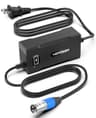
YZPOWER 54.6V 4A XLR Charger (48V packs)

YZPOWER 54.6V 4A XLR Charger (48V packs)

A common, well-reviewed replacement for 48 V systems: it outputs 54.6 V at 4 A (a 48 V pack fully charges to ~54.6 V) through a 3-pin XLR plug, the connector most value e-bikes use. The rule that matters more than brand: confirm your pack is 48 V and uses an XLR port before you order. The listing makes no UL claim.

The matching 48 V charger
$37.58 · View on Amazon

Price as of October 16, 2026. #ad How we’re funded

The picks in full

#1Best 48 V replacement or spare

Unit Pack Power 48V Hailong Battery

One of the most common aftermarket 'Hailong'-style 48 V packs for extending or replacing range on a value e-bike. Batteries are the one upgrade where you should not cut corners: match the voltage and connector to your bike, confirm the BMS and cell type, and strongly prefer a pack with a recognized safety certification.

What you get

  • Common Hailong form factor fits many downtube mounts
  • Available in larger capacities (up to ~20 Ah) for real range gains

Trade-offs

  • Voltage, connector and mount must match your bike exactly
  • Not for Bosch/Shimano/Yamaha systems; no UL claim stated — insist on certification
Key spec48V lithium-ion (Hailong-style) pack; capacities up to ~20 Ah
Best forReplacing or extending a 48 V pack

Specs read from the manufacturer or retailer listing, on July 22, 2026. “Not published” means the maker does not state that figure.

#2Best value 48 V down-tube pack

Yose Power 48V 13Ah Down Tube Battery

A branded Hailong-style 48 V/13 Ah down-tube replacement — a solid, mid-priced way to restore or extend range on a 48 V value bike. Batteries are where the most dangerous corner-cutting happens: the CPSC's advice is blunt, buy packs certified to UL 2271. Match voltage, mount and connector, and never charge an uncertified pack unattended.

What you get

  • 48 V / 13 Ah, a useful capacity bump for short-range bikes
  • An established e-bike battery brand rather than a no-name pack
  • Common down-tube (Hailong) form factor

Trade-offs

  • Confirm UL 2271 certification before buying, and never charge unattended
  • Fit is on you: match voltage, mount rail and connector exactly
Key spec48V 13Ah lithium-ion down-tube (Hailong-style) pack
Best forRestoring range on a 48 V value bike

Specs read from the manufacturer or retailer listing, on July 22, 2026. “Not published” means the maker does not state that figure.

#3Best for a 36 V bike: published BMS rating

VATOSO 36V 10.4Ah Lithium Battery Pack

Many lighter value e-bikes (including several here) run 36 V systems, and a 36 V pack is not interchangeable with a 48 V one. This VATOSO pack is 36 V/10.4 Ah with a built-in 30 A BMS and an XT60 connector, rated by the seller for 100–1000 W motors. If your bike is 36 V, this is the class of replacement you need — match the mount and connector, and note that no safety certification is published for it.

What you get

  • Correct 36 V system voltage for many lighter value e-bikes
  • Built-in 30 A BMS protection board
  • XT60 connector with an SM adapter, the common DIY pairing

Trade-offs

  • 36 V and 48 V packs are NOT interchangeable — match your system
  • No UL or other certification stated — confirm the fit, mount and cells before buying
Key spec36V 10.4Ah lithium-ion; built-in 30A BMS; XT60 + SM connector
Best forReplacing a 36 V pack on a lighter e-bike

Specs read from the manufacturer or retailer listing, on September 29, 2026. “Not published” means the maker does not state that figure.

#4The matching 48 V charger

YZPOWER 54.6V 4A XLR Charger (48V packs)

A common, well-reviewed replacement for 48 V systems: it outputs 54.6 V at 4 A (a 48 V pack fully charges to ~54.6 V) through a 3-pin XLR plug, the connector most value e-bikes use. The rule that matters more than brand: confirm your pack is 48 V and uses an XLR port before you order. The listing makes no UL claim.

What you get

  • 54.6 V / 4 A output charges a 48 V (13S) pack faster than a 2 A unit
  • 3-pin XLR is the most common value-e-bike charge connector
  • A spare at work halves your charging downtime

Trade-offs

  • You MUST confirm your pack is 48 V and uses an XLR port — chargers are not universal
  • No UL listing stated; treat any third-party charger with care and never charge unattended
Key spec54.6V output, 4A, 3-pin XLR connector; charges 48V (13S) lithium packs
Best forA spare or replacement 48 V XLR charger

Specs read from the manufacturer or retailer listing, on July 22, 2026. “Not published” means the maker does not state that figure.

What each mismatch actually does

CheckWhat to compareWhat happens if it is wrong
Nominal voltage36 V, 48 V or 52 V - and the charge voltage that goes with it (42 V, 54.6 V, 58.8 V)A 48 V pack on a 36 V controller is an instant overvoltage failure; a 36 V pack on a 48 V bike will trip low-voltage cut-off and feel dead
Physical mount and form factorHailong down-tube, in-frame, rear-rack or seatpost - plus the base plate, the key lock and the bolt spacingThe commonest reason a correct-voltage pack gets returned: it will not sit in the cradle or the frame closes on it
Connector and polarityThe discharge plug (XT60, Anderson, SM, bullet) AND which pin is positive; plus the separate charge port (3-pin XLR, DC barrel)A reversed-polarity plug that physically fits is how controllers die. Connector shape is not a safety interlock
BMS continuous discharge ratingThe amps the battery management system will deliver continuously, against the amps your controller drawsA 15 A pack on a 25 A controller cuts out under load on hills - the bike feels gutless and the BMS is being punished

Can I put a 52 V pack on a 48 V bike?

This is the most-asked version of the question, and the answer is: sometimes it works, and we would not plan a purchase around it.

A 52 V pack charges to 58.8 V. Many 48 V controllers tolerate that because their capacitors are rated to 60 V or more, and the bike will feel noticeably punchier because power is volts times amps. Plenty do not tolerate it, some display units read the extra voltage as a fault, and your 54.6 V charger will never fill a 52 V pack — so you need the matching charger too. If the bike is under warranty, assume this ends it.

Our position on a value bike: leave the voltage alone. If you want more range, buy more watt-hours at the same voltage — a 48 V 20 Ah pack instead of a 48 V 13 Ah pack is a 50% range increase with nothing to go wrong. We run through the alternatives in how to increase e-bike range.

Chargers match the pack, not the bike

This trips people with two e-bikes in the garage. The charger pairs to the battery’s voltage and charge-port connector, not to the brand on the frame. A 54.6 V 4 A XLR charger will charge any 48 V 13S pack with a 3-pin XLR port regardless of whose bike it came off; the same charger on a 36 V pack is a serious hazard, and nothing about the plug will stop you.

So label your chargers. Write the voltage on the brick in marker if you own more than one. It costs nothing and it removes the single most dangerous mix-up in this whole subject. The CPSC’s guidance is to use the charger supplied with the product, and the practical version of that rule in a two-bike household is a label. Our charger picks list the voltage and connector for each one, and how long a charge takes shows why a 4 amp charger is worth it on a big pack.

Are brand-name packs deliberately incompatible?

Increasingly, yes — and it is worth understanding before you buy the bike, not after.

Brands that sell direct often use a proprietary case, a keyed mount and sometimes a data connection between pack and controller, which means the replacement comes from them at their price for as long as they choose to stock it. The value brands sold on Amazon mostly use variants of generic formats, which is a genuine advantage of buying a cheap bike: in five years you are far more likely to find a pack that fits a Hailong cradle than one that fits a discontinued proprietary frame slot.

That is a real part of the total cost of ownership, because the pack is the component with a calendar life rather than a mileage life. Our battery lifespan guide covers how long you should expect to get, and buying a used e-bikecovers the pre-purchase check, because “can I still get a battery for this?” is the question that decides whether a used bargain is one.

Certification does not transfer

One consequence of mixing and matching that almost nobody mentions. UL 2849 certifies a complete e-bike electrical system — pack, charger, controller and motor tested together. UL 2271 certifies a battery. Put a third-party pack on a UL 2849-listed bike and the system you are now riding is not the system that was tested, whatever either component is listed to on its own.

That is not a reason never to replace a battery; it is a reason to buy a replacement with its own published certification, from a seller who states a BMS rating, rather than the cheapest unbranded pack on the marketplace. It is also worth telling your insurer if you have an e-bike policy, because a modified electrical system is exactly the sort of thing a claims process asks about.

The five-minute version

  1. Read the voltage off your old pack and your charger. Match it exactly.
  2. Measure the cradle or frame slot — length, width, bolt spacing — and compare it with the listing’s dimensions, not its photo.
  3. Photograph your discharge connector and charge port. Match the type, then confirm the polarity.
  4. Find your controller’s amp rating (often on the controller or in the manual) and buy a pack whose BMS continuous rating is equal or higher.
  5. If any of the four is unknown and the seller will not state it, buy a different pack. A $230 battery is not worth a guess.

And if you are building rather than replacing, the easy route is to choose the controller and the pack in one go. Our Bafang conversion kits compared page covers which kit fits which frame, and the main conversion kit roundup explains why none of them includes a battery in the first place.

Frequently asked questions

Are e-bike batteries interchangeable?

Not generally. There is no industry standard, so a pack only swaps between bikes if four things match: nominal voltage (36, 48 or 52 V), the physical mount and case format, the discharge connector and its polarity, and the BMS continuous discharge rating against your controller's draw. The one format that is widely copied across value brands and conversion kits is the Hailong-style down-tube pack, which is why a replacement for a cheap Amazon e-bike is often easier to find than one for a premium direct-sell brand.

Can I use a 52 V battery on a 48 V e-bike?

Sometimes, and we would not plan on it. A 52 V pack charges to 58.8 V, which many 48 V controllers tolerate and some do not; displays may read it as a fault, and your 54.6 V charger cannot fill it, so you need the matching charger too. Any warranty on the bike should be assumed void. If you want more range, buy more amp-hours at the same voltage instead - it is a bigger gain with nothing to go wrong.

Will any charger work with my e-bike battery?

Only one that matches the pack's voltage and its charge-port connector. The charger pairs to the battery, not to the brand on the frame: a 54.6 V 4 A XLR charger suits any 48 V 13S pack with a 3-pin XLR port, and the same charger on a 36 V pack is a serious hazard that the connector will not prevent. If you own more than one e-bike, write the voltage on each charger in marker.

What is a BMS discharge rating and why does it matter?

The battery management system limits how many amps the pack will deliver continuously. If your controller pulls 22 amps climbing a hill and the pack is rated for 15 continuous, the BMS cuts out to protect itself - the bike feels gutless or dies under load, and nothing is actually broken. Match or exceed your controller's rating when you buy a pack, and treat a seller who will not state the figure as a reason to buy elsewhere.

Does replacing the battery void a UL certification?

It changes what the certification covers. UL 2849 certifies a complete e-bike electrical system - pack, charger, controller and motor tested together - while UL 2271 certifies a battery on its own. Fit a third-party pack to a UL 2849-listed bike and you are no longer riding the system that was tested. Buy a replacement with its own published certification and a stated BMS rating, and tell your insurer if you carry a policy.

Can I carry a second battery for more range?

Yes, and it is the most reliable way to extend a day's riding: a second pack of the same voltage, charged at home, swapped at the turnaround. Carry it where it cannot be crushed or shorted, keep the terminals covered, and note that a spare pack is also the one e-bike accessory you cannot take on a plane - airline rules cap spare lithium-ion batteries at 100 Wh, or 160 Wh with approval, and the smallest e-bike pack we list is 281 Wh.

Sources

  • U.S. CPSC — Micromobility Information Center (e-bike battery safety) — CPSC guidance on lithium-ion battery safety and buying e-bikes/batteries certified to UL 2849 / UL 2271 / UL 2272 (accessed July 22, 2026)
  • U.S. FAA - PackSafe: Lithium Batteries (airline passenger rules) — FAA PackSafe entry for lithium batteries: spare (uninstalled) lithium-ion batteries and power banks must be carried in CARRY-ON baggage only, never checked, and terminals must be protected from short circuit. Size limits: lithium-ion (rechargeable) batteries are limited to a rating of 100 watt hours (Wh) per battery; with airline approval a passenger may carry up to TWO spare larger batteries rated 101-160 Wh. Damaged or recalled batteries must not be carried aboard at all. The page cites 49 CFR 175.10(a)(18) and notes that newer batteries carry the Wh rating on the cell, or that it can be calculated by multiplying volts by amp-hours (accessed October 17, 2026)

Keep reading