Why this order
Each of these four fixes a different failure. The lock stops the bike being taken. The light stops you being hit in the dark. The mirror stops you having to look away from the road at 20 mph. The saddle stops the rides ending early. In that sequence, each purchase addresses the most serious remaining problem — and the first two are not really optional if the bike leaves your property.
1. The lock, because an e-bike is a bigger target
An e-bike is worth several times what the bike locked next to it is worth, and thieves know that. It is also heavier and harder to carry off, which means a thief who wants it will take the time to defeat the lock rather than lift the whole bike — so lock quality matters more here than on a bicycle.
The specification to look for is a hardened steel shackle of at least 13 mmand an independent security rating (Sold Secure Gold is the useful benchmark). A cable lock is not a lock; it is a suggestion that takes seconds to cut. If you park overnight in a city, step up to an 18 mm shackle.
Technique matters as much as the hardware: lock the frame to something fixed, fill the U so there is no room for a tool, keep the lock off the ground, and take the battery with you when you can. Our how to lock an e-bike guide covers the full routine, and the lock roundup compares the options by rating and weight.
2. The front light, because 20 mph in the dark is different
Most value e-bikes ship without lights, and the ones that do include them usually fit a token be-seen LED. That is a problem, because an e-bike travels at speeds where a bicycle’s lighting assumptions stop holding.
At 20 mph you cover about 30 feet every second. A light that lets you be seen does nothing to help you see a pothole, a storm drain or a pedestrian in time to react. The useful threshold is around 800 lumensfor lit streets and more if your route goes genuinely dark — enough to light the road surface ahead, not just mark your position.
Two features worth insisting on: a daytime flash mode, since a large share of bike-vehicle collisions happen in daylight and a flashing front light measurably improves how early drivers notice you; and USB recharging, because a light you have to buy batteries for is a light that ends up flat. Add a rear light too — being seen from behind is the other half of the problem, and our lights roundup covers front-and-rear sets.
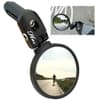
3. The mirror, because a shoulder check costs more at speed
This is the accessory people skip and then wish they had not. On a bicycle at 12 mph, glancing over your shoulder is cheap. At 20 mph, the half-second your eyes leave the road ahead is a half-second riding blind into whatever is in front of you — and many riders drift into the lane while they turn their head.
A mirror converts “is it clear behind me?” from a maneuver into a glance. Two things separate a good one from a frustrating one: lens material (stainless steel or break-proof polymer survives the bike falling over in a garage; glass does not) and mount stability (a bar-end mount sits inside the handlebar tube and stays where you put it, where a clamp mount can creep out of adjustment until you stop trusting it).
Mount it on your left in the US, where overtaking traffic comes from, and set the angle while sitting on the bike in your riding position, not standing next to it. The mirror roundup compares bar-end and clamp designs in full.
4. The saddle, because comfort decides whether you keep riding
Stock saddles on budget e-bikes are chosen on cost, and they are the single most common reason a new rider’s enthusiasm fades after a month. If the answer to “why did that ride end?” is “because I was uncomfortable,” nothing else on this page matters.
Which saddle depends on how you sit. An upright cruiser or step-through positionputs nearly all your weight straight down onto the seat, which wants a wide, well-padded saddle — often with spring or elastomer suspension underneath. A forward-leaning commuter position distributes weight between hands, feet and seat, and a wide soft saddle will actually chafe. Match the saddle to the bike, not to the assumption that softer is better.
Two cheap companions worth knowing about: ergonomic grips, which fix hand numbness for very little money, and a suspension seatpost, which does more for a rigid bike on bad pavement than any saddle can. Both are in our comfort upgrades roundup. If you ride longer distances, padded shorts do more than any saddle swap.
What you can put off
Everything else, honestly, and it is worth saying so on a page that could easily sell you ten more things.
- A rack and panniers— buy when you know what you want to carry, not before. Real, but not urgent unless the bike is replacing car trips. See racks and panniers.
- A phone mount— genuinely useful for navigation, and easy to defer if you know your routes. See phone mounts.
- A bottle and cage— a few dollars, and the thing to check first is not the bottle but whether your frame has anywhere to bolt a cage, because the battery usually occupies the downtube. Our water bottles and cages page covers the band clamps and handlebar holders that solve that.
- A repair stand— not an accessory for the bike so much as for you, and worth it the week the bike arrives if you are doing your own assembly. Most stands are rated for a 25 lb bicycle, so see the stands whose published limit clears an e-bike.
- A spare charger— worth it if you charge at both ends of a commute, pointless otherwise. Never buy one without confirming your pack’s voltage and connector first; the charger page explains what must match.
- A second battery— expensive, and usually the wrong answer to a range problem. Learn your real watt-hours per mile first with our range guide; most people discover they need charging habits, not more cells.
One thing that is not on the deferrable list: a helmet. It sits outside this ranking because it is not an accessory decision — it is the first thing you buy, before the bike arrives.