Volt & Velo

Best Bike Repair Stands for a Heavy E-Bike

Most work stands were designed around a 25 lb road bike. An e-bike weighs two to three times that. These are the stands whose published maximum weight actually clears one — and the honest problem with the biggest number on the page.

By Stephen V.Last updated How we pick

A repair stand is the accessory that changes how you own a bike. Hanging a bike at chest height turns a 40-minute job on the garage floor into a 10-minute one, and it is the difference between actually re-torquing a new e-bike in its first week and promising yourself you will. It is also the accessory most likely to be bought on the wrong spec, because the number that matters is buried and the number in the marketing is price.

Here is the whole problem in one sentence: a work stand is designed around the weight of the bike it holds, and the category was designed around bicycles. A road bike is 20 to 25 lb. A hybrid is 30. The e-bikes we recommend publish weights from 49.6 lb (the Jasion EB5) to 75 lb (the Heybike Mars 2.0). Put a 70 lb bike in a stand rated for 44 lb — and there are plenty of 44 lb stands sold with no warning — and you have not bought a workbench, you have bought something that will let go of your bike while you are leaning on a pedal.

So this page ranks on exactly one figure: the published maximum bike weight. Every capacity quoted below was read on October 10, 2026, from the source named on each card, and all four picks were confirmed in stock the same day. The provenance of those figures is itself a finding, and we say which is which rather than treating a number in a listing title as equivalent to a spec sheet. This is our method.

How this is funded:we earn a commission if you buy through our links, at no extra cost to you. It never changes which product we recommend, and we’ll tell you plainly when to skip one. Full disclosure.

Quick picks

Ranked on published specs, price and buyer fit. Select a row to jump to the full write-up. We have not ridden every one of these — here is exactly what we do instead.

#ProductBest forPrice
1
CXWXC 88 lb E-Bike Repair Stand

CXWXC 88 lb E-Bike Repair Stand

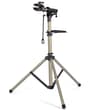
The default tripod stand for a value e-bike, and one of very few in the category that puts an e-bike weight in the product name instead of leaving you to guess. An 88 lb published capacity clears every bike in our registry with real margin, including the 75 lb Heybike Mars 2.0, at around a third of what the shop-grade stands cost.

Best overall for a value e-bike
$99.98 · View on Amazon

Price as of October 11, 2026. #ad How we’re funded

2
CHEPARK 88 lb Bench/Wall Mount Work Stand

CHEPARK 88 lb Bench/Wall Mount Work Stand

The cheapest honest way to hold a heavy e-bike, and structurally the most stable idea on this page: it bolts to a bench or a wall, so the tipping problem that comes with a tripod and a 70 lb bike simply does not exist. Same 88 lb published capacity as the tripod above for about a third of the money, as long as you have somewhere to bolt it.

Best on the tightest budget
$36.54 · View on Amazon

$38.696% off

Price as of October 11, 2026. #ad How we’re funded

3
VEVOR 110 lb Bike Repair Stand

VEVOR 110 lb Bike Repair Stand

The highest published capacity here, with a stated 110 lb limit, a 40.3 to 59.4 in height range and a tool tray, at a price below the 88 lb tripod. If you believe the number, it is the most stand for the money on this page - and the honest caveat is that it is a self-published figure in a listing rather than a tested one, on a stand with a two-leg base.

Highest published capacity
$95.90 · View on Amazon

Price as of October 11, 2026. #ad How we’re funded

4
Park Tool PCS-10.3 Deluxe Home Mechanic Repair Stand

Park Tool PCS-10.3 Deluxe Home Mechanic Repair Stand

The one stand here with a real published specification table rather than a number in a listing title, and the only one whose clamp range (22-76 mm) is stated - which is the figure that decides whether it will actually close on a fat e-bike tube. Its 80 lb capacity is LOWER than the budget claims above, and that is the most interesting fact on this page.

Best specified, buy-once pick
$279.95 · View on Amazon

Price as of October 11, 2026. #ad How we’re funded

The picks in full

#1Best overall for a value e-bike

CXWXC 88 lb E-Bike Repair Stand

The default tripod stand for a value e-bike, and one of very few in the category that puts an e-bike weight in the product name instead of leaving you to guess. An 88 lb published capacity clears every bike in our registry with real margin, including the 75 lb Heybike Mars 2.0, at around a third of what the shop-grade stands cost.

What you get

  • 88 lb published capacity - above the heaviest published bike weight we list (75 lb) with margin
  • Sold and named as an e-bike stand rather than a bicycle stand that might cope
  • Tripod base folds, so it does not live permanently in the middle of the garage
  • Costs roughly a third of the shop-grade alternative

Trade-offs

  • The clamp jaw diameter range is not published, which matters because e-bike tubes are fat
  • A heavy bike at chest height on a folding tripod is a tipping risk if you lean on it - load it low and keep the legs spread
  • No maker spec page we could read: the capacity figure comes from the listing, not from an engineering sheet
Key specTripod clamp work stand; 88 lb published maximum bike weight; folding base; clamp jaw range not published
Best forA 60-75 lb e-bike, on a tripod you can move

Specs read from the manufacturer or retailer listing, on October 10, 2026. “Not published” means the maker does not state that figure.

#2Best on the tightest budget

CHEPARK 88 lb Bench/Wall Mount Work Stand

The cheapest honest way to hold a heavy e-bike, and structurally the most stable idea on this page: it bolts to a bench or a wall, so the tipping problem that comes with a tripod and a 70 lb bike simply does not exist. Same 88 lb published capacity as the tripod above for about a third of the money, as long as you have somewhere to bolt it.

What you get

  • 88 lb published maximum bike weight at the lowest price on this page
  • Bench or wall mounted, so the load goes into the bench and the stand cannot tip
  • Takes up no floor space at all when nothing is clamped in it

Trade-offs

  • Needs a solid bench or stud wall - this is not an option for a renter with plaster and no workbench
  • Fixed location: the bike has to come to the stand, which is awkward with a 70 lb bike and a flight of stairs
  • No height adjustment of the kind a tripod gives you, and the clamp jaw range is not published
Key specBench or wall-mounted clamp work stand; 88 lb published maximum bike weight; no floor footprint; clamp jaw range not published
Best forThe tightest budget, and the most stable hold

Specs read from the manufacturer or retailer listing, on October 10, 2026. “Not published” means the maker does not state that figure.

#3Highest published capacity

VEVOR 110 lb Bike Repair Stand

The highest published capacity here, with a stated 110 lb limit, a 40.3 to 59.4 in height range and a tool tray, at a price below the 88 lb tripod. If you believe the number, it is the most stand for the money on this page - and the honest caveat is that it is a self-published figure in a listing rather than a tested one, on a stand with a two-leg base.

What you get

  • 110 lb published maximum - the only figure here that would clear a bike heavier than anything we recommend
  • Published height range of 40.3-59.4 in, so you can set it to standing work height
  • Includes a tool tray, which stops small parts going into the garage floor
  • Folds for storage and costs less than the 88 lb tripod

Trade-offs

  • A two-leg base with a front stabilizer is less inherently stable than a true tripod at the same load
  • The capacity is published in the listing only; we could not read a maker spec sheet for it
  • Clamp jaw diameter range not published - check your frame tube before you commit
  • A higher claimed number is not the same as a tested one, and the premium stand here publishes a LOWER limit
Key specTwo-leg clamp work stand with tool tray; 110 lb published maximum bike weight; 40.3-59.4 in height range; clamp jaw range not published
Best forThe biggest published number per dollar

Specs read from the manufacturer or retailer listing, on October 10, 2026. “Not published” means the maker does not state that figure.

#4Best specified, buy-once pick

Park Tool PCS-10.3 Deluxe Home Mechanic Repair Stand

The one stand here with a real published specification table rather than a number in a listing title, and the only one whose clamp range (22-76 mm) is stated - which is the figure that decides whether it will actually close on a fat e-bike tube. Its 80 lb capacity is LOWER than the budget claims above, and that is the most interesting fact on this page.

What you get

  • Published spec table: 80 lb (36 kg) maximum, 22-76 mm clamp, 39-57 in height, 36 x 36 in open footprint, 16 lb stand weight
  • The only clamp range published here, and 76 mm is wide enough for the fat tubes on a value e-bike
  • Park Tool states compatibility with fat bikes and most e-bikes, and sells spare parts for its stands years later
  • 80 lb still clears the heaviest published bike weight in our registry (75 lb)

Trade-offs

  • Costs roughly three times the 88 lb tripod and nearly eight times the bench mount
  • Its published 80 lb limit is below the 88 and 110 lb figures the budget stands claim - fine for every bike we recommend, not enough for a 93-110 lb trike
  • A 36 x 36 in open footprint is a lot of floor in a small garage
  • Overkill for anyone who will adjust a derailleur twice a year
Key specTripod clamp work stand; 80 lb (36 kg) published maximum; clamp accepts 22-76 mm round and aero tubes; 39-57 in height; 16 lb stand weight
Best forBuy once, and know what you bought

Specs read from the manufacturer or retailer listing, on October 10, 2026. “Not published” means the maker does not state that figure.

How we picked

One hard requirement and two filters. The requirement: a published maximum bike weight of at least 80 lb, which is the heaviest published bike weight in our registry (75 lb) plus a margin for the rack, bags, tools and the hand you will inevitably lean on the saddle. Stands rated at 44, 55 or 66 lb are not on this page, and there are a great many of them — the 44 lb and 55 lb versions of these same stands are sold alongside the ones above, often at nearly the same price, which is how people end up with the wrong one.

Then: it had to be currently purchasable, and the capacity had to be published somewhere we can point you at. That second filter sorts this page into two groups. Park Tool publishes a full specification table on its own site, including the clamp jaw range, the height range, the footprint and the weight of the stand itself. CXWXC, VEVOR and CHEPARK publish the capacity in the listing title and essentially nothing else. Both kinds of figure are real, published numbers — one is from a company that has sold shop tools for decades and will sell you a replacement clamp knob in 2032, and one is from a listing. We let you weigh that yourself, and we have not pretended there is a test behind either.

Weigh your bike first, and include everything

Before you buy any stand, find your bike’s weight. If the maker publishes it, start there — but read it carefully, because in this price bracket the published figure is often for the bike without the battery, and an e-bike battery is 7 to 12 lb on its own. Our e-bike weight guide covers how the figures are quoted and why the same bike can appear with two different numbers.

Then add what is actually on the bike when you work on it. A rear rack and a pair of loaded panniers can add 10 lb before you have started. A lock carried on the frame, a basket, a child seat, a bottle of water: all of it is on the stand. The arithmetic to do is bike plus accessories plus a generous allowance for leaning, not the bare frame weight from a spec sheet.

And one bike class is simply out of scope here. The adult electric trikes in our electric trike roundup weigh 93 to 110 lb and have three wheels and a welded rear basket; nothing on this page is both rated for that and shaped to hold it. A trike gets worked on with the wheels on the ground, or on a low platform, full stop.

The capacity numbers, and the thing nobody says out loud

Read the four published figures in order and the interesting thing becomes obvious. The $37 bench mount publishes 88 lb. The $100 tripod publishes 88 lb. The $96 two-leg stand publishes 110 lb. And the $280 Park Tool, the stand every bike shop in the country owns a version of, publishes 80 lb (36 kg)— the lowest number on the page.

There are two honest readings of that and we are not able to settle between them from published data. The first is that the budget stands are simply stronger for the money, which does happen; a steel clamp on a steel post is not complicated engineering. The second is that a figure printed on a spec sheet by a company with a warranty department and a reputation to lose is drawn more conservatively than a figure in a listing title. What we can say is which figure comes with a published test standard behind it: none of them. Nobody in this category cites a standard the way a helmet cites CPSC 16 CFR 1203 or a battery cites UL 2271.

The practical conclusion: all four of these clear every e-bike we recommend, so capacity is not the thing to agonize over once you are above 80 lb. Pick on the things that differ — where the stand lives, whether the clamp fits your frame, and how stable it is under load.

Clamp range is the spec that will actually catch you out

A clamp has a jaw range, and e-bike frame tubes are fat. Park Tool publishes its range: 22 to 76 mm, round or aero. That upper figure is the reason the PCS-10.3 is on this page at all — 76 mm is three inches, which will close on the oversized downtube of a value e-bike. The other three stands do not publish a jaw range anywhere we could read. That is a genuine gap, and the cheap fix is to measure the tube you intend to clamp before you order.

Which tube should that be? In order of preference: the seatpost first, every time, because it is round, strong, cheap to replace and has nothing inside it. Then the seat tube. Then a frame tube with nothing routed through it. Never clamp the battery housing, never clamp over a cable or a brake hose, and never clamp a tube with a sticker warning you not to.

Two e-bike-specific catches. Step-through frames, which is most of the value bracket, often leave very little seatpost exposed when the saddle is set low — you may have to raise the saddle to get enough post to clamp, and then remember to set it back. And a lot of these bikes have a suspension seatpost fitted or available (ours is in the comfort upgrades roundup); clamping a suspension post by its moving section is a good way to damage it, so clamp the fixed lower section or the frame instead.

Tripod, two legs, or bolted to the bench

This is the choice that actually decides which of these you should buy, and capacity has nothing to do with it.

A tripod— the CXWXC and the Park Tool — is the classic answer: three legs, folds, goes wherever you need it, and holds the bike away from everything. The weakness is physics. A 70 lb bike clamped at chest height on a folding tripod has a high center of mass, and the moment you lean sideways on a pedal to break a bolt loose, you are testing the base rather than the clamp. Spread the legs fully, clamp as low as the job allows, and push the bike toward the mast rather than away from it.

A two-leg stand with a front stabilizer— the VEVOR — is a compromise that trades some of that base area for a smaller folded package. It publishes the highest capacity here; it is also the design we would be most careful with at the top of its range.

A bench or wall mount— the CHEPARK — removes the problem entirely. There is no base to tip because the load goes into the bench or the studs. It is the cheapest pick on this page by a long way and structurally the best idea on it, and it costs you mobility: the bike has to come to the stand, and a 70 lb bike does not come downstairs easily. If your bike already lives in a garage with a workbench, this is the one to buy, and it pairs naturally with the wall storage in our storage rack roundup.

What you will actually use it for

Three jobs, in the order they arrive. First, assembly. A boxed e-bike arrives 85 to 90% assembled and needs its handlebar, pedals, front wheel and saddle fitted and — the part everyone skips — every fastener checked. Doing that with the bike hanging is a different experience than doing it upside down on cardboard. Our assembly guide walks through it, and the torque figures it asks for want the tools in our tool kit roundup.

Second, the first-week re-torque and the monthly check. Bolts settle. On a bike that weighs 70 lb and makes its own power, a loose stem or a loose rear axle is not a minor issue, and our maintenance checklist is built around a stand being available.

Third, drivetrain and brake work, which is the job a stand genuinely makes possible rather than merely easier: shifting adjustment needs the cranks turning with the rear wheel off the ground, and bleeding or aligning disc brakes needs the bike still and at eye level. Our brakes guide explains which of those is a home job and which is not.

What we would skip

Any stand whose published capacity you cannot find. If a listing does not state a maximum bike weight, assume it was designed for a bicycle and move on. That rules out a large share of the $25-$45 shelf.

Rear-axle and wheel-on “parking” stands, for this purpose. They are useful for cleaning a chain and for storage, but they do not lift the bike, and on a heavy bike the rear-axle types put all the load into one dropout.

Clamping anywhere near the battery.A pack is a sealed assembly with cells and a BMS inside and a case that is not structural. Any clamping force on it is a bad idea, and the CPSC’s micromobility guidance is clear that physical damage to a pack is one of the routes to a thermal event. If the only clampable tube on your frame is the battery housing, buy the bench mount and clamp the seatpost, or do the job with the wheels down.

What we would actually buy

For most people with a garage or a shed: the CXWXC 88 lb. It clears every bike we recommend with margin, it folds out of the way, it is sold as an e-bike stand rather than a bicycle stand that might cope, and it costs about a third of the Park Tool. Measure your clamping tube first, because the jaw range is not published.

If you have a workbench and a tight budget: the CHEPARK bench mount. Same 88 lb published figure, no tipping risk at all, no floor space, and the lowest price here by a wide margin. The condition is a solid bench or a stud wall and accepting that the stand does not travel.

If you want the highest number: the VEVOR 110 lb, with the caveat we have stated plainly — the figure is self-published and the base is two legs rather than three. We would use it well inside its rating.

If you would rather buy once: the Park Tool PCS-10.3. You are paying for the only published specification table on this page, a clamp range that is actually stated, spare parts that will exist in a decade, and a stand that will outlast the bike you bought it for. Its 80 lb limit is the lowest here and still clears every bike in our registry. That is the whole case, and for some people it is enough.

Whichever you choose, one piece of advice costs nothing: set it up once with the bike at a sensible height, load it gently the first time, and see how it feels before you put real force through a bolt. A stand that moves under a light push is telling you something. And if the thing you were actually trying to solve is where the bike lives rather than how you work on it, the storage rack page is the one you want.
Frequently asked questions

What is the best bike repair stand for an e-bike?

For a 60 to 75 lb value e-bike, the CXWXC 88 lb stand: its published maximum bike weight clears every bike we recommend with margin, it is sold specifically as an e-bike stand, and it costs around a third of the shop-grade alternative. If you have a workbench, the CHEPARK bench mount publishes the same 88 lb figure for about a third of that price and cannot tip over, because the load goes into the bench instead of a tripod base.

How much weight can a bike repair stand hold?

It varies enormously, and the figure is the thing to check before you buy. Common bicycle stands are rated at 44, 55 or 66 lb — all of which are below the weight of most e-bikes. The four stands on this page publish 80 lb (Park Tool PCS-10.3), 88 lb (CXWXC tripod and CHEPARK bench mount) and 110 lb (VEVOR). Note that none of these capacities cites a published test standard, so treat them as maker figures rather than certified ones and work well inside them.

Where should I clamp an e-bike in a repair stand?

The seatpost first, every time: it is round, strong, cheap to replace and has nothing inside it. Then the seat tube, then a frame tube with no cables or hoses routed through it. Never clamp the battery housing, never clamp over a cable or brake hose, and do not clamp the moving section of a suspension seatpost. On a step-through frame you may need to raise the saddle to expose enough post to clamp.

Will a bike repair stand hold an electric trike?

No. Adult electric trikes weigh roughly 93 to 110 lb and have three wheels and a welded rear basket, so they are both heavier than most stands are rated for and the wrong shape for a clamp stand. Work on a trike with the wheels on the ground, or raise just the end you need on blocks or a low platform.

Why does the expensive Park Tool stand have a lower weight limit than a cheap one?

It is the most interesting fact on this page and we cannot settle it from published data. Park Tool publishes 80 lb for the PCS-10.3 on its own specification table; two budget stands claim 88 lb and one claims 110 lb in their listing titles. Either the budget stands really are stronger, or a figure published by a company with a warranty department is drawn more conservatively than a figure in a listing. Neither kind of number cites an independent test standard. All four clear every e-bike we recommend, so choose on stability, clamp range and where the stand will live.

Do I need a repair stand, or will a stack of boxes do?

You do not strictly need one for a tire or a chain clean. You effectively do need one for shifting adjustment and brake work, because both require the wheel off the ground and the bike held still at a usable height, and improvising that with a 70 lb bike is where things get dropped. If you only plan to inflate tires and wipe the chain, spend the money on a pump and a tool kit instead.

Is a bench-mounted stand better than a tripod?

Structurally, yes — a bench or wall mount cannot tip, because the load goes into the bench or the studs rather than into three folding legs with a heavy bike held above them. What you give up is mobility and height adjustment: the bike has to come to the stand, which is no small thing when the bike weighs 70 lb. Buy the bench mount if the bike lives where the bench is, and the tripod if it does not.

Sources

  • Park Tool PCS-10.3 Deluxe Home Mechanic Repair Stand (maker product page) — Maker specification: maximum weight capacity 36 kg (80 lb); clamp accepts round and aero tubes from 22 to 76 mm (7/8 in to 3 in); height adjustment 99 cm to 145 cm (39 in to 57 in); open footprint 92 x 92 x 121 cm (36 x 36 x 48 in); stand weight 7.2 kg (16 lb). Park Tool describes the stand as "compatible with virtually all two-wheeled pedal-driven bicycles, including fat bikes and most e-bikes" and publishes no separate e-bike figure (accessed October 10, 2026)
  • U.S. CPSC — Micromobility Information Center (e-bike battery safety) — CPSC guidance on lithium-ion battery safety and buying e-bikes/batteries certified to UL 2849 / UL 2271 / UL 2272 (accessed July 22, 2026)

Keep reading