Volt & Velo

Best Cycling Water Bottles and Cages

Choosing the bottle is the easy half. On a value e-bike the battery usually sits exactly where the cage bolts should be, so this page ranks the mounts too — on the one number almost nobody publishes.

By Stephen V.Last updated How we pick

A water bottle is a $7 to $16 purchase, which is why almost nobody researches it and why a surprising number of people end up with one they do not use. The failure is rarely the bottle. It is that the bottle does not fit the cage, or the cage does not fit the frame, or — on an e-bike specifically — the frame has nowhere to put a cage at all, because the battery lives in the downtube where the two threaded bosses would otherwise be.

So this page is three decisions, not one: which bottle (capacity against insulation, and whether you can squeeze it), which cage (bottle diameter is the spec that decides whether your bottle drops in or fights you), and which mount— the part that only matters on a bike like the ones this site covers, and the part with the one genuinely safety-relevant number in the category: a published maximum load.

Every figure below was read on October 10, 2026, from the source named on each product card: Minoura’s own spec page, CamelBak’s published specification, and for the Topeak, Zefal and ROCKBROS parts the live Amazon listing, where the deciding number — bottle diameter — is printed. We have not drunk from all of these. What we have done is check that the numbers agree with each other, which is where this category actually goes wrong. Here is our method.

How this is funded:we earn a commission if you buy through our links, at no extra cost to you. It never changes which product we recommend, and we’ll tell you plainly when to skip one. Full disclosure.

Quick picks

Ranked on published specs, price and buyer fit. Select a row to jump to the full write-up. We have not ridden every one of these — here is exactly what we do instead.

#ProductBest forPrice
1
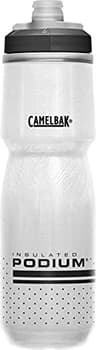
CamelBak Podium Chill 24 oz Bottle

CamelBak Podium Chill 24 oz Bottle

The bottle the rest of the category is measured against, and the only one here that answers the two problems a 20 mph bike creates: a self-sealing valve that does not dribble when the bottle is rattling in a cage over bad pavement, and double-wall insulation that keeps the water drinkable for a commute rather than a lap. You pay roughly double a plain bottle for it, and you give up volume to the insulating wall.

Best overall bottle
$15.99 · View on Amazon

$20.0020% off

Price as of October 11, 2026. #ad How we’re funded

2
Zefal Magnum 975 ml Bottle

Zefal Magnum 975 ml Bottle

Nearly a liter of water for pocket change, and the right answer for anyone whose ride is long enough that a 24 oz bottle runs dry. It is a plain soft-plastic bottle with no insulation and no clever valve, which is exactly why it costs what it does - and it is a big bottle, so the cage and the frame clearance are the things to check before you buy.

Most water per dollar
$6.24 · View on Amazon

Price as of October 11, 2026. #ad How we’re funded

3
Topeak Modula Cage II

Topeak Modula Cage II

The cage to buy when you do not yet know which bottle you will settle on. It adjusts across a published 63 to 74 mm bottle diameter, which covers a slim 550 ml bottle, the 33 oz Magnum on this page and a store-bought bottle of water on the way home. A fixed cage does one width; this one does the whole range for about the same money.

Best cage: fits every bottle
$10.78 · View on Amazon

$14.9528% off

Price as of October 11, 2026. #ad How we’re funded

4
Minoura BH-100EBW Wide Band Cage Holder

Minoura BH-100EBW Wide Band Cage Holder

The fix for the most common hydration problem on a value e-bike: a battery where the bottle bosses should be. This is a stainless band that wraps a fat frame tube, a fork leg or a seat tube and gives you a pair of real cage bosses wherever it lands. Minoura is also one of the only makers in this corner of the market that publishes a maximum load, which is the number that decides whether your bottle choice is safe.

Best fix for a frame with no bosses
$19.65 · View on Amazon

Price as of October 11, 2026. #ad How we’re funded

5
ROCKBROS Handlebar Water Bottle Holder

ROCKBROS Handlebar Water Bottle Holder

A cage that clamps to the handlebar instead of the frame, and the easiest pick here to drink from without looking down. Its published 3.5 in bottle-diameter limit is the widest on this page, so it takes the big-mouth bottles and tumblers no frame cage will hold. It also puts weight where it affects steering, which is a real trade rather than a small one.

Best handlebar mount
$15.99 · View on Amazon

$16.996% off

Price as of October 11, 2026. #ad How we’re funded

The picks in full

#1Best overall bottle

CamelBak Podium Chill 24 oz Bottle

The bottle the rest of the category is measured against, and the only one here that answers the two problems a 20 mph bike creates: a self-sealing valve that does not dribble when the bottle is rattling in a cage over bad pavement, and double-wall insulation that keeps the water drinkable for a commute rather than a lap. You pay roughly double a plain bottle for it, and you give up volume to the insulating wall.

What you get

  • Self-sealing silicone Jet Valve - squeeze to drink, and it shuts on its own instead of weeping down the downtube
  • Double-walled construction that CamelBak states keeps liquid cold twice as long as a standard bottle
  • BPA-free polypropylene and still squeezable, which no vacuum-insulated steel bottle is
  • 122 g empty, so the mount it sits in is never the limiting factor

Trade-offs

  • 24 oz in a bottle the external size of a bigger one - the insulation costs you volume
  • Costs more than twice the cheapest bottle here for less water
  • The valve needs taking apart to clean properly, and it will hold a smell if you put sports drink in it and forget it
Key spec24 oz / 0.71 L; double-wall insulated; self-sealing medical-grade silicone Jet Valve; BPA-free TruTaste polypropylene; 122 g empty
Best forThe one bottle to buy if you are only buying one

Specs read from the manufacturer or retailer listing, on October 10, 2026. “Not published” means the maker does not state that figure.

#2Most water per dollar

Zefal Magnum 975 ml Bottle

Nearly a liter of water for pocket change, and the right answer for anyone whose ride is long enough that a 24 oz bottle runs dry. It is a plain soft-plastic bottle with no insulation and no clever valve, which is exactly why it costs what it does - and it is a big bottle, so the cage and the frame clearance are the things to check before you buy.

What you get

  • 975 ml / 33 oz - about 40% more water than a standard 24 oz bottle
  • Cheapest pick on this page by a wide margin
  • Soft cap and nozzle, BPA-free odorless polypropylene, and squeezes easily with one hand
  • Zefal states it fits most bottle cages, and the listing names France as where it is made

Trade-offs

  • No insulation at all - on a hot day this is warm water within the hour
  • A tall, large-diameter bottle: check your cage range and your frame clearance, especially on a small or full-suspension frame
  • Full, it weighs roughly 1.1 kg, which is past what some clamp-on bottle mounts are rated to carry
Key spec975 ml / 33 oz; soft cap and nozzle; BPA-free odorless polypropylene; no insulation; stated to fit most bottle cages
Best forMost water per dollar on a long ride

Specs read from the manufacturer or retailer listing, on October 10, 2026. “Not published” means the maker does not state that figure.

#3Best cage: fits every bottle

Topeak Modula Cage II

The cage to buy when you do not yet know which bottle you will settle on. It adjusts across a published 63 to 74 mm bottle diameter, which covers a slim 550 ml bottle, the 33 oz Magnum on this page and a store-bought bottle of water on the way home. A fixed cage does one width; this one does the whole range for about the same money.

What you get

  • Published to fit bottles 63-74 mm in diameter, adjusted by pushing a button and sliding
  • Takes a supermarket water bottle, which matters more on a commute than on a club ride
  • Cheap enough to fit two, and it does not care which bottle you buy later

Trade-offs

  • Still needs two standard bottle-cage bosses - if your frame has none, the cage is not the problem, the mount is
  • The adjustment mechanism is one more plastic part than a bent-wire cage has
  • Not a cage for off-road hammering: an adjustable clamp is never as rigid as a fixed one
Key specAdjustable bottle cage; published fit 63-74 mm bottle diameter; button-and-slide adjustment; requires standard bottle-cage bosses
Best forOne cage that fits every bottle you own

Specs read from the manufacturer or retailer listing, on October 10, 2026. “Not published” means the maker does not state that figure.

#4Best fix for a frame with no bosses

Minoura BH-100EBW Wide Band Cage Holder

The fix for the most common hydration problem on a value e-bike: a battery where the bottle bosses should be. This is a stainless band that wraps a fat frame tube, a fork leg or a seat tube and gives you a pair of real cage bosses wherever it lands. Minoura is also one of the only makers in this corner of the market that publishes a maximum load, which is the number that decides whether your bottle choice is safe.

What you get

  • Stainless band fits tubes 22-34 mm in diameter - the wide version exists because e-bike tubes are fat
  • Publishes a maximum load (1.8 kg, about 4 lb), which almost no clamp-on mount does
  • Bracket angle adjusts in six-degree steps, so the cage can sit vertical on a sloping tube
  • Minoura lists the chain stay, stem, frame, fork, cranks and seat tube as mounting locations, so the bottle can go where the battery is not

Trade-offs

  • 1.8 kg is the ceiling: a full 33 oz bottle is about 1.1 kg, and a liter-plus insulated steel bottle is out of the question
  • Costs more than the cage you will bolt to it, and you still need the cage
  • A band clamp on a painted tube can mark it - tape under the band is worth the two minutes
  • 71 g of stainless and alloy added to a bike that is already heavy
Key specStainless band bottle-cage mount; fits 22-34 mm tube diameters; maximum load 1.8 kg (about 4 lb); 71 g; six-degree bracket adjustment
Best forA frame with no bottle-cage bosses at all

Specs read from the manufacturer or retailer listing, on October 10, 2026. “Not published” means the maker does not state that figure.

#5Best handlebar mount

ROCKBROS Handlebar Water Bottle Holder

A cage that clamps to the handlebar instead of the frame, and the easiest pick here to drink from without looking down. Its published 3.5 in bottle-diameter limit is the widest on this page, so it takes the big-mouth bottles and tumblers no frame cage will hold. It also puts weight where it affects steering, which is a real trade rather than a small one.

What you get

  • Fits bottles up to 3.5 in (about 89 mm) in diameter - wider than any frame cage here
  • Clamps to the handlebar, so a frame with no bosses and no clearance is not a problem
  • The quickest pick to reach, because the bottle is already at hand height

Trade-offs

  • Weight on the bar changes how the steering feels, and a full wide bottle is the worst case for that
  • Handlebar space is contested - a phone mount, a light, a bell and a display are already fighting for it
  • ROCKBROS publishes a bottle-diameter limit but no maximum load, so a heavy insulated bottle is untested weight
  • An open cup or tumbler in a bike cage is a spill waiting for the first pothole, whatever the listing photo shows
Key specHandlebar-mounted bottle cage; published fit for bottles up to 3.5 in (about 89 mm) diameter; no maximum load published
Best forReaching a drink in traffic, and for very wide bottles

Specs read from the manufacturer or retailer listing, on October 10, 2026. “Not published” means the maker does not state that figure.

How we picked

Three filters, applied in this order. First, the product had to be currently purchasable — every pick above was returned in stock by a live listing check on the date at the top of this page, and nothing here is a fondly-remembered discontinued model. Second, the maker or the listing had to publish the figure the category is decided on: capacity and valve type for a bottle, bottle-diameter range for a cage, tube diameter and maximum load for a mount. Third, it had to make sense on a heavy bike with a battery in the frame, which quietly eliminates a lot of the road-cycling default answers.

What we deliberately did not rank on: brand, color range, or how a bottle photographs. A bottle is a container. The interesting engineering is all in the valve and the cage interface, and both of those are published numbers rather than opinions.

The e-bike problem: your bottle bosses are under the battery

On a conventional bicycle, two threaded bosses sit on the seat tube and often a second pair on the downtube. A cage bolts straight on. On most of the value e-bikes this site covers, the downtube is occupied by a removable battery pack, the seat tube is short because the frame is a step-through, and what is left is either one awkward pair of bosses or none at all.

That is why half this page is mounts. There are three honest answers to a frame with nowhere to bolt a cage. A band clampthat wraps a tube and gives you real bosses wherever it lands — the Minoura above, and the only pick here that publishes a load limit. A handlebar cage, which puts the bottle in the easiest place to reach and the worst place for handling. Or a bag with a bottle pocket, which is a different purchase than this page covers; if that is the direction you are going, the top-tube and handlebar bags in our phone mount and bag roundup overlap it, and a pannier from our racks and panniers page will swallow a two-liter bottle without touching the frame at all.

Before you buy anything, do one measurement. Put a tape around the tube you are thinking of clamping and note the diameter, not the circumference. The Minoura band fits 22–34 mm. A lot of e-bike downtubes are fatter than 34 mm, which is the whole reason the “wide” version of that band exists — and if yours is fatter still, the seat tube, the fork leg or the handlebar is where your bottle is going.

Capacity: how much water a 20 mph bike actually needs

The standard bottle is 24 oz, which is about 0.7 liters. The big bottle here is 975 ml, which is 33 oz. In practical terms: one standard bottle is a commute each way, and the big one is a Saturday ride or a hot commute where you drink more than you planned to.

An e-bike changes the calculation in both directions at once, which is worth understanding before you buy the biggest bottle on principle. You work less for the same distance, so you need less water per mile. But you travel further, you are out in the air longer at higher speed, and you are more likely to keep going when a pedal-bike rider would have turned back — that is the whole point of the assist. Our range guidemakes a similar point about watt-hours: the bike’s capability is what extends the ride, and everything you carry has to extend with it.

One number that is easy to forget: water weighs about a kilogram per liter. A full 33 oz bottle plus the bottle itself is roughly 1.1 kg. That is fine in a frame cage bolted to threaded bosses. It is right at the published 1.8 kg ceiling of the Minoura band, and it is a genuine unknown on a handlebar mount that publishes no load figure at all. The bottle you choose and the mount you choose are the same decision.

Insulation is a trade, not an upgrade

An insulated bottle has two walls with a gap, and CamelBak states the Podium Chill keeps liquid cold twice as long as a standard bottle. The cost of that is volume: a 24 oz insulated bottle is the external size of a larger plain one, because the insulating wall has to go somewhere. You are paying roughly twice the money for less water that stays cold longer.

Whether that is a good trade depends entirely on your ride. For a 25-minute commute, an insulated bottle is a luxury — water does not have time to get warm. For an hour on an exposed bike path in August, with a black bottle on a black frame in direct sun, it is the difference between drinking and carrying. If you ride all year, see our winter riding guide for the reverse version of this problem: an uninsulated bottle in freezing weather turns into a block with a nozzle, and insulation helps there too.

What an insulated cycling bottle is not, is a vacuum flask. A stainless vacuum bottle keeps drinks cold far longer than either bottle here, and it is the wrong tool on a bike: it does not squeeze, so you have to unscrew a lid one-handed at 20 mph; it is heavy enough to matter to a clamp-on mount; and it will not fit most frame cages. If that is the bottle you want to carry, carry it in a bag.

Bottle diameter is the spec that ruins bottle purchases

This is the part almost nobody checks. A cage is built around a bottle diameter, and bottles are not a standard width. The Topeak Modula Cage II above publishes a 63–74 mm range, adjusted by pushing a button and sliding the band. That range is the reason it is on this page: it covers a slim 550 ml bottle at one end and a big 33 oz bottle at the other, and it will also take the bottle of water you bought at a gas station, which a fixed road cage absolutely will not.

Go wider than that and you are into handlebar-mount territory. The ROCKBROS holder publishes a limit of 3.5 in — about 89 mm — which is wide enough for the big-mouth bottles and travel tumblers that no frame cage will take. That width is its whole reason for existing, and the trade-off is that the weight sits on the steering.

The practical rule: buy the cage for the bottle you already own, or buy an adjustable cage and stop thinking about it. The one thing not to do is assume. A cage that is slightly too wide rattles and eventually spits the bottle out on a pothole; a cage that is slightly too narrow needs two hands to reload, which means you will not reload it while moving.

Maximum load: the number that separates a mount from a gadget

Of every product on this page, exactly one publishes a maximum load: Minoura states 1.8 kg for the BH-100EBW. That is not a criticism of Minoura, it is the finding. A clamp-on bottle mount is a cantilevered bracket on a painted tube, carrying a mass that is going to be shaken at road frequency for a thousand miles, and almost nobody in the category tells you what it is rated to hold.

Here is the arithmetic that makes 1.8 kg meaningful rather than abstract. A full 24 oz bottle is about 0.83 kg. A full 33 oz bottle is about 1.1 kg. A one-liter stainless vacuum bottle, full, is comfortably over 1.5 kg before you add the cage. So the Minoura covers both bottles on this page with margin, and rules out the steel flask — which is exactly the kind of question a published figure lets you answer in ten seconds and an unpublished one leaves you guessing about.

Where no load figure is published, treat the mount as untested rather than unlimited, and keep the bottle light. This is the same reasoning we apply to the published load ratings on our storage rack picks and the published payload figures in our heavy-rider roundup: a number with a maker’s name attached is worth something, and a confident silence is worth nothing.

The valve, and why a cheap bottle leaks on an e-bike first

A bike bottle is drunk from by squeezing, and the cap has to let water out fast while you are moving and then not let it out at all while you are not. There are two designs. A pull-up nozzle— the Zefal above — is open when it is up and closed when it is pushed down, and it costs almost nothing. A self-sealing valve— the CamelBak’s silicone Jet Valve — stays shut under its own tension and opens only when you squeeze, so it does not matter whether you remembered to close it.

The reason this matters more on an e-bike than on a road bike is vibration and speed. You are doing 20 mph on whatever surface the bike lane is made of, on a heavy bike, often with no suspension to speak of, with the bottle sitting in a cage near the bottom bracket — the busiest, dirtiest part of the frame. A nozzle you forgot to shut will weep onto your drivetrain for the whole ride. A self-sealing valve will not. That is most of what the extra money buys, and it is also the part that needs taking apart and washing occasionally, because a silicone valve with a fortnight of sports drink in it is a genuinely unpleasant object.

Cleaning, and the one thing that will actually ruin your bottle

Plain water and a rinse after every ride is enough for a bottle that only ever has water in it. The moment you put anything sugary in — sports mix, juice, electrolyte tablets — the bottle needs washing that day, with the cap taken apart, or it will grow something and keep the taste permanently. Polypropylene holds flavors; this is not a quality problem, it is what the material does.

Two other habits worth having. Do not leave a bottle in a hot car or in the sun on a parked bike for days — heat plus residue is the fast route to a bottle you throw away. And do not store a bottle with the cap sealed while it is damp. Both of these are cheaper lessons than a new bottle, and they apply to the $6 bottle and the $16 bottle identically.

What we would actually buy

If you are buying one bottle: the CamelBak Podium Chill. The self-sealing valve is the feature that justifies the price on a bike that spends its life at 20 mph over bad pavement, and the insulation is a real benefit on any ride over about half an hour in warm weather. You lose volume to the insulating wall and you pay more than double the cheapest option here. Those are the right trades for most riders.

If your ride is long or your budget is firm: the Zefal Magnum. Nearly a liter of water for the price of a coffee is hard to argue with, and a plain nozzle is one less thing to break. Accept that it is warm water on a hot day, check your cage range before you order, and remember that full it is about 1.1 kg — which is a frame-cage bottle, not a handlebar bottle.

Then buy the mount you actually need.If your frame has bosses, the Topeak Modula Cage II and nothing else — it fits every bottle on this page plus a supermarket one, and it costs about the same as a fixed cage. If your frame has no bosses, the Minoura band, because it is the only mount here that tells you what it can carry. If you want the bottle at hand height or your bottle is simply too fat for a frame cage, the ROCKBROS handlebar holder, knowing the weight is now part of your steering.

One last honest note about where to buy. These are small, cheap items where shipping and multi-buy pricing move the total more than the sticker does, and a bike shop will often match an online price on a $10 cage while also telling you whether it fits the frame in front of them. We earn a commission if you use the links on this page, and we would still rather you bought the right cage locally than the wrong one through us. If you are kitting out a new bike from scratch, our what to buy firstpage puts this purchase in its proper place in the queue — which is after a lock and lights, and before almost everything else.
Frequently asked questions

What is the best cycling water bottle?

For most riders, the CamelBak Podium Chill 24 oz: it has a self-sealing silicone valve that does not weep onto your frame when you forget to close it, and double-wall insulation that CamelBak states keeps liquid cold twice as long as a standard bottle. If you want the most water for the least money instead, the 975 ml Zefal Magnum holds about 40% more and costs a fraction as much, with no insulation and a simple pull-up nozzle.

How do I put a water bottle on an electric bike with no bottle cage mounts?

Three options. A band clamp like the Minoura BH-100EBW wraps a frame tube between 22 and 34 mm in diameter and gives you a pair of standard cage bosses wherever you put it — it is also the only mount on this page that publishes a maximum load (1.8 kg). A handlebar holder clamps to the bar instead of the frame and takes much wider bottles, at the cost of putting weight on the steering. Or skip the cage entirely and carry the bottle in a pannier or a handlebar bag. Measure the tube diameter before you order anything.

Will a 33 oz bottle fit a normal bottle cage?

Not reliably. Cages are built around a bottle diameter, and a 975 ml bottle is wider and taller than the 24 oz standard most fixed cages are designed for. An adjustable cage is the safe answer: the Topeak Modula Cage II publishes a 63 to 74 mm bottle-diameter range, which covers both sizes on this page. Also check frame clearance — on a small or full-suspension frame a tall bottle can foul the top tube or the shock.

Is an insulated bike bottle worth it?

On rides over about half an hour in warm weather, yes. Below that, water does not have time to get warm and you are paying for nothing. The trade is volume and money: an insulated 24 oz bottle is the external size of a larger plain bottle, because the second wall takes up space, and it typically costs twice as much. Note too that an insulated cycling bottle is not a vacuum flask — it still squeezes, which is the point.

How much weight can a clamp-on bottle cage mount hold?

Only one maker on this page publishes a figure: Minoura rates the BH-100EBW at a 1.8 kg maximum load. For context, a full 24 oz bottle is about 0.83 kg and a full 33 oz bottle about 1.1 kg, so both fit with margin, while a full one-liter stainless vacuum bottle does not. Where no load figure is published, treat the mount as untested rather than unlimited and keep the bottle light.

Can I put a coffee cup or a tumbler on my e-bike?

You can mount one — the ROCKBROS handlebar holder publishes a 3.5 in diameter limit, which takes most tumblers — but an open or loosely-lidded container in a bike cage will spill at the first pothole, and hot liquid on a moving bike is a bad idea at any speed. If you want coffee at the other end, a sealed screw-lid flask in a pannier is the honest answer.

How often should I clean a bike water bottle?

Rinse after every ride if it only ever holds water. If you put anything sugary in it — sports mix, juice, electrolyte tablets — wash it the same day with the cap taken apart, because polypropylene holds flavors and a residue left overnight becomes permanent. Do not leave a bottle in a hot car or sealed while damp.

Sources

  • CamelBak Podium Chill 24 oz Bike Bottle (published specification) — Published specification for the Podium Chill 24 oz: capacity 0.71 L / 24 oz; "double-walled construction to maintain refreshing temperatures twice as long as standard bottles"; high-flow self-sealing cap with a medical-grade self-sealing silicone Jet Valve; BPA-free TruTaste polypropylene; 4 oz / 122 g empty; "Optimized Cage Fit". CamelBak's own product page renders its specification table in JavaScript and returned no readable specs on the access date, so the figures were read from this retailer listing of the same model (accessed October 10, 2026)
  • Minoura BH-100EBW Wide Band bottle-cage holder (maker product page) — Maker specification: stainless band fits 22-34 mm tube diameters (stated as working only within 22-35 mm diameter / 70-110 mm circumference); MAX LOAD 1.8 kg; net weight 71 g; stainless, diecast and plastic construction; bracket angle adjustable in six-degree increments; named mounting locations include the chain stay, stem, frame, fork, cranks and seat tube (accessed October 10, 2026)
  • Topeak Modula Cage II (Amazon listing, read via the Amazon Creators API) — The deciding figure for this cage is published in the listing itself: "Topeak Modula Cage II Adjustable Bike Water Bottle Cage, Fits 63-74 mm". Returned In Stock by a live Creators API getItems call on the access date. Retailer spec tables for the same cage quote a slightly wider 60-74 mm range, so the narrower published figure is the one used on the page (accessed October 10, 2026)

Keep reading