Volt & Velo

Commuting to Work by E-Bike: What It Actually Takes

Route, range, sweat, clothes, charging at the office, weather and the lock that goes with you. A working commuter's checklist, in the order the problems show up, with the four cheap items that solve most of them.

By Stephen V.Last updated How we pick

Most people who buy an e-bike to commute have already decided the bike. What they have not decided is everything around it: whether the battery makes the round trip, what happens to a shirt in July, where the bike lives for nine hours, and what to do when it rains on Tuesday. Those are the things that decide whether the bike is still being ridden in March, and none of them is on a spec sheet.

What to sort out, in the order it comes up. The round trip in watt-hours, because a commute is two rides and the second one is uphill and into the wind more often than seems fair. Arriving presentable, which is the whole reason a motor beats a bicycle for this job. Carrying things, which on an e-bike should never be on your back. Charging at work, and the policy conversation that goes with it. Weather, which is a fenders problem before it is a jacket problem. And the lock, which is a bigger decision than the bike rack it goes on. The four products after this section are the cheap ones that fix most of it: a lock, a pannier, a light set and fenders. The bike itself is a separate decision, and our commuter e-bikes roundup makes it.

How this is funded:we earn a commission if you buy through our links, at no extra cost to you. It never changes which product we recommend, and we’ll tell you plainly when to skip one. Full disclosure.

Quick picks

Ranked on published specs, price and buyer fit. Select a row to jump to the full write-up. We have not ridden every one of these — here is exactly what we do instead.

#ProductBest forPrice
1
Kryptonite Evolution Mini-7 U-Lock

Kryptonite Evolution Mini-7 U-Lock

The sweet-spot e-bike lock: a 13 mm hardened-steel shackle, a double-deadbolt design and a Sold Secure Gold rating, at a weight you'll actually carry. It even ships with a flex cable for your front wheel. For most value e-bikes, this is the one to buy.

The lock that goes with you
$93.09 · View on Amazon

$109.9515% off

Price as of September 17, 2026. #ad How we’re funded

2
ROCKBROS 15L Rear Rack Pannier Trunk Bag

ROCKBROS 15L Rear Rack Pannier Trunk Bag

Fifteen liters and an included rain cover is the honest sweet spot for commuting: enough for a change of clothes and a laptop sleeve, not so much that the bike handles like a shopping cart. The rain cover matters more than the liters — most cheap bags omit it.

Get the bag off your back
$41.99 · View on Amazon

Price as of September 17, 2026. #ad How we’re funded

3
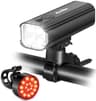
Ascher 1000-Lumen USB Light Set

Ascher 1000-Lumen USB Light Set

The value front-and-rear set: the current model pairs a 1000-lumen headlight with a big 6000 mAh battery and a rear light, for a fraction of what the name-brand pairs cost. Not as refined as a Cygolite, but for being seen on a budget it's the obvious pick.

Front and rear, every ride
$18.99 · View on Amazon

Price as of September 17, 2026. #ad How we’re funded

4
ROCKBROS Adjustable Bike Fender Set

ROCKBROS Adjustable Bike Fender Set

The pragmatic pick for a skinnier-tired commuter: adjustable clip-on fenders that span 700c through 27.5-inch wheels, so they follow you to the next bike instead of becoming landfill when you change frames.

The rain answer, before the jacket
$36.99 · View on Amazon

Price as of September 17, 2026. #ad How we’re funded

The picks in full

#1The lock that goes with you

Kryptonite Evolution Mini-7 U-Lock

The sweet-spot e-bike lock: a 13 mm hardened-steel shackle, a double-deadbolt design and a Sold Secure Gold rating, at a weight you'll actually carry. It even ships with a flex cable for your front wheel. For most value e-bikes, this is the one to buy.

What you get

  • 13 mm hardened steel shackle, Sold Secure Gold rated
  • Double-deadbolt design resists prying and twisting
  • Includes a 4 ft flex cable for a wheel or seat

Trade-offs

  • Heavier than a cable lock (but that's the point)
  • Small internal area — plan how you'll lock to a rack
Key spec13 mm hardened steel shackle; Sold Secure Gold; ships with a 4 ft flex cable
Best forThe best all-round e-bike lock

Specs read from the manufacturer or retailer listing, on July 22, 2026. “Not published” means the maker does not state that figure.

#2Get the bag off your back

ROCKBROS 15L Rear Rack Pannier Trunk Bag

Fifteen liters and an included rain cover is the honest sweet spot for commuting: enough for a change of clothes and a laptop sleeve, not so much that the bike handles like a shopping cart. The rain cover matters more than the liters — most cheap bags omit it.

What you get

  • 15 L capacity handles a commute's worth of kit
  • Rain cover included rather than sold separately
  • Mounts on a standard rear rack top

Trade-offs

  • Needs a rack — it is not a standalone bag
  • Fabric bags are less weatherproof than roll-top hard panniers
Key spec15 L rear rack trunk/pannier bag with rain cover
Best forEveryday commuting cargo

Specs read from the manufacturer or retailer listing, on August 11, 2026. “Not published” means the maker does not state that figure.

#3Front and rear, every ride

Ascher 1000-Lumen USB Light Set

The value front-and-rear set: the current model pairs a 1000-lumen headlight with a big 6000 mAh battery and a rear light, for a fraction of what the name-brand pairs cost. Not as refined as a Cygolite, but for being seen on a budget it's the obvious pick.

What you get

  • 1000-lumen front light with a large 6000 mAh battery
  • Front and rear included — a complete set
  • USB rechargeable, tool-free mounts

Trade-offs

  • Beam quality and mount durability trail premium brands
  • Older 'Ultra Bright' versions don't publish a firm lumen figure
Key spec1000-lumen front + rear set; 6000 mAh; USB rechargeable; 4 modes
Best forA front + rear set on a budget

Specs read from the manufacturer or retailer listing, on July 22, 2026. “Not published” means the maker does not state that figure.

#4The rain answer, before the jacket

ROCKBROS Adjustable Bike Fender Set

The pragmatic pick for a skinnier-tired commuter: adjustable clip-on fenders that span 700c through 27.5-inch wheels, so they follow you to the next bike instead of becoming landfill when you change frames.

What you get

  • One set covers 700c and 26–27.5 in wheels
  • Adjustable length and angle to clear a rack or a disc caliper
  • Comes off in a minute for a wash or a car trip

Trade-offs

  • Not for fat tires
  • Clip-on fenders rattle if the mounts are left loose
Key specAdjustable clip-on fender set; fits 700c and 26–27.5 in wheels
Best forRoad and hybrid-tired e-bikes, and riders who swap bikes

Specs read from the manufacturer or retailer listing, on August 18, 2026. “Not published” means the maker does not state that figure.

Size the battery to the round trip, not the distance

The planning figure this site uses is about 20 Wh per mile for a heavy value e-bike ridden with real assist. A 6-mile commute is a 12-mile day, or roughly 240 Wh, which every bike we list covers with margin. A 12-mile commute is a 24-mile day and about 480 Wh, which starts to rule out the 360 Wh bikes unless you can charge at work. Add a third for winter, hills or a headwind. Our range guide explains why the maker’s claim is the wrong number to plan around, and the long-range roundup ranks the bracket on published watt-hours.

Arriving without sweating

This is the e-bike’s real advantage over a bicycle for commuting, and it is a matter of technique rather than hardware. Ride the morning leg at a higher assist level than feels virtuous, keep your cadence easy, and let the motor do the hill before the office. Save the workout for the ride home, where nobody cares. On a bike with a torque sensor, the assist scales with your effort, so “pedal gently” genuinely means “arrive dry”; on a cadence-sensor bike, pick the assist level and spin lightly. Our pedal-assist guide explains the difference. If you still arrive warm, a set of work clothes in the pannier and a five-minute cool-down before you change beats any technical fabric.

What to wear, and what not to

Not cycling kit, unless you want to. For a sub-30-minute ride at assist speeds, ordinary clothes work with three adjustments: a trouser strap or tucked cuff on the chain side (NHTSA’s advice, and also just true), gloves because hands hit the ground first, and something reflective for the side a car at a junction sees. Our what to wear guide covers the rest, and the helmet question has its own page: do you need a special e-bike helmet?

Get the bag off your back

A backpack on an e-bike is a sweaty back and a high center of gravity on a bike that is already heavy. A rear rack and one pannier is the standard answer, and it is cheap: the 15-liter bag above carries a laptop sleeve and a change of clothes and includes the rain cover most budget bags omit. If your bike has no rack, our racks and panniers roundup covers the disc-brake-compatible ones that fit the awkward geometry of budget frames. A front basket is the cruiser alternative for a drop-in-and-go commute.

Charging at work: the conversation to have first

At the current U.S. average residential rate of 18.44 cents per kilowatt-hour (May 2026, EIA), a full charge of a 500 Wh pack costs about 10 cents, so no employer is worried about the electricity. What they are increasingly worried about is the battery, and reasonably so. Before you plug in under your desk, ask facilities. Expect to be asked what certification the pack carries (UL 2849 for the bike, UL 2271 for the pack) and to be told where it may charge, if at all. Whatever the answer, follow the CPSC’s rules: the maker’s charger only, unplug when done, and never leave a charging pack unattended. A removable battery that charges at your desk while the bike stays locked outside is the tidy solution, and our battery care guide covers the habits that make it last.

Weather: fenders first, jacket second

The thing that stops most winter commutes is not the rain; it is the stripe of road water up your back. Fenders fix that cheaply, and the clip-on set above fits the 26 to 27.5 inch and 700c wheels most road-tired commuters run; fat-tire bikes need the fat-bike set in our fenders roundup. Then a packable waterproof shell that lives in the pannier permanently, from the rain jackets roundup. Our riding in the rain and winter riding guides cover what water and cold do to the bike itself.

The lock: a bigger decision than the bike rack

A commuter e-bike sits in the same place for nine hours a day, five days a week, which is the most predictable theft target there is. A Sold Secure Gold U-lock through the frame and rear wheel to a fixed rack, with the included cable through the front wheel, is the baseline; the Kryptonite above is the one we would carry. Take the battery inside if it is removable. And register the serial number with Bike Index before the first commute. Our how to lock an e-bike guide has the technique; the trackers roundup covers the hidden tag that gets a stolen bike back.

The health case, since you are wondering

A UK Biobank study of 263,450 people published in the BMJ in 2017 found that cycle commuting was associated with the largest reductions in cardiovascular disease, cancer and all-cause mortality of any commute mode studied. That was conventional cycling; the research on e-cycling places it at moderate intensity, lower than a regular bike and higher than walking, and our e-bike vs regular bike guide goes through it. The practical version: an e-bike commute you actually do beats a bicycle commute you do twice in May.

The first week

Ride the route on a weekend first, at the time of day you will actually commute, and note where the bike lane disappears. Charge to full the night before. Pack the pannier the evening before. Leave ten minutes earlier than the map says for the first week, then adjust. And read our safety tips once, because the six things on that page are the difference between a commute and an incident.

Frequently asked questions

How far can I commute on an e-bike?

Plan on about 20 Wh per mile for a heavy value e-bike with real assist, and double the one-way distance. A 360 Wh bike is comfortable for a 6-mile commute (12-mile day); a 12-mile commute wants 500 Wh or more, or a charge at work. Add a third for winter, hills or headwinds.

How do I not sweat commuting on an e-bike?

Use a higher assist level on the morning leg than feels virtuous, keep your cadence easy, and let the motor take the hills. A torque-sensor bike makes this natural because assist scales with effort. Keep a change of clothes in a pannier, not a backpack, and cool down for five minutes before changing.

Can I charge my e-bike at work?

Ask facilities first. Electricity cost is trivial, but a facilities team has every reason to restrict where lithium batteries charge and to ask for UL 2849 or UL 2271 certification by number. A removable pack that charges at your desk while the bike stays locked outside is the tidy answer. Never leave a charging pack unattended.

Do I need a rack and panniers for commuting?

A rack and one pannier is the standard answer: it takes the bag off your back, which on a heavy e-bike matters for both comfort and balance. A 15-liter bag with a rain cover carries a laptop and a change of clothes. A front basket is the cruiser alternative.

What lock should I use for a commuter e-bike?

A Sold Secure Gold U-lock through the frame and rear wheel to a fixed rack, with a cable through the front wheel. A bike parked in the same spot nine hours a day is the most predictable theft target there is, so also take a removable battery inside and register the serial number with Bike Index.

Sources

Keep reading