1. Speed: ride the class, not the number on the listing
A Class 1 or 2 e-bike assists to 20 mph; a Class 3 to 28 mph. Those are not arbitrary. At 20 mph you are riding at the top of what a fit cyclist does on a flat road; at 28 you are riding at a speed that most bike paths, most drivers turning across you and most of your own reflexes are not calibrated for. Kinetic energy rises with the square of speed, so 28 mph carries roughly twice the energy of 20. For a new rider, the single most effective safety decision is to ride a 20 mph bike, or to set a faster bike to 20 until the rest of this page is habit. Our speed guide explains what each class feels like, and classes and laws covers where each one is allowed.
The listing’s peak-wattage number and any “up to 32 mph” claim are not invitations. A bike that can exceed 28 mph on assist is outside the three-class system and is not a bicycle in law; our e-bikes vs e-motos guide explains how to tell.
2. Braking: the spec people skip
A value e-bike weighs 50 to 75 lb before you sit on it, and it arrives at a junction faster than a bicycle would. That is more mass at more speed through the same brakes, and on a budget bike those brakes are usually mechanical discs with 160 mm rotors. They work, but they need to be set up properly and they need more distance than you think. The habit to build: brake earlier than feels necessary, use both levers, and practice a hard stop in an empty parking lot before your first ride in traffic, so you know where the bike actually stops. Check pad wear monthly — a heavy bike ridden daily eats pads. Our brakes guide covers mechanical versus hydraulic and what to adjust.
3. Being seen: lights in daylight, reflectives for the side
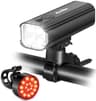
NHTSA lists bicyclists not being visible as the second most common factor in fatal bike crashes, and notes that nearly three quarters of bicyclist deaths happen in urban areas. Three things follow. Run a white front light and a red rear light at all times, including daylight, because a flashing light is what a driver’s eye catches at a junction; the set above is the cheapest way to have both, and our lights roundup has the brighter options for unlit routes. Wear something reflective, because lights point forward and back and a car at a side street sees neither; a vest or bands cover the angle the lights miss, and reflective gear is the cheapest safety spend on this site. And ride where you are expected to be seen: in the lane position a driver looks at, not hugging the gutter.
4. Being predictable: the number one factor
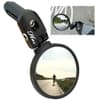
NHTSA’s data puts bicyclists failing to yield the right of way as the highest factor in fatal bike crashes. The e-bike version of that problem is speed at junctions: you arrive faster than a driver expects a bicycle to, which breaks the guess they are making about whether they have time to turn. Ride with traffic, obey signals as a car would, signal turns, and look over your shoulder before every lane change — which is where a mirror earns its place, because a shoulder check at 20 mph on a heavy bike wobbles the bars more than it does on a light one. Assume you have not been seen until the driver’s eyes tell you otherwise. And avoid sidewalks, which NHTSA also advises: a driver pulling out of a driveway is not looking for something doing 20 mph on the pavement.
5. The battery: the risk that happens at home
The one e-bike hazard that has nothing to do with riding is the battery charging in your hallway. The CPSC’s guidance is short and worth following exactly: use devices and batteries certified to the applicable safety standards (UL 2849 for the bike, UL 2271 for the pack); follow the maker’s charging instructions and unplug when done; always be present while charging, and never charge while asleep or away from home, because the CPSC has seen many battery fires and deaths happen at night with families asleep; use only the charger the maker provided or recommends; and only fit a replacement or spare pack the maker has confirmed for your bike, never one that has been modified or rebuilt from used cells. Our battery care guide turns that into a routine, and e-bikes in an apartment covers the case where the hallway is shared.
6. The lock: the most likely bad day
You are far more likely to lose the bike than to crash it. A U-lock through the frame and rear wheel to a fixed object, a removable battery that comes inside with you, and a serial number registered before the first ride are the three things that matter. Our how to lock an e-bike guide has the technique and the locks roundup the locks.
The helmet, and the rest of the gear
A helmet certified to the CPSC standard is the legal minimum everywhere in the U.S. and is required by many states for younger riders and for all Class 3 riders. Fit it with NHTSA’s two-finger rule: two fingers above the eyebrows, a V of strap around each ear, two fingers between strap and chin. Our e-bike helmets guide covers the standards, including the European one written for 28 mph. Beyond the helmet, the gear that reduces risk is boring: gloves, because hands hit the ground first; closed shoes; tucked laces and pant legs, per NHTSA; and a phone mounted where you can glance at it rather than held in a hand.
Before every ride, in thirty seconds
Squeeze both brakes. Check tire pressure by thumb, or properly with a gauge once a week (our tire pressure guide explains why it is the cheapest safety upgrade there is). Lights on. Battery locked into the frame. Then ride the bike you have, at the speed the path allows, as though nobody can see you. That is most of it.