Volt & Velo

Best E-Bike Bells and Horns

Every listing in this category shouts a decibel number and not one publishes the distance it was measured at. Five picks ranked on what the law actually asks for - a signal audible at 100 feet, and not a siren.

By Stephen V.Last updated How we pick

Buy the ROCKBROS brass alloy bell if most of your miles are on a shared path, and the Hornit dB140 if they are in traffic. Those are two different products for two different problems, and the single biggest mistake in this category is buying the loudest thing you can find for riding where loud is the wrong answer. If you want one device that covers both and costs the least, the YBLNTEK 125dB is the best-specified of the cheap electronic horns — with one setting you should leave alone.

Here is the thing that shapes this entire page. Not one horn we looked at publishes the distance its decibel figure was measured at, or the standard it was measured to. A sound pressure level is meaningless without a distance, because level falls off as you move away from the source — roughly 6 dB for every doubling of distance in open air. “140 dB” at the horn’s grille and “140 dB” at one meter are not the same product, and nothing in any of these listings tells you which one you are reading. So we rank these on the specifications that are real: the handlebar diameter they fit, what powers them, whether they are weatherproof, and whether they can be set to a sound that is illegal on a bicycle in some states.

That last one is the finding worth the click. Bicycle equipment law does not ask for a decibel number at all. New York’s, to take one state’s wording, requires “a bell or other device capable of giving a signal audible for a distance of at least one hundred feet” and then says a bicycle “shall not be equipped with nor shall any person use upon a bicycle any siren or whistle.” Several of the horns below ship with a siren or alarm mode. All five were confirmed in stock on October 17, 2026, and every figure quoted here was read from the listing on that date. This is our method.

How this is funded:we earn a commission if you buy through our links, at no extra cost to you. It never changes which product we recommend, and we’ll tell you plainly when to skip one. Full disclosure.

Quick picks

Ranked on published specs, price and buyer fit. Select a row to jump to the full write-up. We have not ridden every one of these — here is exactly what we do instead.

#ProductBest forPrice
1
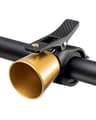
ROCKBROS Classic Brass Alloy Bike Bell

ROCKBROS Classic Brass Alloy Bike Bell

Buy this and not a horn if most of your miles are on a shared path. A bell is the sound pedestrians and other riders already read as coming past, it never needs charging, it cannot be set to a siren mode, and it satisfies an equipment law written in terms of a bell rather than a decibel figure. It publishes a handlebar range (0.87-1.25 in) and ships the hex key to fit it.

Best for shared paths
$11.72 · View on Amazon

$14.9922% off

Price as of October 18, 2026. #ad How we’re funded

2
YBLNTEK Electric Bike Horn 125dB (USB rechargeable, with alarm)

YBLNTEK Electric Bike Horn 125dB (USB rechargeable, with alarm)

The best-specified cheap horn on this page: USB rechargeable rather than running on a coin cell, stated waterproof, and the only one that publishes its handlebar fit as a figure (22.2-31.8 mm) instead of calling itself universal. That matters more than it sounds on an e-bike, because the oversized bars some value models use sit at the top of that band. The alarm mode is the thing to be careful with.

Best cheap electronic horn
$11.99 · View on Amazon

$13.9914% off

Price as of October 18, 2026. #ad How we’re funded

3
Hornit dB140 Bike Horn (V3)

Hornit dB140 Bike Horn (V3)

The only horn here from a brand whose whole business is this one product, and the only one whose claimed figure is the model name rather than a line in a listing bullet. Two volume levels and a trigger you fit at the brake lever, so the loud setting is a deliberate choice instead of the only setting. It costs roughly three times what everything else on this page costs, and it is the pick if you ride in traffic that does not look.

Best for traffic
$39.95 · View on Amazon

Price as of October 18, 2026. #ad How we’re funded

4
Powvine Electric Bike Horn 130db

Powvine Electric Bike Horn 130db

The widest published handlebar range on the page - 22.2 to 32 mm - which makes it the one to buy if you have measured your bar and found it fatter than a bicycle's. It runs on a 3 V battery rather than USB, which is a real downgrade on a bike you already plug in every few days, and that is why it ranks below the YBLNTEK despite claiming a higher number.

Best for oversized bars
$12.99 · View on Amazon

Price as of October 18, 2026. #ad How we’re funded

5
LESOVI Electronic Bike Horn 120db (4 sound modes)

LESOVI Electronic Bike Horn 120db (4 sound modes)

Four sound modes, a rechargeable battery and a stated waterproof rating, on much the longest-standing listing on this page - which in a category full of six-month-old listings is the closest thing to a track record available. The four modes are the problem as well as the feature: at least one of them is effectively a siren, and that is the mode to leave alone.

Most sound modes
$12.99 · View on Amazon

$13.886% off

Price as of October 18, 2026. #ad How we’re funded

The picks in full

#1Best for shared paths

ROCKBROS Classic Brass Alloy Bike Bell

Buy this and not a horn if most of your miles are on a shared path. A bell is the sound pedestrians and other riders already read as coming past, it never needs charging, it cannot be set to a siren mode, and it satisfies an equipment law written in terms of a bell rather than a decibel figure. It publishes a handlebar range (0.87-1.25 in) and ships the hex key to fit it.

What you get

  • No battery, no charging and nothing to fail in the wet
  • The sound other path users actually read as a passing signal, rather than as a car
  • Published handlebar fit of 0.87-1.25 in (roughly 22-32 mm), with a hex wrench and two anti-skid pads included
  • Mounts left or right, so it goes wherever your thumb already is
  • Cannot be set to a siren or whistle mode, which keeps it legal in states that prohibit those

Trade-offs

  • Nowhere near as loud as any horn here, and a bell does not carry over traffic noise or a closed car window
  • No decibel figure published at all - the listing says loud and clear and nothing more
  • Brass alloy rather than solid brass, so the tone is a little shorter
  • One sound, one volume
Key specMechanical bell; brass alloy; no decibel figure published; fits 0.87-1.25 in (roughly 22-32 mm) bars; hex wrench and 2 anti-skid pads included; left or right mount
Best forShared paths, and the one that never needs charging

Specs read from the manufacturer or retailer listing, on October 17, 2026. “Not published” means the maker does not state that figure.

#2Best cheap electronic horn

YBLNTEK Electric Bike Horn 125dB (USB rechargeable, with alarm)

The best-specified cheap horn on this page: USB rechargeable rather than running on a coin cell, stated waterproof, and the only one that publishes its handlebar fit as a figure (22.2-31.8 mm) instead of calling itself universal. That matters more than it sounds on an e-bike, because the oversized bars some value models use sit at the top of that band. The alarm mode is the thing to be careful with.

What you get

  • USB rechargeable, so there is no coin cell to run out mid-winter
  • Published handlebar fit of 22.2-31.8 mm rather than an unqualified universal claim
  • Stated waterproof, which the fender-free riding this kind of bike gets makes necessary rather than optional
  • 125 dB claimed on a device that costs less than a tank of gas

Trade-offs

  • Has an ALARM mode, and a siren is specifically prohibited on a bicycle under New York's equipment law - check your own state before using that setting
  • No measurement distance and no standard published behind the 125 dB claim
  • No IP rating given, just the word waterproof
  • No brand history in cycling, and no published battery capacity or runtime
Key specElectronic horn; 125 dB claimed (no measurement distance or standard published); USB rechargeable; stated waterproof with no IP rating; fits 22.2-31.8 mm bars; includes an alarm mode
Best forThe best-specified cheap horn

Specs read from the manufacturer or retailer listing, on October 17, 2026. “Not published” means the maker does not state that figure.

#3Best for traffic

Hornit dB140 Bike Horn (V3)

The only horn here from a brand whose whole business is this one product, and the only one whose claimed figure is the model name rather than a line in a listing bullet. Two volume levels and a trigger you fit at the brake lever, so the loud setting is a deliberate choice instead of the only setting. It costs roughly three times what everything else on this page costs, and it is the pick if you ride in traffic that does not look.

What you get

  • Two selectable volume levels, so the quiet one can be used on a shared path and the loud one kept for a car door
  • Trigger mounts separately at the lever, so you sound it without taking a hand off the bar
  • A single-product brand with a long-running model line, which is rare in this category
  • The claimed figure is stated as the model name (dB140) rather than appearing only in marketing copy

Trade-offs

  • Roughly three times the price of the electronic horns on this page
  • The 140 dB claim is published with no measurement distance and no standard, so it cannot be verified or compared
  • Battery powered rather than USB rechargeable
  • Bulkier on the bar than a bell, and the trigger needs its own clamp space
Key specElectronic horn; 140 dB claimed (no measurement distance or standard published); two volume levels; separate lever-mounted trigger; battery powered
Best forTraffic that is not looking at you

Specs read from the manufacturer or retailer listing, on October 17, 2026. “Not published” means the maker does not state that figure.

#4Best for oversized bars

Powvine Electric Bike Horn 130db

The widest published handlebar range on the page - 22.2 to 32 mm - which makes it the one to buy if you have measured your bar and found it fatter than a bicycle's. It runs on a 3 V battery rather than USB, which is a real downgrade on a bike you already plug in every few days, and that is why it ranks below the YBLNTEK despite claiming a higher number.

What you get

  • Published 22.2-32 mm handlebar fit - the widest here, and it covers the fatter bars on some value e-bikes
  • 130 dB claimed, the second-highest figure on the page
  • Single-piece unit with no separate trigger to find clamp space for
  • Cheap enough to treat as a consumable if it gets taken off the bar

Trade-offs

  • Runs on a 3 V replaceable battery rather than USB rechargeable - one more cell to remember
  • No measurement distance and no standard published behind the 130 dB claim
  • No IP rating and no waterproof statement at all in the listing
  • No published volume levels, so it is as loud on a shared path as it is in traffic
Key specElectronic horn; 130 dB claimed (no measurement distance or standard published); 3 V replaceable battery; fits 22.2-32 mm bars; no IP rating published
Best forOversized or non-standard handlebars

Specs read from the manufacturer or retailer listing, on October 17, 2026. “Not published” means the maker does not state that figure.

#5Most sound modes

LESOVI Electronic Bike Horn 120db (4 sound modes)

Four sound modes, a rechargeable battery and a stated waterproof rating, on much the longest-standing listing on this page - which in a category full of six-month-old listings is the closest thing to a track record available. The four modes are the problem as well as the feature: at least one of them is effectively a siren, and that is the mode to leave alone.

What you get

  • Four selectable sound modes, so a polite tone exists alongside the loud one
  • Rechargeable battery rather than a coin cell
  • Stated waterproof, with an adjustable mount
  • Much the longest-established listing in this category, which is worth something where most listings are months old

Trade-offs

  • At least one of the four modes is a siren-style sound, which bicycle equipment law in some states specifically prohibits
  • 120 dB claimed - the lowest electronic figure here - and again with no measurement distance or standard
  • No published handlebar diameter range, only the word adjustable
  • No IP rating, no published runtime and no charge time
Key specElectronic horn; 120 dB claimed (no measurement distance or standard published); rechargeable; 4 sound modes; stated waterproof with no IP rating; adjustable mount
Best forA rechargeable horn with a track record

Specs read from the manufacturer or retailer listing, on October 17, 2026. “Not published” means the maker does not state that figure.

How we picked

We started from the decibel claims, because that is what every listing leads with, and abandoned them within an hour. Across every horn in this bracket, the figure is published with no measurement distance, no microphone position and no reference to any standard — not IEC, not ANSI, not an in-house test. Two listings claiming 120 dB and 130 dB may well be the same component with a different number printed on the box, and you cannot tell from outside.

For scale, here is a measured number from a body that does measure: NIOSH sets a recommended occupational exposure limit of 85 dBA averaged over an eight-hour day, with a 3 dBA exchange rate — every 3 dBA louder halves the time you should be exposed. Around 85 dBA is the level at which you have to raise your voice to be heard three feet away. We are not going to tell you a 140 dB bike horn is 55 dB above a measured occupational limit, because nobody has published where that 140 was taken. We will tell you that a device loud enough to be useful through a car window is loud enough to deserve some care about where your own ears are, and that a horn with two volume levels is worth more than a horn with one big number.

So the ranking criteria, in order:

  • Will it fit your handlebar? The only spec in this category that is binary. A clamp sized for a 22.2 mm bicycle bar does not go round the 31.8 mm bar some value e-bikes use. Two of these five publish a diameter range; three do not.
  • What powers it, and will that still work in February? USB rechargeable beats a replaceable coin cell on a bike you already plug in every few days. A mechanical bell beats both, because it has no power source to go flat.
  • Is the sound legal where you ride?A siren or whistle mode is expressly prohibited on a bicycle in at least one state’s equipment law, and e-bikes are regulated as bicycles for this purpose in most places — see our guide to e-bike classes and laws for how that framework works.
  • Will it survive the weather this bike gets ridden in? A stated waterproof claim is weak evidence, but it is more than silence. Nobody here publishes an IP rating.
  • Does it have more than one volume? The difference between a device you use and a device you stop using is whether you can warn a pedestrian without startling them off the path.

What each one actually publishes

DeviceLoudness claimPowerPublished bar fitNotes
Hornit dB140 (V3)140 dB claimedBatteryNot published2 volume levels, lever-mounted trigger
YBLNTEK 125dB125 dB claimedUSB rechargeable22.2-31.8 mmAlarm mode (see the legal note)
Powvine 130db130 dB claimed3 V replaceable cell22.2-32 mmWidest published bar range
LESOVI 120db120 dB claimedRechargeableNot published4 sound modes, one siren-like
ROCKBROS brass alloy bellNo figure publishedNone0.87-1.25 inCannot be set to a siren

Read that table as a provenance table rather than a performance table. Every entry in the loudness column is a manufacturer claim with no distance attached; every entry in the bar-fit column is either a measurable commitment or an admission that the seller would rather not make one. The only device on the page with nothing at all in the loudness column is the bell — and the bell is the one we recommend first, for the riding most owners of a value e-bike actually do.

Measure your handlebar before you order anything

This takes a minute and it is the difference between a cheap purchase and a cheap return. Wrap a strip of paper round the bar where the clamp will sit, mark where it overlaps, lay it flat and measure, then divide by 3.14. You want the diameter at the mounting position, not in the middle: many e-bike bars bulge to 31.8 mm at the stem clamp and taper to 22.2 mm at the grips.

Then check what is already there. A value e-bike bar is crowded — a display in the middle, a throttle on the right, brake levers, often a phone mount and a front light. A horn with a separate trigger, like the Hornit, needs clamp space in two places, one of which has to be within thumb reach of a brake lever. If your bar is full, the honest options are a bell on the free side or a handlebar extender to create space.

Bell or horn? The honest answer is where you ride

A bell is a social signal.On a rail trail or a park path, the problem is not that pedestrians cannot hear you — it is that they do not know what the sound means. A bell is the one sound every path user has already learned, and the response is to move right and stay walking. An electronic horn on the same path reads as a car, and people step the wrong way or freeze.

A horn is a collision signal. In traffic the problem is different: a driver with the windows up and the stereo on is not going to hear a bell at all, and the sound you need is one that gets through a closed car door at the moment a driver is about to turn across you. That is what the Hornit is for, and it is the only pick here with a quiet setting so it can do both jobs.

One more thing about horns specifically, and it applies to every e-bike: you are closing on people faster than they expect a bicycle to. A 20 mph Class 2 bike covers 100 feet in about three and a half seconds. The legal standard of “audible at 100 feet” is not generous at e-bike speeds, which is the real argument for sounding early and twice rather than for buying a bigger number. Our trail access guide covers where that speed is also a posted rule rather than just a courtesy.

The legal part, in plain language

Equipment law is state by state and we are not going to pretend otherwise. What is worth knowing is the shapeof the requirement, which is consistent, and New York’s is a clean example of it. The rule is expressed two ways at once:

  • A positive requirement, stated as distance.“A bell or other device capable of giving a signal audible for a distance of at least one hundred feet.” Not a decibel figure. Any of the devices here will clear that, including the bell.
  • A prohibition, stated as a type of sound. A bicycle “shall not be equipped with nor shall any person use upon a bicycle any siren or whistle.” This is the one that matters when you are buying a horn with four sound modes, because at least one of those modes is usually a siren, and the law bans being equipped with one, not just sounding it.

Practically: a bell is always compliant, a single-tone horn is almost always compliant, and a multi-mode horn with an alarm or siren setting is the one to check your own state about before you fit it. If the siren mode is what attracted you — as a theft alarm — buy an actual tracker and a real lock instead. A 120 dB chirp does not stop anybody from cutting a cable lock, and our locking guide explains what does.

What we would skip

Anything marketed on decibels alone.There are listings in this category claiming 150 dB at the very bottom of the price range. With no measurement distance published anywhere in the segment, a bigger number is not evidence of a louder device — it is evidence of a bolder copywriter.

Air horns with a squeeze bulb. They are loud and genuinely fun, and they need a hand off the bar for a second and a half at exactly the moment you want both hands. On a 70 lb bike at 20 mph that is the wrong trade.

A horn wired into the bike’s own battery. Some value e-bikes do have a factory horn on the left control pod, and if yours does, use it. Retrofitting one by tapping the main pack is a different proposition: there is usually no fused accessory circuit and no published wiring diagram, and the risk sits on the one component you least want to disturb. We go through the same problem in detail on the handlebar USB power page.

Bar-end bells on a bike with grip shifters or a throttle. There is no room, and they put the lever where your hand needs to be.

What we would actually buy

For most people: the ROCKBROS brass alloy bell.It is the right sound for the riding most value e-bikes do, it publishes a bar range of 0.87 to 1.25 in, it ships the hex key, and it will still work on a wet morning in three winters’ time with no charging. It cannot be set to anything illegal.

If you want one device for path and road: the YBLNTEK 125dB. USB rechargeable, stated waterproof, and the only cheap horn here that publishes its clamp range (22.2-31.8 mm). Fit it, ignore the alarm mode, and check your state before you ever use that setting.

If you ride in traffic: the Hornit dB140. Two volume levels and a separate lever trigger, from the only brand here that exists to make this one thing. It is three times the price of the others and it is the only pick that lets you choose how loud you are being.

If your bar is fatter than a bicycle’s: the Powvine 130db. A published 22.2-32 mm range is the widest here. The 3 V cell instead of USB is the compromise you accept for the fit.

A warning device is the cheapest safety upgrade on this entire site, and it is the one most value e-bike owners never fit, which is strange on a bike that reaches 20 mph silently. If you are kitting out a new bike, it belongs in the same order as a light and a mirror — see our accessory picks for the full list, and our safety guide for the habits that matter more than the hardware.
Frequently asked questions

What is the best horn for an e-bike?

If you ride in traffic, the Hornit dB140 — it is the only pick with two selectable volume levels and a separate trigger you mount at the brake lever, from the one brand in this category that makes nothing else. If you want a cheap single device, the YBLNTEK 125dB is the best-specified: USB rechargeable, stated waterproof, and the only budget horn here that publishes its handlebar clamp range (22.2-31.8 mm). If most of your miles are on a shared path, buy a bell instead — a bell is the sound other path users already understand.

Are the decibel numbers on bike horns real?

They are unverifiable as published. Not one horn listing we read states the distance the figure was measured at or the standard it was measured to, and a sound pressure level without a distance cannot be compared — level falls off roughly 6 dB per doubling of distance in open air. Two horns claiming 120 dB and 130 dB may be the same component with different marketing. That is why this page ranks on handlebar fit, power source, weatherproofing and legality, which are specifications you can actually check.

Is a bell legally required on an e-bike?

It depends on your state, and the requirement is usually written as audibility rather than loudness. New York's equipment law, for example, requires a bell or other device capable of giving a signal audible at least one hundred feet, and expressly prohibits a bicycle from being equipped with a siren or whistle. E-bikes are treated as bicycles for equipment purposes in most states. Check your own state's vehicle code — and note that the prohibition is on being equipped with a siren, not only on sounding one, which matters if you are buying a multi-mode horn.

Are electric bike horns with a siren or alarm mode legal?

The siren mode specifically may not be. New York's law prohibits a bicycle from being equipped with any siren or whistle, and several of the cheap electronic horns here ship with an alarm or siren setting. The rest of the device is fine; it is that mode that is the problem. If you wanted the alarm as theft protection, it is not doing that job anyway — buy a proper lock and a tracker, which actually change the outcome.

How loud is too loud for a bike horn?

There is no bicycle standard to answer that, but there is an occupational one worth knowing: NIOSH recommends an exposure limit of 85 A-weighted decibels averaged over an eight-hour day, and halving the exposure time for every 3 dBA increase. Since no bike-horn listing publishes a measurement distance, we cannot say how any of these compares to that limit. The practical answer is to buy a horn with two volume levels so the loud setting stays reserved for traffic, and not to test it next to your own ear.

Will a bike horn fit my e-bike's handlebars?

Measure first. Wrap a strip of paper around the bar where the clamp will sit, mark the overlap, lay it flat and divide the length by 3.14. Check the diameter at the mounting position rather than in the middle, because many e-bike bars are 31.8 mm at the stem and 22.2 mm at the grips. The ROCKBROS bell publishes 0.87-1.25 in, the Powvine 22.2-32 mm and the YBLNTEK 22.2-31.8 mm; the Hornit and the LESOVI publish no range at all.

Do I need a horn if my e-bike came with one?

Probably not. Some value e-bikes include a small horn on the left control pod, wired into the bike's own battery, and if yours works and is loud enough to be heard at 100 feet it already satisfies the usual legal standard. The common reasons owners add one anyway are that the factory horn is quiet, that it sounds like an alarm rather than a warning, or that they want a bell for path riding where a horn is the wrong signal.

Sources

  • New York Vehicle & Traffic Law § 1236 - Lamps and other equipment on bicycles — Read in full on the access date. Subdivision (b): "No person shall operate a bicycle unless it is equipped with a bell or other device capable of giving a signal audible for a distance of at least one hundred feet, except that a bicycle shall not be equipped with nor shall any person use upon a bicycle any siren or whistle." The requirement is therefore stated as AUDIBILITY AT 100 FEET, not as a decibel figure, and sirens and whistles are expressly prohibited - which is directly relevant to the alarm and siren modes built into several electronic bike horns. The same section also sets lighting (a white front lamp visible at 500 ft and a red or amber rear light visible at 300 ft after dark), a brake able to skid the braked wheel on dry level clean pavement, and reflector requirements. Equipment law is state by state; this is New York's wording and is cited as an example of how the requirement is framed, not as a national rule (accessed October 17, 2026)
  • U.S. CDC / NIOSH - Noise and Hearing Loss (occupational noise exposure) — NIOSH established a recommended exposure limit (REL) of 85 A-weighted decibels (dBA) averaged over an eight-hour workday; workers exposed at or above the REL are at risk of significant hearing loss over a working lifetime. The exchange rate is 3 dBA: for each 3 dBA increase in level, NIOSH recommends halving the exposure duration. Sounds around 85 dBA typically require raising your voice to be heard by someone three feet away. Cited on the bells-and-horns page for exposure context only - it is a measured occupational standard, and the decibel figures printed on bike-horn listings are unverified claims published with no measurement distance or standard, so the two are never compared as like for like (accessed October 17, 2026)
  • PeopleForBikes — Electric Bike Policies & Laws — The 3-class e-bike system (Class 1/2 to 20 mph, Class 3 to 28 mph), access rules and the state-by-state law reference (accessed July 22, 2026)

Keep reading