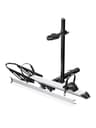
Every method, with its real limit
| Method | Typical weight limit | Why it works | The catch |
|---|
| Hitch rack (platform, with ramp) | Published per-bike ratings of 50-150 lb | No lifting with a ramp; bike sits low; fits fat tires | Needs a 2 in receiver; costs the most; blocks the tailgate on some cars |
| Trunk-strap rack | Typically 35-40 lb per bike | Cheap, fits almost any car | Almost never rated for an e-bike. Do not use one for a 60 lb bike |
| Roof rack | Varies; roof load limit is the real cap | Leaves the tailgate free | You are lifting 60-75 lb over your head. Not realistic for most riders |
| Truck bed | No practical limit | Simplest and safest; use a tailgate pad or a wheel chock | Needs tie-downs and a cover; bike is exposed to road grit and rain |
| RV bumper or ladder rack | Often around 50 lb per bike | Already fitted to many rigs | The tightest limit of all, at the end of a flexing lever. Check the label |
| Inside the car, folded | No limit beyond your back | Secure, dry, nothing to steal off a rack | Two-person lift; a folded e-bike is shorter, not lighter |
| Checked or carried on a plane | Battery capped at 100 Wh, or 160 Wh with airline approval | The frame can be shipped as a boxed bicycle | The battery cannot fly. Every e-bike pack we list is 281 Wh or more |
In a car or SUV: the hitch rack, and what to check
Four things, in order.
- Your receiver size and class. Most e-bike-rated racks want a 2-inch receiver; 1.25-inch receivers are common on small cars and are usually rated for much less tongue weight. The receiver, not the rack, is often the real limit.
- Tongue weight.Rack plus two 70 lb bikes is roughly 180 lb hanging behind the axle. Check your vehicle’s stated tongue-weight capacity, which is in the owner’s manual and is frequently lower than people assume on a crossover.
- Tire width. Fat tires do not fit every tray. The racks we list state a tire-width range, which is the spec to match against your bike.
- A ramp.Lifting 70 lb to tray height, at arm’s length, repeatedly, is the part people underestimate. All three racks we recommend include one.
Our e-bike car rack roundup ranks these on published capacity, and it is the page to read if you are choosing rather than packing.
In a pickup truck: the easiest option there is
A truck bed takes an e-bike’s weight without a thought, so the job is just stopping it moving and stopping it getting wet.
Lay a tailgate pad or a folded blanket over the gate, stand the bike with the front wheel over the gate or use a fork-mount or wheel chock bolted to the bed, and strap at two points so the bike cannot pivot. Ratchet straps over a frame are fine; over a rim or a derailleur are not. Then cover it — a hundred miles of interstate spray puts a surprising amount of grit into brake pads and a chain, which is why a waterproof cover pays for itself on the first long trip, and why the cleaning kit is the companion purchase.
On an RV: read the label first
This is where people get caught. Bumper and ladder racks are commonly rated near 50 lb per bike, and they sit at the end of a long lever on a vehicle that flexes constantly. An e-bike on a bumper rack rated for a bicycle is not a borderline call.
If your rig has a 2-inch receiver, use a hitch rack with a published rating like the ones above. If it does not, the realistic choices are a lighter bike or carrying it inside. Our e-bikes for camping and RV travel page ranks bikes specifically on published weight against rack limits, and the lightest bike we list is the only one that clears a 50 lb limit.
On a plane: the frame can fly, the battery cannot
This is the clearest rule in the whole subject, and it is worth knowing before you book.
Under the FAA’s passenger rules, spare lithium-ion batteries must travel in carry-on baggage only, never checked, and are limited to 100 watt-hours per battery— with airline approval, up to two spares rated between 101 and 160 Wh. Terminals must be protected from short circuit, and damaged or recalled batteries may not be carried at all.
Now compare that to the packs on this site. The smallest is 281 Wh; a typical commuter pack is 500–700 Wh; the biggest we list is 1,040 Wh. Every single one is multiples over the limit, with or without airline approval. So an e-bike battery does not fly, in the cabin or in the hold, and no amount of asking nicely at the gate changes that. The bike itself can be boxed and shipped as a bicycle, and the pack has to go by ground freight through a carrier that handles lithium batteries, or stay at home. For a destination trip, renting at the other end is usually both cheaper and simpler.
Theft and the five-minute stop
A bike on a rack behind a parked car is the easiest theft on this list, and the battery is easier still. Three habits that cost nothing: take the battery with you, lock the bike to the rack and the rack to the vehicle, and park where you can see the rack through a window. Our locking guide covers what actually resists an angle grinder, and a tracker is the cheap insurance for the trip where you have to leave it.
One last thing worth doing before any long drive: pump the tires and check the axle nuts. Vibration at 70 mph finds whatever was already slightly loose, and a hub-motor axle is the fastener you least want to discover is loose at the trailhead. Our maintenance checklist has the full pre-trip version.