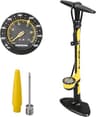
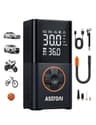
How we picked
Valve compatibility led, because it is the one thing that can make a pump useless: e-bike tubes are usually Schrader, road tubes are usually Presta, and a household with both needs a head that takes each without an adapter to lose. Gauge readabilitycame next — a small dial at floor level is hard to read at the low pressures fat tires run. Then build, since a steel barrel and a stable base are what stop a pump wobbling when you lean on it. We have not ridden every one of these; this is exactly what we do instead.
Fat tires are a volume problem, not a pressure one
A road tire wants 80 to 100 psi in a small volume. A 20 x 4.0 fat tire wants somewhere between about 10 and 25 psi — but there is an enormous amount of air in it. That inverts what makes a pump good.
For fat tires you want high volume per strokeand a gauge that is readable at the bottom of its range, not a pump rated to 160 psi you will never approach. A mini-pump that fills a road tire in 100 strokes can take 400 or more on a fat tire, which is why so many e-bike owners quietly stop checking their pressures — and then wonder where their range went. Our tire pressure guide covers what to actually run.
Presta, Schrader and the head that matters
Schrader is the car-style valve: fat, with a spring-loaded pin in the middle. Nearly every value e-bike uses it, and it is the valve a gas station air hose fits.
Presta is the slim valve with a knurled nut you unscrew before inflating. It appears on road and some hybrid tires.
A reversible or twin head handles both without an adapter, which is what you want if there is more than one kind of bike in the house. Where a pump needs a plastic adapter, assume it will be lost within a year. One warning about gas station air hoses: they deliver a lot of air very quickly, and a fat tire that wants 15 psi can be over-inflated in a second. Use a bike pump with a gauge you can read.
Cordless inflators: worth it or a gadget?
For most bikes, a gadget. For a fat-tire e-bike, genuinely useful. A cordless compressor fills a high-volume tire without you doing the work, sets a target pressure so you cannot overshoot, and lives in a pannier for roadside flats where a hand pump means five minutes of hard work by the side of a road.
The honest downsides: it is another lithium battery to keep charged, it is slower than a floor pump on skinny tires, and it is loud. It is also not a replacement for a floor pump at home — a compressor run flat is a compressor that cannot help you. Buy the floor pump first.
Check pressure weekly, not monthly
All inner tubes lose air, and the lower the pressure the more a small loss matters proportionally. A fat tire dropping from 18 to 12 psi is a third of its pressure gone, and you will feel it as sluggishness and reduced range long before it looks flat.
Weekly is the right interval for an e-bike ridden regularly. It takes two minutes with a floor pump next to the door, and it is the cheapest range increase available — considerably cheaper than the bigger battery people buy instead. While you are there, look at the tread and sidewalls for glass and cuts, which is the other half of never getting a flat.