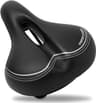
Width is the spec. Padding is the consolation prize.
A saddle is comfortable when your sit bones — the two bony points at the base of your pelvis — land on the supported part of the shell. If the saddle is too narrow, they hang over the edges and all the padding in the world does not help; if it is much too wide, the nose and the wings chafe. Sitting upright, as you do on nearly every value e-bike, rotates your pelvis back and moves those points further apart than they sit on a road bike, which is why cruiser and step-through riders so often need a wider saddle than the one that came on the bike.
That is the whole argument for ranking this band on published dimensions. Two of these seats give you a number you can hold against a saddle you already own. Three do not, which leaves you buying a photograph. If you want to do it properly, measure your sit-bone spacing at home first — sit on a sheet of corrugated card on a hard chair, find the two dents, measure between their centers, and add roughly 20 to 30 mm for an upright position. Our full saddle roundup covers shapes and fit in more depth, including the pricier option this page excludes.
What each one publishes
| Seat | Size as published | Cushioning | Rails | Worth knowing |
|---|
| Planet Bike A.R.S. Lift, 175 mm | 275 x 175 mm, 581 g | Gel + foam, relief channel, shell dampers | Steel | Molded lift handle underneath |
| Planet Bike A.R.S. Lift, 210 mm | 265 x 210 mm, 631 g | Gel + foam, relief channel, shell dampers | Steel | Same saddle, wider platform, same price |
| Bikeroo Extra Wide (cutout) | Not published | Memory foam, steel spring + elastomer | Standard two-bolt | Center cutout as well as springs |
| DAWAY C99 Sprung | Not published | Memory foam, dual springs | Standard two-bolt | Waterproof cover; clip-on courtesy taillight |
| Cloud-9 Cruiser Select | 10.5 x 10.75 in | Soft-touch vinyl over wide platform | Standard two-bolt | Weatherproof cover for a bike kept outside |
One row in that table is worth reading twice. The two Planet Bike widths are the same saddleat the same price, 175 and 210 mm — so width is a choice here, not an upsell. If you ride bolt upright on a cruiser or a step-through, or the stock saddle leaves you perched on the edges, take the 210. If you lean forward at all, take the 175. That single decision will do more for your comfort than any amount of extra foam.
Springs: not a gimmick on a rigid e-bike
Two picks here have steel springs or elastomers under the shell, and on a hardtail e-bike that is genuine suspension rather than a styling cue. A value e-bike has a motor, fat-ish tires and no rear shock, so every pavement edge goes up the seatpost into you. Springs take the edge off it. The trade is weight, a slight bounce when you pedal hard, and a saddle that sits a little higher — check your saddle height after fitting one.
If the bumps are the real problem rather than the perch, spend the money one part lower instead. A suspension seatpost publishes travel and a rider-weight range, which no saddle in this band does, and it works with whatever saddle already suits you. Note one fitting rule before you buy either: federal bicycle requirements call for a minimum-insertion mark no less than two post diameters from the bottom of the shaft, which on a 27.2 mm post is about 54 mm of post that has to stay inside the frame. Honor that mark whatever you bolt on top of it.
Fitting it, and the one mistake everyone makes
All five seats here use ordinary two-rail clamps, so fitting is a single bolt on most value e-bikes and takes five minutes. Level the saddle first — a phone level app on the shell is accurate enough — then set the height so your knee stays slightly bent at the bottom of the pedal stroke, then set fore-aft last. Tighten the clamp with a torque wrench if you have one, because a rail clamp is easy to overtighten and a cracked rail is not a warranty claim.
The mistake is judging a new saddle on the first ride. A different shape puts pressure in different places and takes three or four rides to settle, so if the width is right, give it a week before deciding. And if the discomfort is numbness rather than soreness, that is a pressure problem rather than a padding problem: look for the relief channel or cutout, which three of these five have. For the clothing half of the answer, padded shorts do more than a softer saddle, and the comfort upgrade page ranks the whole contact-point list in the order worth buying it.