How we picked
We ranked on published width, then rail standard, then suspension, then relief, in that order. Width comes first because it is the only one of the four that is a fit question rather than a preference, and getting it wrong is what makes a saddle hurt.
Here is what each criterion actually decides:
- Width.You sit on two bones, not on your soft tissue. If the saddle is narrower than the distance between those bones, they hang off the edges and your weight lands somewhere it should not. If it is much wider than it needs to be, the shell starts rubbing the insides of your thighs instead. An upright e-bike position loads those bones more heavily and spreads them slightly further apart than a leaned-forward road position, which is why wide saddles dominate this category — but “wide” is not a measurement, and 175 against 210 mm is.
- Rail standard.Every saddle here uses ordinary rails that clamp into a normal two-bolt seatpost head, and Planet Bike is the only one that says so in writing (steel). This matters because the alternative — the noseless cushions and oversized “seat” products that fill this search — frequently use their own mount and will not go on your post.
- Suspension in the saddle. Most value e-bikes are hardtails with a rigid rear end, so the only springs between you and a pothole are the tire and whatever is under the saddle. A sprung saddle is a real, cheap fix for a rough commute. It is also taller, heavier and slightly vague-feeling, which is why it is not our top pick.
- Relief.A channel or cutout down the middle is the one comfort feature on a saddle with published research behind it rather than adjectives — see the section below.
What we deliberately did notrank on: foam thickness, cover material, or the word “ergonomic.” None of those is comparable across listings, and three of these five publish nothing you could compare anyway.
What each one publishes
| Saddle | Width | Length | Suspension | Relief | Weight |
|---|
| Planet Bike A.R.S. Lift, 175 mm | 175 mm (published) | 275 mm (published) | None | Anatomic relief channel | 581 g (published) |
| Planet Bike A.R.S. Lift, 210 mm | 210 mm (published) | 265 mm (published) | None | Anatomic relief channel | 631 g (published) |
| Bikeroo Extra Wide | Not published | Not published | Steel spring + elastomer | Center cutout | Not published |
| DAWAY C99 | Not published | Not published | Dual spring | None stated | Not published |
| Selle Royal Respiro Moderate | Not published | Not published | None | Ventilation channel + cutout | Not published |
Count the “Not published” cells. That is a whole product category selling a fit item without stating its size, and it is why our top two picks are the same saddle in two widths rather than five different brands. When one manufacturer gives you numbers and four give you adjectives, the numbers are the story.
Measure yourself first — it takes two minutes
You cannot pick a width without knowing roughly how far apart your sit bones are, and you do not need a shop to find out. Put a piece of corrugated cardboard on a hard, flat chair, sit on it normally with your feet flat and lean forward slightly to mimic a riding position, then stand up and look at the two dents. Measure between their centers in millimeters.
That number is your sit-bone spacing, and your saddle wants to be wider than it— the bones need to land on the padded platform, not on the edge. How much wider depends on how upright you sit: the more upright your back, the more of your weight is straight down through those bones and the more platform you want under them. Most adults land somewhere in the 100–130 mm range, which is why a 175 mm saddle suits most people and a 210 mm saddle suits the upright-cruiser end of the market.
This is also the honest answer to the most common version of this question. There is no separate “men’s” and “women’s” measurement to apply; there is an average difference in sit-bone spacing between groups, and a very large overlap. Measure the cardboard, not the marketing. If you are shopping around our step-through picks or our upright, easy-mount bikes, you are in the position that wants the wider platform.
The one comfort feature with research behind it
Almost everything a saddle listing says about pressure is unverifiable. The exception is the relief channel, and the reason is that the U.S. National Institute for Occupational Safety and Health studied this in people who ride for a living. NIOSH’s workplace-solutions publication on the subject — DHHS (NIOSH) Publication Number 2009-131, April 2009 — states that NIOSH “has conducted studies that have demonstrated the effectiveness of no-nose bicycle saddles” in reducing groin pressure and improving sexual health in male bicycle patrol police officers, and adds that “recent evidence suggests that no-nose bicycle saddles may also benefit women.”
Two sensible conclusions follow, and they pull in slightly different directions. First: pressure on the soft tissue at the front of the saddle is a real, measured mechanism, not an invented problem, so a channel or cutout down the middle is worth having and all but one of our picks has one. Second, and more awkwardly for the usual advice: the research NIOSH is pointing at is about genuinely noseless saddles, used by officers riding for whole shifts — not about the cheap oversized cushions that dominate an “e-bike seat” search. If you ride many hours a day, a real no-nose saddle is an evidence-backed option worth researching properly. For a half-hour commute, a conventional saddle in the right width with a relief channel is the pragmatic version of the same idea.
Worth saying plainly: NIOSH is studying an occupational exposure, and the detailed study figures sit in a PDF we have not read, so we are not going to put a percentage on your commute. The mechanism is documented. The dose is yours.
Often it is not the saddle
Before you spend anything, rule out the three things that masquerade as a saddle problem on a value e-bike. We would rather you fixed one of these for free than bought a saddle that cannot help.
1. Saddle height.Too low is the near-universal error on a first e-bike, because people set the seat so they can put both feet flat on the ground while sitting. That puts your knees in a permanent half-squat and rolls your weight forward onto the soft tissue. With the pedal at the bottom of its stroke, your knee should be very slightly bent — which usually means tiptoes, not flat feet, when you are stopped and seated. On a step-through you can have both, which is most of why they are popular.
2. Saddle angle.A nose tilted up is the fastest way to make any saddle, including a good one, unbearable. Level is the default. Put a phone’s spirit level on it and adjust in small increments.
3. Tire pressure. Over-inflated tires transmit every seam in the road straight into the saddle, and a fat tire pumped to a road-bike number rides appallingly. Our tire pressure guide covers reading the sidewall range and where in it to sit; dropping a few psi is free and is often more comfort than a new saddle buys.
Only after those three is the saddle itself the problem — and then the question is width, which is where this page started.
What we would skip
Gel seat covers. A cover slides, bunches, traps water against your actual saddle and does nothing about width, which is the thing that was wrong. They are the cheapest option on the shelf and the one most likely to be in a drawer by spring.
Oversized noseless cushions sold as the “most comfortable seat for an electric bike.” Not because noseless is wrong — see the NIOSH section above — but because these specific products are a different thing from the saddles that research looked at. Many are built for stationary exercise bikes, where you never steer or stand; several use their own mount rather than standard rails; and losing the nose entirely removes the part of the saddle you grip with your thighs to control the bike. On a 60 lb machine that does 20 mph, that is a real trade, not a free upgrade.
A suspension seatpost bought at the same time as a saddle. Do one at a time. Both change your effective seat height and your riding position, and if you change both at once and it still hurts you have learned nothing. When you are ready for step two, our suspension seatpost roundup ranks four on published travel and rider weight, and the comfort upgrades roundup puts all three parts in order. And grips have their own pagefor the same reason this one exists — a contact point is a sized, specific part, and the grip roundup ranks on whether the grip can rotate on the bar before it ranks on how soft it is.
The widest saddle you can find, as a strategy. Width should match your measurement and your riding position. Beyond that it is just more shell to rub your thighs and more leverage on the rails.
Fitting it without a second trip to the toolbox
A saddle swap is four minutes and one bolt, with three things worth knowing. Mark your current saddle height first — a wrap of tape round the seatpost before you loosen anything — because a sprung or thicker saddle will raise your effective height and you will want to come back down. Note the fore-aft position too; the rails have a usable range and the middle of it is a sane starting point.
Then torque the clamp properly. Seatpost and saddle-rail bolts are small fasteners holding a person onto a heavy bike, they thread into soft alloy, and the two failure modes are a saddle that tips under load and a stripped clamp. Use the figure printed on the post or in the manual and a torque wrench rather than feel. If your toolbox is still empty, a boxed tool kit covers this and most of the first year.
Finally, give it three rides before you judge it. A new saddle in the correct width frequently feels worse than a broken-in wrong one for the first half hour, and the guidance NIOSH gives about allowing time to adjust applies to ordinary saddle changes too. Ride it, adjust the angle a degree at a time, and only then decide.
What we would actually buy
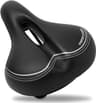
Most riders: the Planet Bike A.R.S. Lift, 175 mm.Steel rails, a published 275 x 175 mm and 581 g, a relief channel, gel and foam over the sit-bone area, and a lift handle underneath that earns its keep the first time you have to haul the bike over a threshold. The only saddle here whose maker both states its size and names e-bikes as the use case.
Upright cruisers and step-throughs: the same saddle at 210 mm. Same construction, same price, 265 x 210 mm and 631 g. If your back is near vertical and the 175 leaves you perched, this is the fix — and because it is the same model, you are changing one variable rather than three.
A rough commute on a hardtail: the Bikeroo Extra Wide. Steel spring plus elastomer suspension and a center cutout, which is the combination most sprung cruiser saddles skip. It publishes no dimensions, which is the price of admission in this part of the market.
The cheapest honest version of that: the DAWAY C99.Dual springs and memory foam for less, with a courtesy taillight on the back that you should not count as your rear light — buy a real one from our lights picks.
Longer rides: the Selle Royal Respiro Moderate. The one pick from a dedicated saddle maker, with Royalgel over a ventilated relief cutout and a named riding angle rather than a universal claim. It costs the most here and it is the one we would expect to still be fine at hour two.
A saddle is the cheapest change you can make to how a budget e-bike feels, and the one most worth getting right — our weight guide explains why a heavy bike is harder on you and on its consumables than the bicycle you had before, and what to buy first puts this in order against the lock and the lights. If you are solving a carrying problem rather than a comfort one, our basket picks are the other cheap upgrade that changes what the bike is for.