The bundle, part by part
Everything in this table comes from our registry, which records what each listing actually states. Nothing here is a bundle sold as one SKU — that is the point of the page.
Read it as two columns of one bundle: pick a kit from the top two rows, a pack from the middle two, and add the charger unless the pack arrives with one that matches. The prices in the quick-picks table above are live and carry the date they were read, so the total is yours to add up on the day you buy rather than a figure we claim.
Four things have to match, and voltage is only the first
This is the whole skill of buying a kit and a pack separately, and it is not difficult — it is just four checks that nobody tells you to make.
1. System voltage.A 48 V kit needs a 48 V pack. A 36 V pack will run a 48 V controller badly or not at all, and a 48 V pack on a 36 V controller is how you release smoke. Both of the kits here are 48 V, which is why both battery picks are 48 V. If you are working on a 36 V bike instead, our battery rounduplists a 36 V pack and explains why the two are not interchangeable.
2. The connector.Packs and controllers terminate in XT60, XT90, Anderson or a bare 2-pin, and the two ends of your bundle will frequently not be the same. This is a genuinely minor problem — an adapter lead is a couple of dollars — but it is the single most common reason a conversion sits in a box for a week. Read both listings for the connector name before you order, and buy the adapter at the same time.
3. Controller current.A 750 W kit at 48 V pulls roughly 15–20 A under load. A pack’s battery management system has a continuous discharge limit, and if that limit is below what the controller asks for, the BMS cuts out under hard acceleration and the bike feels like it has a fault. Both packs here are sold for this class of motor; a small scooter pack is not, no matter what the voltage says.
4. The mount.Hailong-style packs bolt to a rail on the down tube and need the bottle-cage bosses, or a clear stretch of tube to strap to. Measure the triangle before you order: a 20 Ah pack is a physically large object, and on a small frame with a suspension fork and a water bottle there may not be room. A rear-rack pack is the alternative and moves the weight to the worst possible place for handling.
Compare packs on cost per watt-hour, not on price
Battery listings in this category are written to make capacity look bigger than it is: amp-hours are quoted without volts, “equivalent capacity” is quoted instead of real capacity, and cell brands are claimed without a datasheet. The only number worth comparing is watt-hours, which is volts multiplied by amp-hours — a 48 V 13 Ah pack is 624 Wh, and a 48 V 20 Ah pack is 960 Wh.
Divide the live price by that figure and you have a cost per watt-hour you can hold up against any other listing. It also lets you compare a conversion against a complete bike: the biggest pack on any e-bike in our registry is the 1,040 Wh in the SASIKEIBIKE folder, and if your conversion’s pack alone costs more per watt-hour than that whole bike does, the conversion is a hobby rather than a saving. Our is-a-kit-worth-it guide does that arithmetic properly.
For range planning, use the same 20 Wh-per-mile figure this site uses everywhere else: a 624 Wh pack is about a 31-mile bike ridden with plenty of throttle, and a 960 Wh pack is about 48. Our range guide explains why the mileage claim on the listing is not the number to plan around.
Certification is the one corner not to cut
The CPSC runs an entire micromobility safety program because of lithium-ion fires, and its advice is specific: buy e-bikes certified to UL 2849 and batteries certified to UL 2271, use the charger that came with the product, and do not charge unattended or in the exit path from a bedroom.
A self-built conversion can never carry UL 2849, because that standard certifies a complete electrical system as assembled by a manufacturer, and you are the manufacturer now. That is an honest structural disadvantage of converting, and it is worth saying plainly rather than skipping. What you cancontrol is the pack: UL 2271 applies to the battery on its own, and a pack that publishes it is a different proposition from one that does not. Neither battery listed here states a UL listing, which we print in both product cards rather than hiding — if you can find an equivalent pack that does, buy that one instead and tell us.
The non-negotiables, whatever you buy: charge on a hard surface away from anything flammable, never overnight, never on carpet, and stop using a pack that has been dropped, swollen or soaked. Our battery care guide is the longer version, and it applies with more force to a pack you assembled into a system yourself.
The charger people forget to budget for
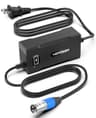
Some packs ship with a charger and some do not, and the ones that do often include a 2 A unit that takes most of a working day to fill a large pack. The charger here outputs 54.6 V at 4 A through a 3-pin XLR plug, which is the connector most value e-bikes and most Hailong packs use. Two rules: a 48 V pack charges to about 54.6 V and a 36 V pack to 42 V, so the two chargers are not interchangeable in either direction; and faster charging is heat, so a 4 A unit is a convenience that costs a little cycle life. Our charger roundupcovers the 36 V case and the one genuinely UL-listed unit we have found.
What the legal picture looks like once it is built
Both kits here are switchable between 500 W and 750 W, and 750 W is the federal ceiling for a vehicle that counts as an electric bicycle rather than a motor vehicle — the NPS regulation uses exactly that figure in its definition. Leave the kit in its 750 W setting with a 20 mph limit and you have built something that looks like a Class 2 e-bike; configure the controller for more and you have built a vehicle that most bike paths, and the three-class system itself, do not cover. Our classes and laws guide explains what that costs you in practice.
What we would actually buy
For a donor bike you intend to keep for years: the Bafang kit plus the largest Unit Pack Power 48 V pack that fits your frame triangle, plus the XLR charger. Bafang spares and replacement controllers are the most widely stocked in the category, which matters three winters in when something needs replacing.
For the cheapest build that still rides properly with the power off: the Varstrom geared kit plus the Yose Power 48 V 13 Ahpack. A geared hub freewheels, so a flat battery leaves you with a bicycle instead of a very heavy one with drag — on a conversion, where the battery is the part most likely to be undersized, that is worth more than the brand name.
And if the answer to “what should I buy” turns out to be “a bike,” we would rather tell you. A conversion makes sense when the donor frame is good and you want to keep it. It makes much less sense as a route to the cheapest possible e-bike, which is what our under-$500 bikes page and the worth-it guide exist to settle.