Volt & Velo

Are E-Bike Conversion Kits Worth It?

A kit is not the price of an e-bike. It is the price of a motor — then a battery, then a charger, then your afternoon. Here is the comparison done honestly, against the cheapest certified e-bike we can point you at.

By Stephen V.Last updated How we pick

The honest answer, up front: a conversion is worth it when the bike you already own is genuinely good and you want that specific bike electrified. It is usually not worth it as a route to the cheapest possible e-bike. The reason is that a kit price and an e-bike price are not the same kind of number. A kit buys you a motor, a wheel, a controller, a display and a throttle. A complete e-bike buys you all of that plusa battery, a charger, an assembled bike, a warranty and a UL 2849 certification you can never give a self-built system.

So this page does the comparison properly. Below are the three things a conversion actually requires — a kit, a pack and a charger — next to the cheapest certified complete e-bike in our registry, all four with live prices read on the same day. Add the first three and compare them with the fourth. That is the whole arithmetic, and we would rather you did it with today’s numbers than trust a figure we wrote weeks ago.

After the picks: what a complete bike gives you that a conversion cannot, the three cases where converting clearly wins, and the costs people leave out — resale, time, and the certification problem. We have not built every one of these conversions; here is exactly what we do instead.

How this is funded:we earn a commission if you buy through our links, at no extra cost to you. It never changes which product we recommend, and we’ll tell you plainly when to skip one. Full disclosure.

Quick picks

Ranked on published specs, price and buyer fit. Select a row to jump to the full write-up. We have not ridden every one of these — here is exactly what we do instead.

#ProductBest forPrice
1
Varstrom 48V 500W/750W Geared Rear Hub Kit

Varstrom 48V 500W/750W Geared Rear Hub Kit

The cheaper way in, and geared rather than direct-drive — which means it freewheels when you stop pedaling, so the bike still rides like a bike when the battery is flat. That matters more on a conversion than on a purpose-built e-bike.

Cost 1 of 3: the kit
$163.88 · View on Amazon

Price as of October 5, 2026. #ad How we’re funded

2
Unit Pack Power 48V Hailong Battery

Unit Pack Power 48V Hailong Battery

One of the most common aftermarket 'Hailong'-style 48 V packs for extending or replacing range on a value e-bike. Batteries are the one upgrade where you should not cut corners: match the voltage and connector to your bike, confirm the BMS and cell type, and strongly prefer a pack with a recognized safety certification.

Cost 2 of 3: the battery
$247.00 · View on Amazon

Price as of October 5, 2026. #ad How we’re funded

3
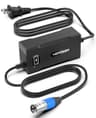
YZPOWER 54.6V 4A XLR Charger (48V packs)

YZPOWER 54.6V 4A XLR Charger (48V packs)

A common, well-reviewed replacement for 48 V systems: it outputs 54.6 V at 4 A (a 48 V pack fully charges to ~54.6 V) through a 3-pin XLR plug, the connector most value e-bikes use. The rule that matters more than brand: confirm your pack is 48 V and uses an XLR port before you order. The listing makes no UL claim.

Cost 3 of 3: the charger
$37.58 · View on Amazon

Price as of October 5, 2026. #ad How we’re funded

4
Jasion EB5

Jasion EB5

One of the lightest and cheapest ways into a real e-bike: the EB5 is a 26-inch commuter with a removable 360 Wh battery, a Shimano 7-speed and front suspension, at ~50 lb. Power is modest, but for flat-to-rolling commutes it's a lot of usable bike for the money.

What it has to beat: a complete bike
$199.00 · View on Amazon

Price as of October 5, 2026. #ad How we’re funded

The picks in full

#1Cost 1 of 3: the kit

Varstrom 48V 500W/750W Geared Rear Hub Kit

The cheaper way in, and geared rather than direct-drive — which means it freewheels when you stop pedaling, so the bike still rides like a bike when the battery is flat. That matters more on a conversion than on a purpose-built e-bike.

What you get

  • Geared hub freewheels, so there is no drag with the power off
  • Notably cheaper than the equivalent Bafang kit
  • Switchable 500 W / 750 W output

Trade-offs

  • Less brand support and fewer spares than Bafang
  • Battery is a separate purchase and usually the bigger half of the cost
Key spec48 V 500/750 W geared brushless rear hub kit
Best forThe lowest-cost conversion that still coasts properly

Specs read from the manufacturer or retailer listing, on August 18, 2026. “Not published” means the maker does not state that figure.

#2Cost 2 of 3: the battery

Unit Pack Power 48V Hailong Battery

One of the most common aftermarket 'Hailong'-style 48 V packs for extending or replacing range on a value e-bike. Batteries are the one upgrade where you should not cut corners: match the voltage and connector to your bike, confirm the BMS and cell type, and strongly prefer a pack with a recognized safety certification.

What you get

  • Common Hailong form factor fits many downtube mounts
  • Available in larger capacities (up to ~20 Ah) for real range gains

Trade-offs

  • Voltage, connector and mount must match your bike exactly
  • Not for Bosch/Shimano/Yamaha systems; no UL claim stated — insist on certification
Key spec48V lithium-ion (Hailong-style) pack; capacities up to ~20 Ah
Best forReplacing or extending a 48 V pack

Specs read from the manufacturer or retailer listing, on July 22, 2026. “Not published” means the maker does not state that figure.

#3Cost 3 of 3: the charger

YZPOWER 54.6V 4A XLR Charger (48V packs)

A common, well-reviewed replacement for 48 V systems: it outputs 54.6 V at 4 A (a 48 V pack fully charges to ~54.6 V) through a 3-pin XLR plug, the connector most value e-bikes use. The rule that matters more than brand: confirm your pack is 48 V and uses an XLR port before you order. The listing makes no UL claim.

What you get

  • 54.6 V / 4 A output charges a 48 V (13S) pack faster than a 2 A unit
  • 3-pin XLR is the most common value-e-bike charge connector
  • A spare at work halves your charging downtime

Trade-offs

  • You MUST confirm your pack is 48 V and uses an XLR port — chargers are not universal
  • No UL listing stated; treat any third-party charger with care and never charge unattended
Key spec54.6V output, 4A, 3-pin XLR connector; charges 48V (13S) lithium packs
Best forA spare or replacement 48 V XLR charger

Specs read from the manufacturer or retailer listing, on July 22, 2026. “Not published” means the maker does not state that figure.

#4What it has to beat: a complete bike

Jasion EB5

One of the lightest and cheapest ways into a real e-bike: the EB5 is a 26-inch commuter with a removable 360 Wh battery, a Shimano 7-speed and front suspension, at ~50 lb. Power is modest, but for flat-to-rolling commutes it's a lot of usable bike for the money.

What you get

  • Light for an e-bike at ~49.6 lb — easier to carry and store
  • Removable 360 Wh battery charges off the bike
  • Shimano 7-speed and front suspension included

Trade-offs

  • 350 W rated is modest; steep hills will need your legs
  • Class not formally published by Jasion
  • Some listings advertise inflated peak-watt figures
Rated motor350 W
Battery360 Wh
Claimed rangeUp to 40 mi
Top assisted speed20 mph
Weight49.6 lb
ClassNot published

Specs read from the manufacturer or retailer listing, on July 22, 2026. “Not published” means the maker does not state that figure.

Three purchases, and the battery is the big one

Search results in this category are dominated by kit-only listings, because a kit without a battery is the cheapest thing anyone can put in front of you. It is also not a working e-bike. The pack is normally the most expensive single line in a conversion, and it is the part where cutting corners is genuinely dangerous rather than merely disappointing.

The charger is the line people forget entirely. Some packs include one, many do not, and a 48 V system needs a 54.6 V charger while a 36 V system needs a 42 V one — they are not swappable in either direction. Our kits-with-a-battery page covers the four things that have to match between a kit and a pack, which is the part of this that takes ten minutes of reading and saves a return shipment.

Three smaller costs belong in the total too: torque arms, which are not optional on a 750 W kit with aluminium dropouts; a connector adapter, because the two halves of your bundle will often not match; and consumables — brake pads and a chain, because you are about to make the bike heavier and faster.

What a complete e-bike gives you that a conversion cannot

A UL 2849 listing.This is the big one and it is structural rather than a matter of care. UL 2849 certifies a complete electrical system — motor, controller, battery, charger and wiring — as assembled by a manufacturer. Build it yourself and you are the manufacturer, and no certification exists for what you built. The CPSC specifically advises buying e-bikes certified to UL 2849 and batteries to UL 2271. You can satisfy the second on a conversion by choosing a pack that publishes it. You cannot satisfy the first at all.

A warranty, and someone to call.On a complete bike, a controller that dies in month four is the maker’s problem. On a conversion it is yours, and you will be diagnosing whether the fault is the controller, the pack, the BMS or a connector you crimped. That is a genuine skill and some people enjoy it; it is not free.

Integration. The value bikes in our registry increasingly arrive with the battery locked into the frame, lights wired into the system, and in some cases turn signals and a brake light. A conversion has a pack strapped to the down tube, a controller cable-tied somewhere, and whatever lights you bolt on. That is cosmetic until it rains, at which point an integrated, IP-rated system is genuinely better engineering than a bundle of connectors in a plastic bag.

Resale. Converted bikes sell badly. A buyer looking at a secondhand e-bike wants a model name they can search, a certification and a battery with a known history. A home-built bike offers none of those, which is why our used e-bike guide treats them as a category to approach very carefully. If you might sell within two years, count that as a cost.

The three cases where converting clearly wins

1. The donor frame is genuinely good.This is the real case. A steel tourer, a quality hardtail, a bike that has been serviced and fits you — the frame and fork alone represent more engineering than anything in the sub-$700 e-bike bracket, and electrifying it keeps that while adding assist. Our mountain-bike conversion guide covers whether yours is actually a candidate, which is a six-measurement question.

2. The bike is one nobody sells electrified.A cargo bike, a tandem, a recumbent, a trike, a folder you have been happy with for ten years, or a frame size the e-bike market simply does not make. If no manufacturer will sell you an assisted version of the bike you need, the certification argument above becomes moot — there is nothing to compare against.

3. The project is part of the point. Some people want to understand the system, choose the pack, upgrade the controller and have a bike they can fix themselves for a decade. A conversion is a serviceable, upgradeable, part-by-part machine in a way a sealed value e-bike is not. That is a legitimate reason to convert and it has nothing to do with saving money.

Where it loses, stated plainly

It loses when the donor is a supermarket bike. The conversion costs the same whatever is underneath it, and spending it on stamped dropouts, worn rim brakes and a bent hanger produces a heavy, fast bicycle with brakes that were marginal when it was light and slow. Our brakes guide is the relevant reading, and the conclusion is usually to walk away.

It loses when the goal is the lowest possible price for an e-bike. The bottom of the complete-bike market is genuinely cheap, certified and warrantied — see our under-$500 page and under-$1,000 roundup— and a kit plus a decent pack plus a charger lands in the same territory without the certification or the warranty.

And it loses when you do not want a project. An afternoon is the optimistic estimate, there is a pedal-assist sensor and brake cut-offs to fit, and something will not match the first time. If “I just want to ride it” is the honest requirement, buy the bike.

The range question, which decides more than people expect

Compare capacity, not kit wattage. Watt-hours are volts times amp-hours: a 48 V 13 Ah pack is 624 Wh and a 48 V 20 Ah pack is 960 Wh. Using the planning figure this site uses everywhere — about 20 Wh per mile on a heavy bike ridden with plenty of throttle — those are roughly 31-mile and 48-mile bikes.

Now check that against the complete bikes. Several value e-bikes in our registry carry packs in the 500–700 Wh range as standard, and the largest is over 1,000 Wh. If a conversion’s pack is smaller than what a complete bike includes at the same total price, the conversion is losing on the specification that matters most for actual use. Our range guide explains why the mileage claim on either product is not the number to plan around.

Legally, a conversion is just an e-bike

The law does not care who built it. The federal definition used in the NPS rule is a cycle with fully operable pedals and a motor of not more than 750 watts, inside the three-class system based on assisted speed. Both the kits we list switch between 500 W and 750 W, so a conversion can sit squarely inside that. Configure the controller for more and you have built a vehicle that is outside the system, with the path access and insurance consequences our classes and laws guide describes.

One practical knock-on: if you live somewhere that has started asking about battery certification — some apartment buildings, some campuses, some insurers — a self-built system has no UL 2849 listing to show them. Our apartment living guide covers how that conversation tends to go.

Our verdict

Buy a kit if you have a good bike you love, if you need an assisted version of something nobody manufactures, or if you want the project. In all three cases, buy the pack carefully, insist on UL 2271, and fit proper torque arms.

Buy a complete bike if the aim is simply to have an e-bike for the least money, if you want a warranty, if certification matters where you live or store it, or if you might sell it. For most readers of this site — value buyers who want 90% of the result for 40% of the price — that is the answer, and we would rather say so than sell you three boxes.

Frequently asked questions

Are e-bike conversion kits worth it?

They are worth it when the bike you already own is genuinely good and you want that specific bike electrified, when you need an assisted version of something nobody manufactures (a cargo bike, a tandem, an unusual frame size), or when the project itself is part of the appeal. They are usually not worth it as a route to the cheapest possible e-bike, because a kit needs a battery and a charger on top, and the complete bike arrives certified and warrantied.

Is a conversion kit cheaper than buying an e-bike?

Compare three prices against one: the kit, the battery and the charger versus a complete bike. The kit-only price that looks so cheap excludes the most expensive component. On this page we put all four prices side by side, read live on the same day, so you can do that arithmetic with today's numbers rather than an estimate.

Can a converted bike be UL certified?

Not as a system. UL 2849 certifies a complete electrical system as assembled by a manufacturer, and on a home conversion that manufacturer is you — so no listing exists for the finished bike. You can and should buy a battery that publishes UL 2271, which certifies the pack on its own. This is the one disadvantage of converting that care and skill cannot remove.

Do conversion kits damage the bike?

They can, if the frame is not suitable. A hub motor's reaction torque works against the rear dropouts, which is why a torque arm is mandatory on a 750 W kit and why aluminium dropouts want two. The other common damage is indirect: more weight and more speed through brakes, a chain and a wheel that were specified for a lighter, slower bicycle.

How long does an e-bike conversion take?

An afternoon if your measurements were right and the connectors match, a weekend if you are also replacing brake pads and tidying cable routing. The motor itself is a wheel swap; the time goes into the pedal-assist sensor, the brake cut-offs and making sure two metres of wiring does not rub through. Budget longer the first time.

Can you sell a converted e-bike?

You can, for noticeably less than you put into it. Secondhand e-bike buyers want a model name they can research, a certification and a battery with a known history, and a home-built bike offers none of those. If there is any chance you will sell inside two years, count the resale gap as part of the cost of converting.

Sources

  • U.S. CPSC — Micromobility Information Center (e-bike battery safety) — CPSC guidance on lithium-ion battery safety and buying e-bikes/batteries certified to UL 2849 / UL 2271 / UL 2272 (accessed July 22, 2026)
  • U.S. National Park Service — Electric Bicycles (e-bikes) in National Parks — The NPS final regulation (published in the Federal Register November 2, 2020, effective December 2, 2020) defines an electric bicycle as a two- or three-wheeled cycle with fully operable pedals and an electric motor of not more than 750 watts, and establishes the three-class system. Superintendents may allow e-bikes where traditional bicycles are allowed; e-bikes may NOT be used where traditional bicycles are prohibited; both traditional bikes and e-bikes are prohibited in wilderness areas by federal statute; and superintendents may restrict, impose conditions on, or close locations to e-bike use, including opening a road or trail to some classes but not others. Class 2 riders are prohibited from using the throttle exclusively for an extended period without pedaling, except in locations open to public motor-vehicle use (accessed October 5, 2026)
  • PeopleForBikes — Electric Bike Policies & Laws — The 3-class e-bike system (Class 1/2 to 20 mph, Class 3 to 28 mph), access rules and the state-by-state law reference (accessed July 22, 2026)

Keep reading