Volt & Velo

Best Bike Pumps Under $50

Three pumps that clear the $50 band, ranked for what an e-bike tire actually needs — air volume at low pressure, not the 160 psi number on the box.

By Stephen V.Last updated How we pick

Buy the BV Steel Floor Pump. It is the cheapest pump here with a steel barrel and a reversible Presta/Schrader head — the right call for anyone keeping one pump in the garage for an e-bike, a kid’s bike and a car-free household. If your bike wears fat tires, or you would rather not pump at all, the AstroAI L7 cordless inflator does the same job with a button. The budget pick is the MOHEGIA floor pump, the cheapest pump here that still has a real gauge. All three were selling under $50 when we last refreshed prices, as of November 22, 2026; each row shows its own live number.

Here is the thing nobody in this band tells you: every pump on this page advertises 150 or 160 psi, and no e-bike tire will ever see a quarter of it. A 20 x 4 in fat tire runs somewhere around 20 psi, a 26-inch commuter tire around 40 to 50. The advertised ceiling is a road-bike number being used as a marketing number. What actually matters on a heavy bike with high-volume tires is how much air moves per stroke, whether the head grips the valve without you holding it, and whether you can read the gauge at the low end of its scale.

How this is funded:we earn a commission if you buy through our links, at no extra cost to you. It never changes which product we recommend, and we’ll tell you plainly when to skip one. Full disclosure.

Quick picks

Ranked on published specs, price and buyer fit. Select a row to jump to the full write-up. We have not ridden every one of these — here is exactly what we do instead.

#ProductBest forPrice
1
BV Steel Floor Pump with Gauge

BV Steel Floor Pump with Gauge

The value standard. A steel barrel, a gauge you can read from standing, and a reversible head that takes Presta and Schrader without an adapter — which matters because e-bike tubes are usually Schrader and everything else you own probably is not.

Best under $50
$19.99 · View on Amazon

$23.9917% off

Price as of November 22, 2026. #ad How we’re funded

2
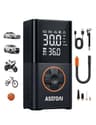
AstroAI L7 Cordless Tire Inflator

AstroAI L7 Cordless Tire Inflator

The one that lives in the pannier. Inflating a 4-inch fat tire by hand is genuinely tiring, and a cordless compressor turns a roadside flat from a chore into a two-minute stop. It does car tires too, which is how most people justify it.

Best for fat tires
$21.83 · View on Amazon

$39.9945% off

Price as of November 22, 2026. #ad How we’re funded

3
MOHEGIA Floor Pump with Gauge

MOHEGIA Floor Pump with Gauge

The floor pump for someone who owns none at all. It has the two things that matter — a gauge, and heads for both valve types — at a price that makes the decision easy. Buy it now, upgrade in five years if it dies.

Budget pick: cheapest with a gauge
$16.99 · View on Amazon

Price as of November 22, 2026. #ad How we’re funded

The picks in full

#1Best under $50

BV Steel Floor Pump with Gauge

The value standard. A steel barrel, a gauge you can read from standing, and a reversible head that takes Presta and Schrader without an adapter — which matters because e-bike tubes are usually Schrader and everything else you own probably is not.

What you get

  • Reversible Presta/Schrader head — no adapter to lose
  • Steel barrel rather than the plastic used at the very bottom of the market
  • 160 psi rating covers everything from fat tires to road tires

Trade-offs

  • Dial gauge is accurate enough for tires, not for fine-tuning a 20 psi fat tire
  • Floor pumps live in the garage; you still want something portable for the road
Key specSteel floor pump, 160 psi, reversible Presta/Schrader head with gauge
Best forThe home floor pump most riders should buy

Specs read from the manufacturer or retailer listing, on August 18, 2026. “Not published” means the maker does not state that figure.

#2Best for fat tires

AstroAI L7 Cordless Tire Inflator

The one that lives in the pannier. Inflating a 4-inch fat tire by hand is genuinely tiring, and a cordless compressor turns a roadside flat from a chore into a two-minute stop. It does car tires too, which is how most people justify it.

What you get

  • Cordless — no floor pump, no car socket, no cable
  • 150 psi rating covers bike, car and sports-ball duty
  • Far less effort than hand-pumping a high-volume fat tire

Trade-offs

  • Another lithium battery to keep charged
  • Compressors are loud and slower than a floor pump on skinny tires
Key specCordless electric inflator, 150 psi rating
Best forFat tires, roadside repairs and people who hate pumping

Specs read from the manufacturer or retailer listing, on August 18, 2026. “Not published” means the maker does not state that figure.

#3Budget pick: cheapest with a gauge

MOHEGIA Floor Pump with Gauge

The floor pump for someone who owns none at all. It has the two things that matter — a gauge, and heads for both valve types — at a price that makes the decision easy. Buy it now, upgrade in five years if it dies.

What you get

  • Cheapest pump here that still has a real pressure gauge
  • Fits Schrader and Presta out of the box
  • 160 psi rating is more than any bike tire needs

Trade-offs

  • More plastic in the base and handle than the steel pumps
  • Budget gauges drift; treat the number as a guide, not a lab reading
Key specFloor pump with gauge, 160 psi, fits Schrader and Presta
Best forA first floor pump on the tightest budget

Specs read from the manufacturer or retailer listing, on August 18, 2026. “Not published” means the maker does not state that figure.

How we picked the $50 band

Three of the four pumps we track clear $50, and the one that does not is the comparison that makes the band meaningful. The Topeak JoeBlow Sport III sits at roughly $65 and buys two things this band does not offer: a 3-inch analog gauge instead of a small dial, and a TwinHead DX5 that takes Presta, Schrader and Dunlop. If you inflate tires weekly and squint at small gauges, that is a sensible $15. If you top up once a month, it is not.

Two of the three picks are floor pumps and one is a cordless compressor, which is deliberate rather than untidy. They solve the same problem in opposite ways, and on a value e-bike the compressor has a real argument: a fat tire holds a lot of air at a low pressure, which is the single most tiring thing to pump by hand and the easiest thing for a small motor to do. It is also the only pick here that works at the roadside, where a floor pump is useless.

What each one publishes

PumpTypeValve headPressure ratingGaugeBuild
BV Steel Floor PumpFloor pumpReversible Presta / Schrader160 psiDial gauge, small faceSteel barrel
AstroAI L7 Cordless InflatorCordless electricPresta / Schrader adapters150 psiDigital, set-and-stopPlastic, rechargeable pack
MOHEGIA Floor PumpFloor pumpSchrader and Presta160 psiDial gauge, small facePlastic base and handle
Topeak JoeBlow Sport III (over the band)Floor pumpTwinHead DX5: Presta / Schrader / Dunlop160 psi3 in analog faceSteel barrel, long hose

The honest gap in that table is a column we could not fill: not one pump in this bracket publishes air volume per stroke, barrel diameter or gauge accuracy. Those are the three figures that would let you rank floor pumps properly, and they do not exist at this price. So the ranking falls back on what is published and what is physical: a steel barrel over a plastic one, a reversible head over an adapter you will lose, and a gauge you can read.

Gauge accuracy is the real limitation down here

Treat a budget dial as a guide rather than a measurement. Nobody at this price states a tolerance, and a small face marked to 160 psi has very little resolution at the 20 psi end — which, on a fat-tire e-bike, is exactly where you are working. Two practical consequences. First, set pressure by feel and ride quality as well as by the needle, and re-check with the same pump each time so you are at least consistent. Second, if you run fat tires and care about getting 18 against 22 psi right, the digital readout on the cordless inflator is more useful than a cheap dial, because you set a target and it stops there. Our e-bike tire pressure guide covers the numbers to aim for and why the sidewall maximum is not a target.

Check your valve before you buy

Almost every value e-bike ships with Schradervalves — the fat ones, same as a car tire — so any pump here fits. Thinner Presta valves show up on road and some hybrid wheels. The BV head reverses between the two with no adapter, which is the detail worth paying the few dollars for, because a lost adapter turns a working pump into a paperweight. If you already carry a multi-tool and a patch kit, a floor pump at home plus a mini pump on the bike is the complete answer; see the multi-tool picks for the carry-on-the-bike half and how to fix an e-bike flat for the job itself, which is a bigger one on a hub-motor wheel than on a bicycle.

One caution specific to the cordless pick: it is another lithium battery in the house, and it wants the same treatment as your bike pack — charge it where you can see it, not overnight in a hallway, and do not store it flat. That is the price of not pumping a fat tire by hand.

Frequently asked questions

What pressure should an e-bike tire run?

Far lower than the pump's rating. A 20 x 4 in fat tire typically runs around 20 psi, a 26-inch commuter tire 40 to 50 psi, and a narrower hybrid tire more again. Always read the range printed on the tire sidewall and treat the upper figure as a limit, not a target — the lower half of the range rides better and grips better on a heavy bike.

Is a cordless inflator better than a floor pump for an e-bike?

For fat tires, often yes. A high-volume tire at low pressure is the most tiring thing to pump by hand and the easiest thing for a small compressor to do, and a digital target-and-stop readout beats a cheap dial at 20 psi. A floor pump is still faster on narrow tires, needs no charging and never fails — which is why the floor pump is our overall pick and the inflator is the fat-tire pick.

Do I need a pump rated to 160 psi?

No. It is a road-bike number used as marketing. No e-bike tire needs anything close, and every pump in this band advertises 150 or 160 psi anyway, so the figure does not separate them. Judge a pump on its valve head, its gauge and whether the barrel is steel or plastic.

Schrader or Presta — which valve does my e-bike have?

Almost certainly Schrader, the wide car-style valve, which is what value e-bikes ship with. Presta is the thin valve with a small knurled nut on top, common on road and some hybrid wheels. The BV pump's head reverses to fit either without an adapter; the cheaper MOHEGIA fits both out of the box as well.

Sources

  • U.S. CPSC - Requirements for Bicycles (16 CFR part 1512), business guidance — Read in full on the access date. Braking: "A bicycle that only has hand brakes must stop within 15 feet when tested with a 150-pound rider riding at 15 miles per hour"; bicycles with foot brakes "must stop within 15 feet when tested with a rider of at least 150 pounds at a speed of 10-mph"; and "when the hand lever is pushed down with 10 pounds or less applied 1 inch from the end of the lever, the brake pads must contact the braking surface on the wheel." Foot brakes must produce at least 40 lbf of braking force for 70 lb of pedal force, and the distance from the middle of a hand lever to the handlebar may be no more than 3 1/2 inches (3 inches on sidewalk bicycles). The test conditions - a 150 lb rider and 15 mph - are the reference point this site uses when explaining why a 50-75 lb e-bike ridden at 20 mph is outside the envelope the standard was written around. The standard sets a system-level stopping distance; it does not specify a pad compound, a pad thickness or a wear limit (accessed October 24, 2026)
  • U.S. CPSC — Micromobility Information Center (e-bike battery safety) — CPSC guidance on lithium-ion battery safety and buying e-bikes/batteries certified to UL 2849 / UL 2271 / UL 2272 (accessed July 22, 2026)

Keep reading