The rule we used: measuring instruments versus hand tools
A bike workshop is full of two different kinds of object, and they deserve different budgets.
A hand tool either fits or it does not.A 5 mm hex key, a tire lever, a cone wrench, a brush. You can see whether it engages, you can feel whether it flexes, and a bad one fails obviously and cheaply. There is no hidden specification to get wrong, which is why a 31-piece generic kit and a Park Tool kit do the same work on the same bolts, and why the price difference here is mostly finish, warranty and the fact that a Park Tool kit has a named part number for every item in it.
A measuring instrument is only worth what its published accuracy says it is. A torque wrench that reads 5 Nm and applies 7 is worse than no torque wrench, because it gives you false confidence on a carbon seatpost or a disc-rotor bolt. This is the one category where Park Tool’s premium buys something you cannot see: the TW-5.2 states “calibrated to be accurate to +/- 4%”, adjusts in 0.2 Nm steps, registers torque in both thread directions, and can be sent back for calibration. Not one torque wrench in the value bracket publishes an accuracy percentage — we checked all four we track, and the finding is the same now as when we built the torque-wrench roundup.
Item for item, against Park Tool's own list prices
| Job | Park Tool, and what it publishes | Park Tool price | Substitute here | Our call |
|---|
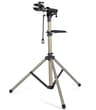
| Work stand | PCS-10.3 — 80 lb max, clamp 22-76 mm, 39-57 in, 16 lb stand | About $280 | CXWXC e-bike stand — 88 lb claimed, clamp range not published | Substitute |
| Torque wrench | TW-5.2 — 2-14 N·m, 0.2 N·m steps, accurate to +/- 4% | $100.95 list | LEXIVON LX-191 — 2-26 N·m, 15 pieces, accuracy not published | Substitute with eyes open |
| Home tool kit | SK-4 — 14 named Park Tool items plus the Big Blue Book | $230.95 list | DURATECH 31-piece kit — piece count published, contents generic | Substitute |
| Cleaning brushes | BCB-4.2 — 4 named pieces, no scrubber, no degreaser | $25.95 list | focopot 9-piece kit — includes a chain scrubber | Substitute |
| Chain scrubber | CM-5.3 — reversible for mid-drive e-bikes, 59 mL, RBS-5 refills | $34.95 list, out of stock on 22 Nov | Scrubber inside the focopot kit — no refill part number | Substitute for a hub motor |
Two rows in that table deserve the full explanation, because they are where a reader could lose money by taking the headline at face value.
The stand: the cheap one publishes a bigger number, and that is real
Park Tool’s PCS-10.3 publishes a maximum bike weight of 80 lb (36 kg), a clamp that accepts round and aero tubes from 22 to 76 mm, a 39 to 57 inch height range and a 16 lb stand weight. The CXWXC e-bike stand publishes 88 lb. The numbers are not comparable with any precision — one comes from a maker’s specification table and one from a product listing — but both clear the heaviest bike we track, and that is the filter that matters.
What you give up is the clamp range. No stand under $100 publishes the diameter range its jaw will close on, and on an e-bike that is the figure that decides whether the clamp grips at all, because e-bike down tubes and seat tubes are oversized to house a battery and take motor torque. The workaround is free: clamp the seatpost rather than the frame wherever the post is long enough and round. Our full stand roundup carries the Park Tool alongside the budget options, and the under-$100 band page ranks only the stands that clear the price line.
The torque wrench: Park Tool's does not reach e-bike axle torque
This is the most useful thing on the page, and it runs against the obvious conclusion. The TW-5.2 is the better instrument — it is the only wrench in this comparison that publishes an accuracy figure — and Park Tool explicitly states “do not exceed 14 Nm”when using it, because 2 to 14 Nm is its entire range. That covers stem bolts, seatpost clamps and rotor bolts beautifully. It does not reach a hub-motor rear axle nut, which is routinely above 30 Nm, and it does not reach the mid-30s figures a crank or cassette can ask for. Park Tool’s own answer is the TW-6.2, covering 10 to 60 Nm — a second wrench, at a second price.
The LEXIVON LX-191 publishes 2 to 26 Nm in one tool with a 15-piece bit set, at about half the TW-5.2’s list price, and publishes no accuracy percentage at all. So the substitution is a real trade rather than a free lunch: you gain the range that matches more of an e-bike’s fasteners and you lose the one number that tells you the reading means something. Our position, stated plainly: if you work on carbon parts or you want one tool you can trust for a decade, buy the Park Tool and accept that axle nuts need a spanner and the manual. If you are assembling a value e-bike and keeping it in service, the wider single-tool range is the more useful purchase, and you should re-check critical bolts by feel as well as by click.
Cleaning: the cheap kit includes the tool Park Tool sells separately
Park Tool’s BCB-4.2 brush set lists at $25.95 for four named pieces: the GSC-1 GearClean brush, a tapered detail brush, a frame sponge-and-bristle brush and a soft soaping brush. It contains no degreaser and no chain scrubber— that is the CM-5.3 Cyclone, a separate $34.95 tool, which was listed as temporarily out of stock when we read Park Tool’s catalog on 22 November. The focopot 9-piece kit includes a chain scrubber in the box for a fraction of either price, which is why it is the budget pick here.
One genuine Park Tool advantage in this category is worth knowing about if you own a mid-drive bike: the CM-5.3 states that its handle reverses so the chain can pass through in either direction, which Park Tool says makes it compatible with center-drive e-bikes. No budget scrubber we have seen makes that claim. If your motor is at the cranks rather than in the rear hub, that is a real reason to buy the Park Tool version. Almost every bike on this site is a hub-motor bike, where a conventional scrubber works fine. Our cleaning-kit roundup compares all four kits on contents, and the chain-lubing procedure explains why the scrubber matters more on a motor-driven drivetrain than on a bicycle’s.
What a value e-bike workshop actually needs
In the order we would buy it, and this is the order most people get wrong. A multi-tool first, because it does the roadside jobs and the first-week bolt check — the multi-tool picks cover that. A floor pump second, since tire pressure is the single biggest lever on both range and puncture risk. A stand third, because it makes every other job possible and you cannot turn an e-bike upside down — it is heavy, and the display, controller and battery are not meant to invert. A torque wrench fourth, and a home tool kit fifth, at which point you have covered everything on our maintenance checklist except brake bleeding.
Two spends we would not substitute at all, for different reasons. Buy brake pads to the caliper’s own specification rather than by price — pad shape is a fitment question, not a quality question, and a 70 lb bike at 28 mph asks far more of a pad than the federal bicycle brake standard was written around. And buy chain lube rated for the torque a motor puts through a chain; the lube comparison found only two of four brands willing to say their formulation is intended for e-bikes.
A last word on warranty, because it is part of what the Park Tool price buys and it is easy to overlook. Park Tool states a one-year warranty on the tools we read and sells replacement parts individually — the chain scrubber’s brushes have their own part number. A marketplace tool kit is generally a returns-window product rather than a serviceable one. That matters most for the tool you will still be using in ten years, which for most people is the stand and the torque wrench, and matters least for the brushes.