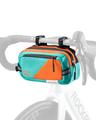
The e-bike problem is bar real estate, not capacity
A standard flat handlebar gives you roughly 60 cm of tube, and on an acoustic bike almost all of it is empty. On an e-bike, look at what is already there: a center-mounted display straddling the stem, a thumb or twist throttle inboard of the right grip, brake and shifter clamps, frequently a phone mount, sometimes a horn or a bar-mounted light. The clear, parallel span that a hard bracket needs may simply not exist.
That is why this page splits the category in two rather than ranking it as one list:
- Bracket bags clamp a permanent mount to the bar and the bag clicks on and off it. Rock solid, no sway, one-handed removal, and both published-spec bags here are this type. They demand clear bar space beside the stem and they commit that space to this bag forever.
- Strap bags hang from the bar and the head tube on hook-and-loop or buckle straps. They fit around a display, they cost less, and they will sway and settle in a way a bracket bag never does.
If your display is a small side-mounted unit and you have 8–10 cm of bare bar on one side of the stem, buy a bracket. If your display sits dead center on the stem clamp — which is the common layout on value e-bikes — buy straps and stop fighting it.
The two numbers almost nobody publishes
Here is the category finding, and it is the same shape as the one we hit on rear rack bags: every bag here publishes a capacity in liters, and only two publish a maximum load.Topeak states 5 kg (11 lb) for the TourGuide. Ortlieb instructs you not to exceed a 5 kg maximum payload across the Ultimate range. The other three say nothing at all, at any price.
Bar diameter is worse: one bag in five publishes it.Topeak’s Fixer 8 bracket is listed for 25.4, 28.6 and 31.8 mm bars with shims supplied, which covers essentially every flat bar you will meet. Ortlieb describes the Ultimate Six family as compatible with virtually all handlebars but publishes no figure for the Classic clamp on any page we could read, and the three strap bags publish nothing — which matters less for straps, since a strap does not care about diameter the way a clamp does.
Waterproofing is the third column and it is almost entirely adjectives. Ortlieb is the only maker here that publishes an ingress rating — IP53 for the Ultimate range, with the separate Ultimate Plus line listed at IP54, so we could not confirm which figure attaches to this exact variant and have reported the range figure. Topeak includes a rain cover, which is a maker quietly telling you the bag itself is not the barrier. ROCKBROS states a seamless 600D TPU roll-top construction, which is the right recipe without a number behind it. Our waterproof bag picks rank bar bags and rack bags together on exactly this question. Rhinowalk says waterproof and publishes nothing.
The whole table, including the empty columns
| Bag | Mount | Volume | Published max load | Bar diameter | Water protection |
|---|
| Topeak TourGuide (Fixer 8) | Hard bracket (Fixer 8) | 5 L (305 ci) | 5 kg / 11 lb | 25.4 / 28.6 / 31.8 mm, shims included | Rain cover included |
| Ortlieb Ultimate Six Classic | Hard bracket | 6.5 L | 5 kg | Not published | IP53 (range figure) |
| Rhinowalk Roll-Top | Straps, no bracket | 8–13 L | Not published | Not published | Roll-top, no rating published |
| ROCKBROS 2.5 L Quick-Release | Three straps, quick release | 2.5 L | Not published | Not published | None published |
| ROCKBROS 6 L Roll-Top | Three-point quick release | 6 L | Not published | Not published | 600D TPU seamless, no rating |
Three of the five columns are mostly empty, and the two bags that fill them in are the two most expensive bags on the page. That is the honest summary of this category: you are paying for documentation, exactly as you are on child seats. The difference is that a bar bag is not carrying your child, so the cheap option is a much more reasonable risk here.
Why you should load it light even when the bag allows more
Weight on the handlebar is weight on your steering. Everything you put in a bar bag sits high, ahead of the steering axis, and swings when you turn — which is why 5 kg is the published limit on both documented bags and not 10. Two things make this more noticeable on an e-bike than on a bicycle:
- Speed.At 20 mph a slow steering wobble that would be harmless at 10 becomes a thing you have to correct. Front-end weight makes the bike feel lazy going in and vague coming out of a turn.
- Suspension forks. A large share of value e-bikes come with a basic suspension fork. Hanging a loaded bag off the bar adds unsprung input above a spring that was not tuned for it, and a bag that sits low in front of the head tube can foul the fork crown or a front light at full compression. Check clearance at full travel, not just standing still.
The practical rule: put the small, light, frequently neededthings up front — phone, wallet, keys, a multi-tool, a snack, a patch kit— and put the heavy things over the rear wheel in a rack bag or panniers. A U-lock is the classic mistake: a 3 lb hardened steel lock belongs on the frame or in a rear bag, not swinging off your bars. Our lock roundup covers which locks come with a frame mount, which is the correct answer to that problem.
What about a front basket instead?
Worth knowing before you buy either. A basket is cheaper, bigger and far easier to load, and on some bikes it is a genuinely better answer — our basket roundup has the picks and the one fitment exclusion that catches most value e-bikes, which is that a classic steel front basket should not be fitted to a bike with a suspension or springer fork. A bag wins on three things: it closes, so your contents stay in and stay dry; it comes off and goes with you, which a bolted basket does not; and it does not announce itself as an open container to anyone walking past. If you leave the bike locked up in public, a bag is the one to buy.
Fitting and living with one
Bracket bags: dry-fit the bracket before you tighten anything, with the bag on it, and check three clearances — brake and shifter levers through their full sweep, the display’s buttons, and the bag’s bottom against a front light or fork crown. Bar clamp bolts are small and go into aluminum, so use the published torque figure if there is one; this is one of the places a torque wrench earns its cost, and our e-bike assembly guide lists what else to re-check after anything is clamped to the bar.
Strap bags: mount, ride a mile, then re-tension every strap. Hook-and-loop relaxes, and a hub motor puts more buzz through a handlebar than a bicycle does — the same reason we tell readers to re-tension rack bags monthly. Then check the bag has not drifted into the cables: a strap bag that creeps can pull on a brake hose or a display cable, and on an e-bike the display cable is not something you want loaded.
Both types: take the bag with you. Every pick on this page has a shoulder strap, and a bar bag is held on by a plastic latch or hook-and-loop — neither is security. The bag is the part you can replace cheaply; what is inside it is not.
One closing note on value, because this is a value site. The gap between the budget pick and the top pick here is large in percentage terms and small in absolute money, and what the extra buys is a published load limit, a published bar fit and a bracket that does not move. If your cockpit has the space and you ride year-round, that is worth paying. If your display sits in the middle of your bar — and on most bikes in this bracket it does — the premium bracket bag cannot physically go on, and the cheap roll-top is not a compromise but the correct purchase. Spend the difference on something else under $25.